

Nanotechnology News – Latest Headlines
Scientists using lasers to cool and control molecules
A team of Yale physicists has used lasers to cool molecules down to temperatures near what's known as absolute zero, about -460 degrees Fahrenheit. Their new method for laser cooling is a significant step toward the ultimate goal of using individual molecules as information bits in quantum computing.
September 21, 2010 Read more
Certain doped-oxide ceramics resist Ohm's Law
For months, Anthony West could hardly believe what he and his colleagues were seeing in the lab -- or the only explanation for the unexpected phenomena that seemed to make sense. Several of the slightly doped high-purity barium titanate (BT) ceramics his research group was investigating were not following the venerable Ohm's Law, which relates electrical voltage to current and resistance.
September 21, 2010 Read more
Watching electrons move in real time
At its most basic level, understanding chemistry means understanding what electrons are doing. New research not only maps the movement of electrons in real time but also observes a concerted electron and proton transfer that is quite different from any previously known phase transitions in the model crystal, ammonium sulfate.
September 21, 2010 Read more
Ultrashort laser ablation enables novel metal films
Researchers have studied the properties of femtosecond laser ablation plumes to better understand how to apply them to specialized films.
September 21, 2010 Read more
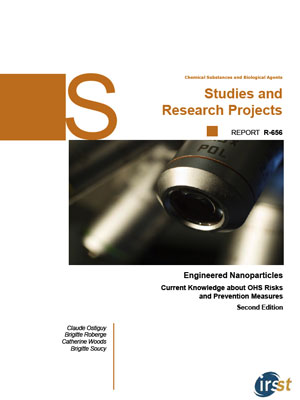
New report on engineered nanoparticle risk
Quebec-based IRSST has released the second edition of its report 'Engineered Nanoparticles: Current Knowledge about Occupational Health and Safety Risks and Prevention Measures'.
September 21, 2010 Read more
European project solves variability issues of designing in deep submicron IC technology
REALITY, a European funded initiative on Design for Variability, has just finished its project mission. In about its 2.5 years lifespan REALITY has focused on developing industrially relevant innovative design techniques, methods, and flows for the design and analysis of energy-efficient self-adaptive System-on-Chips (SoCs).
September 21, 2010 Read more
Geckos inspire new method to print electronics on complex surfaces
Researchers from Northwestern University and the University of Illinois at Urbana-Champaign designed a clever square polymer stamp that allows them to vary its adhesion strength. The stamp can easily pick up an array of electronic devices from a silicon surface and move and print them on a curved surface.
September 20, 2010 Read more
New York State announces unprecedented high-tech/nanotechnology initiative
Infotonics Technology Center and College of Nanoscale Science and Engineering form unprecedented partnership to enable world-class nanotechnology research, development and commercialization.
September 20, 2010 Read more
Buckyball Discovery Gala to celebrate nanotechnology research at Rice
Next month Rice University's Richard E. Smalley Institute for Nanoscale Science and Technology will kick off its Week of Nano with the Buckyball Discovery Gala, celebrating the 25th anniversary of the discovery of the buckminsterfullerene at Rice and the 1996 Nobel Prize in Chemistry that followed.
September 20, 2010 Read more
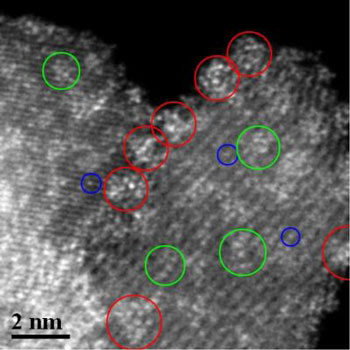
Gaseous nanocatalyst could make fuel production better, greener
A nanoparticle-based catalyst developed at Rice University may give that tiger in your tank a little more roar.
September 20, 2010 Read more
Nano antenna increases light intensity 1000 fold
Everybody who's ever used a TV, radio or cell phone knows what an antenna does: It captures the aerial signals that make those devices practical. A lab at Rice University has built an antenna that captures light in the same way, at a small scale that has big potential.
September 20, 2010 Read more
Citizen scientist
Researchers have mapped out an approach to virtual organizations that might allow scientific advances made in part by citizen scientists to move forward much more quickly.
September 20, 2010 Read more
End of microplates? Novel nanoelectronic biosensing technology could facilitate new era of personalized medicine
The multi-welled microplate, long a standard tool in biomedical research and diagnostic laboratories, could become a thing of the past thanks to new electronic biosensing technology developed by a team of microelectronics engineers and biomedical scientists at the Georgia Institute of Technology.
September 20, 2010 Read more
Nano Israel 2010 this year will be under the banner of renewable energy, nanomaterials, nanobio, nanomedicine and nanoelectronics
The Nano Israel 2010 Conference and the Exhibition accompanying will be held on November the 8th and the 9th in the Dan Panorama Hotel, Tel Aviv.
September 20, 2010 Read more
Surrey nanotechnology funding scheme encourages interaction between industry and academia
The Nanotechnology Knowledge Transfer Network (NanoKTN) in the UK has announced the launch of BlueSkyNano, an award scheme aiming to increase engagement between industry and academia. The first award is in partnership with the University of Surrey.
September 20, 2010 Read more
GDCh zeichnet Quantenchemiker Joachim Sauer aus
Eine der traditionsreichsten Auszeichnungen der Gesellschaft Deutscher Chemiker (GDCh), die Liebig-Denkmuenze wurde am Montag in Dresden bei der Tagung der Gesellschaft Deutscher Naturforscher und Aerzte an den Berliner Chemiker Prof. Joachim Sauer verliehen.
September 20, 2010 Read more
 Subscribe to our Nanotechnology News feed