

Nanotechnology News – Latest Headlines
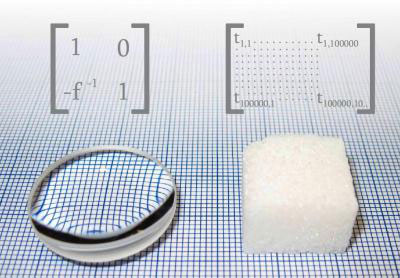
Physicsists find a way to see through paint, paper, and other opaque materials
A new experiment has shown that it is possible to focus light through opaque materials and detect objects hidden behind them, provided you know enough about the material.
March 8, 2010 Read more
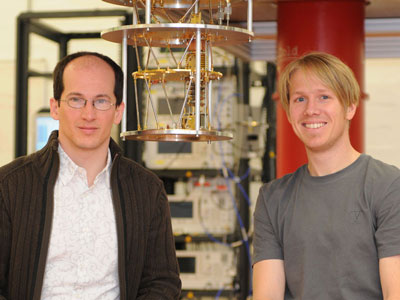
On the way to a quantum computer
The hybrid of microelectronic circuits and atoms which combines the best quantum mechanical characteristics of both systems, may help to realize a breakthrough in quantum computing. Not only Andreas Wallraff believes this, but also the European Research Council, which has been supporting his project for five years with almost two million Euros.
March 8, 2010 Read more
Strength is shore thing for sea shell scientists
A team of materials scientists and chemists have taken inspiration from sea shells found on the beach to create a composite material from dissimilar 'ingredients'. Their technique could be used to make ceramics with high resistance to cracking - which could in turn be used in crack-resistant building materials and bone replacements.
March 8, 2010 Read more
Two leading nanoscience institutes in the US and UK join forces
The agreement between the Centre for Nanoscience and Quantum Information (NSQI) at the University of Bristol, UK, and the California NanoSystems Institute (CNSI) at UCLA in the USA, forges a link between two of the world's foremost centres in nanoscience research.
March 8, 2010 Read more
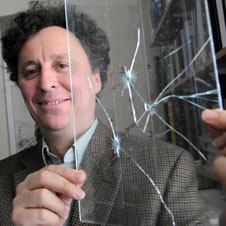
Unlocking the mysteries of crack formation
Northeastern University physicists have pioneered the development of large-scale computer simulations to assess how cracks form and proliferate in materials ranging from steel and glass to nanostructures and human bones.
March 8, 2010 Read more
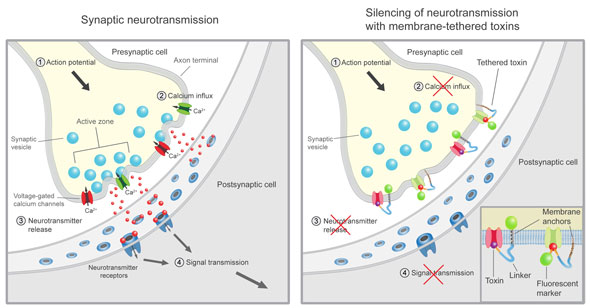
New tool to investigate the function of ion channels in neurons
Neurotoxins from cone snails and spiders help neurobiologists to investigate the function of ion channels in neurons.
March 8, 2010 Read more
Scientists transform polyethylene into a heat-conducting material
Conducts heat just as well as most metals, yet remains an electrical insulator.
March 7, 2010 Read more
Nanotechnology researchers discover new way of producing energy
Phenomenon causes powerful waves of energy to shoot through carbon nanotubes.
March 7, 2010 Read more
Carbon nanotube sensor detects hydrogen peroxide emanating from a single living cell
MIT chemical engineers have built a sensor array that, for the first time, can detect single molecules of hydrogen peroxide emanating from a single living cell.
March 7, 2010 Read more
Collaboration between ethicists and nanotechnology scientists reveals unique synergies and insights
The Nanoethics Group has announced the release of a new book to engage the rising tide of interest and concern over nanotechnology.
March 7, 2010 Read more
Biomineralization techniques used for new bone-disease treatment
Dr. Marc McKee, of McGill's Faculty of Dentistry and the Department of Anatomy and Cell Biology, is collaborating closely with Enobia Pharma Inc, a Quebec biotech company, to develop innovative treatments for serious genetic bone diseases.
March 6, 2010 Read more
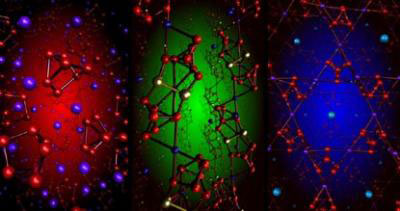
Designing nanoscale materials with a precise control over properties
Shiv Khanna, Ph.D., a professor in the Virginia Commonwealth University (VCU) Department of Physics, together with colleagues from VCU, Penn State University and the California Nanosystems Institute, were recently highlighted in the Editor's Choice section of the journal Science for their work demonstrating how nanomaterials with control of specific properties can be created.
March 5, 2010 Read more
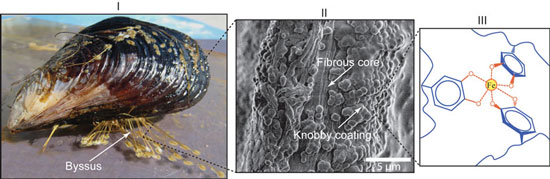
Iron atoms convey mussel fibres with a robust but stretchy covering
Researchers at the Max Planck Institute of Colloids and Interfaces and collaborators at the University of California at Santa Barbara and the University of Chicago believe they have uncovered the basis how marine mussels use the byssus, a bundle of tough and extensible fibres, to fasten securely to wave-swept rocky coastlines.
March 5, 2010 Read more
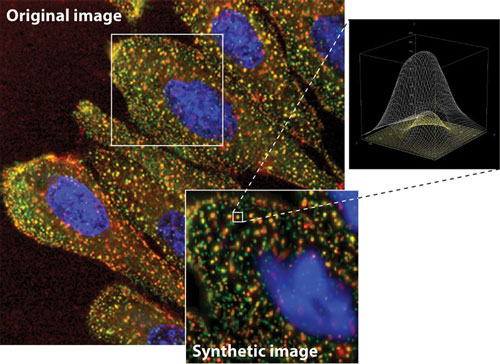
A fingerprint for genes
Scientists applied a new strategy to identify and characterize genes involved in endocytosis. For that a combination of high-resolution microscopy and quantitative image analysis enabled the scientists to investigate the effects of a large number of genes.
March 5, 2010 Read more
Neues Verfahren zur Herstellung photonischer Kristalle
Wissenschaftler lassen Licht selbst die kristallinen Strukturen bilden, in denen das Licht dann effektiv geleitet und gespeichert werden kann. Diese Technik koennte zum Beispiel zur Herstellung hocheffizienter Flachbildschirme eingesetzt werden.
March 5, 2010 Read more
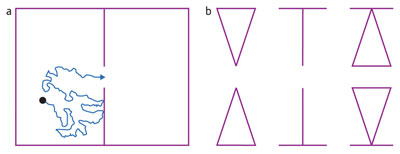
The geometry of randomness
Geometric factors can have a strong influence on the seemingly random walk of objects across pores in a thin membrane
March 5, 2010 Read more
 Subscribe to our Nanotechnology News feed