

Nanotechnology News – Latest Headlines
The focus of Nanofair 2010 will be on various aspects of nanomaterials
Nanofair 2010 will take place at the International Conference Center in Dresden from July 6th and 7th, 2010.
January 20, 2010 Read more
Thermogeneratoren die auf Nanomaterialien beruhen
Die Wissenschaftler des Nano-Netzwerks CeNIDE der Uni Duisburg-Essen verfuegen ueber einen entscheidenden Vorteil: eine Technologie, mit der sich Nanomaterialien in grossem Massstab herstellen lassen. Solche Anlagen sind weltweit noch sehr selten - allerdings bilden sie die Voraussetzung dafuer, dass Thermogeneratoren, die auf Nanomaterialien basieren, ueberhaupt zur Serienreife gebracht werden koennen.
January 20, 2010 Read more
Venture funding of nanotechnology start-ups in life sciences and healthcare increased as overall funding declined in 2009
The heyday for nanotechnology venture capital (VC) likely saw its peak in 2008, when overall investment reached $1.4 billion. Last year, the sector raised only $792 million, signifying a 42% decline from 2008.
January 20, 2010 Read more

An electrifying advance toward tomorrow's power suits
Could powering an iPod or cell phone become as easy as plugging it into your tee shirt or jeans, and then recharging the clothing overnight? Scientists in California are reporting an advance in that direction with an easier way of changing ordinary cotton and polyester into 'conductive energy textiles'.
January 20, 2010 Read more
From the Wright Brothers Flyer to the Dreamliner - Composites Manufacturing 2010
Composites Manufacturing 2010 will showcase how lightweight materials help Boeing, NASA and other manufacturers 'Take Flight'.
January 20, 2010 Read more
Link found between golden ratio and atomic symmetry
Researchers in Germany and the UK have discovered symmetry hidden in solid state matter at very small scales.
January 20, 2010 Read more
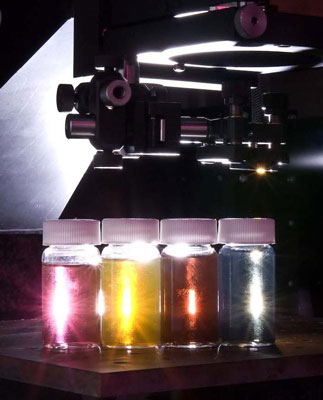
Laser Zentrum Hannover is coming out big in 2010 with ultrapure nanoparticles for medical applications
One example are LZH nanoparticle exponants that can currently be seen at the new 'Center for New Technologies' (ZNT) at the Deutsche Museum in Munich. Also, in 2010 the LZH will host the first international conference on the generation of ultrapure nanoparticles.
January 20, 2010 Read more
How do free electrons originate?
Scientists at Max Planck Institute of Plasma Physics (IPP) in Garching and Greifswald and Fritz Haber Institute in Berlin have discovered a new way in which high-energy radiation in water can release slow electrons.
January 20, 2010 Read more
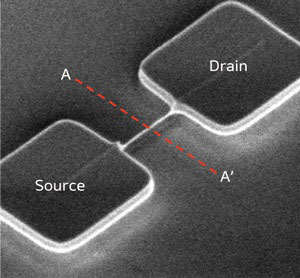
Data storage: Memory boost on a wire
A nanowire-based device may set the stage for the realization of next-generation ultra-small memories.
January 20, 2010 Read more
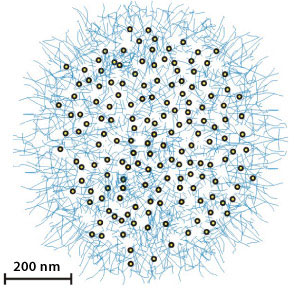
Smart materials: Illuminated treatments
Embedding quantum dots into thermally reactive polymers allows traceable detection within living systems.
January 20, 2010 Read more
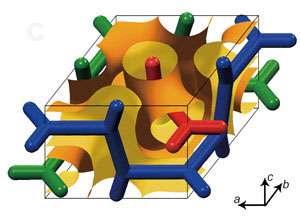
Mesoporous materials: Three times the connection
An innovative surfactant design enables the synthesis of the first nanoporous silica with a tri-continuous network.
January 20, 2010 Read more
European recognition for Leeds terahertz expertise
Research into terahertz technology at the University of Leeds has received a major boost with a 2.5 million euros European grant.
January 20, 2010 Read more
MicroRNA: Keeping death in check
Recent research has illuminated a surprisingly important role for tiny RNA molecules, known as microRNAs, in downregulating the production of a variety of proteins and researchers have now teased out the role of microRNAs in managing p53 levels
January 20, 2010 Read more
New visible light nanoparticle photocatalyst kills bacteria, even after light turned off
In the battle against bacteria, researchers at the University of Illinois have developed a powerful new weapon - an enhanced photocatalytic disinfection process that uses visible light to destroy harmful bacteria and viruses, even in the dark.
January 19, 2010 Read more
Solder magnetic nanocomposites that could help streamline the process of computer electronic packaging
Carnegie Mellon University and Intel Corporation will unveil a new class of materials called solder magnetic nanocomposites that could help streamline the process of computer electronic packaging.
January 19, 2010 Read more
Single-molecule experiments bring a higher-resolution tool to the study of protein folding
Biophysicists at TUM, the Technische Universitaet Muenchen, have published the results of single-molecule experiments that bring a higher-resolution tool to the study of protein folding.
January 19, 2010 Read more
 Subscribe to our Nanotechnology News feed