

Nanotechnology News – Latest Headlines
Nanotechnologien nachhaltig gestalten
Die neue Broschuere 'Nano Massstaebe' gibt einen konkreten Wegweiser fuer Forschung und Entwicklung im Bereich der Nanotechnologien.
November 25, 2008 Read more
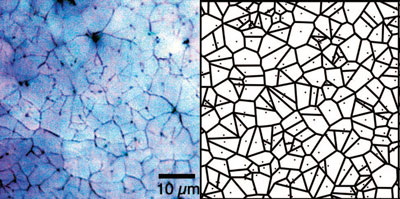
Nanoscale imaging reveals mother of pearl secret
In addition to its iridescent beauty, mother of pearl, or nacre, the inner lining of the shells of abalone, mussels and certain other mollusks, is also renowned for an amazing strength and toughness that has been a long-standing mystery. Now, scientists have brought to light a new aspect of nacre?s nanostructural architecture using the polarized x-ray beams and nanoscale imaging capabilities of the Advanced Light Source (ALS), a national synchrotron facility at the Lawrence Berkeley National Laboratory.
November 25, 2008 Read more
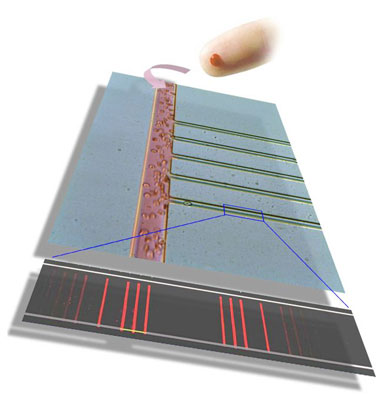
Barcode chip promises to revolutionize diagnostic medical testing
A new 'barcode chip' developed by researchers at the California Institute of Technology (Caltech) promises to revolutionize diagnostic medical testing. In less than 10 minutes, and using just a pinprick's worth of blood, the chip can measure the concentrations of dozens of proteins, including those that herald the presence of diseases like cancer and heart disease.
November 25, 2008 Read more
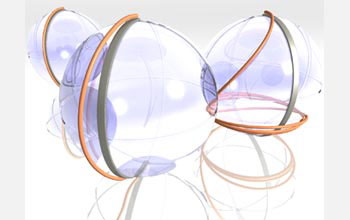
Scientists crack secret of unusual magnetic resonance, key to enhanced MRIs
In developing a model to explain the motion of atoms in a magnetic field, scientists have overcome a decades-old obstacle to understanding a key component of magnetic resonance.
November 25, 2008 Read more
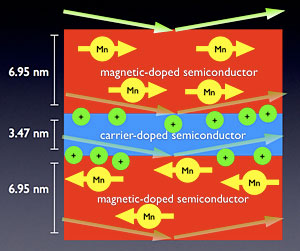
Neutron researchers discover widely sought property in magnetic semiconductor
Researchers working at the National Institute of Standards and Technology (NIST) have demonstrated for the first time the existence of a key magnetic - as opposed to electronic - property of specially built semiconductor devices.
November 25, 2008 Read more
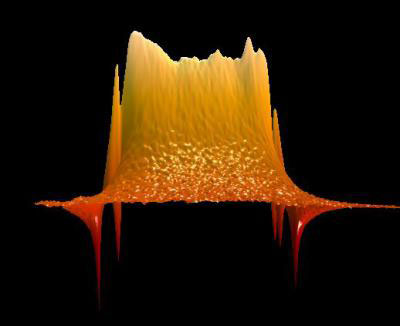
New probe can stress-test semiconductor devices as small as 10 nanometers
Researchers at the National Institute of Standards and Technology (NIST) have demonstrated their ability to measure relatively low levels of stress or strain in regions of a semiconductor device as small as 10 nanometers across.
November 25, 2008 Read more
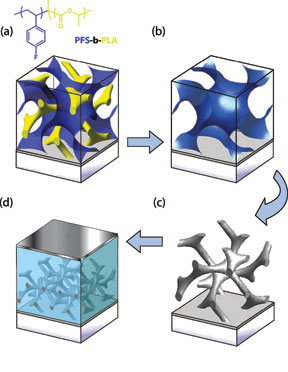
Solar cell economics improve with novel nanomanufactured polymer film
You never know where basic research may lead. For decades materials scientists have been experimenting with a corkscrew-like polymer structure called a gyroid. Now an international team of researchers has shown that the gyroid structure can be used to self-assemble a low-cost photovoltaic cell.
November 25, 2008 Read more
Rice optics pioneer wins lucrative grant for nanophotonics research
Rice University nanophotonics pioneer Naomi Halas has been named a National Security Science and Engineering Faculty Fellow (NSSEFF) by the Department of Defense. Halas is one of just six fellows chosen from more than 650 nominees this year for the prestigious program.
November 25, 2008 Read more
New Society for the Study of Nanoscience and Emerging Technologies
The Society for the Study of Nanoscience and Emerging Technologies (S-NET) is poised to become an international organization to promote open intellectual exchange towards the advancement of knowledge and understanding of nanotechnologies in society.
November 25, 2008 Read more
Nanoengineered hospital-on-a-chip could revolutionize battlefield medicine
The battlefield of the future may react differently to combat injuries, providing instant treatment to wounded soldiers even before a medic reaches their side.
November 25, 2008 Read more
The European Synchrotron radiation facility launches 177m euro upgrade program
Over the next seven years, unique new experimental facilities for research with X-rays will come into operation. This decision, taken by the ESRF Council, representing the 19 countries financing the ESRF, confirms Europe's vision to expand its global leadership in photon science.
November 25, 2008 Read more
Researchers create electrical wires made from protein fibers
Researchers in Sweden have succeeded in creating electrical wires consisting of protein fibers encased in plastic. The 10 nanometer thin fibers are self-organizing and compatible with biological systems.
November 25, 2008 Read more
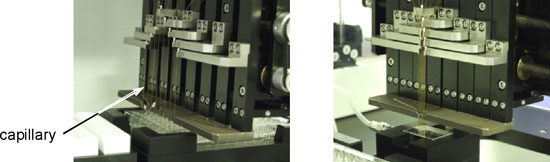
New array spotter rapidly dispenses nanoliter-level liquid samples
Researchers at AIST in Japan have developed an array spotter capable of dispensing an infinitesimal amount of liquid sample and of changing freely the intervals between the capillaries that serve as dispensing outlets.
November 25, 2008 Read more
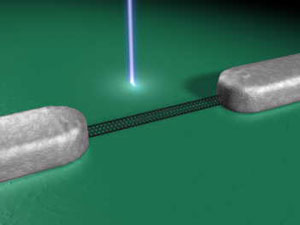
Schalter der Zukunft: Elektroneninseln auf Nanotubes
Wissenschaftler des Karlsruher Instituts fuer Technologie (KIT) haben einen unerwarteten elektronischen Effekt entdeckt, der mittelfristig einen Durchbruch bei der Herstellung neuartiger Schaltelemente bringen koennte.
November 25, 2008 Read more
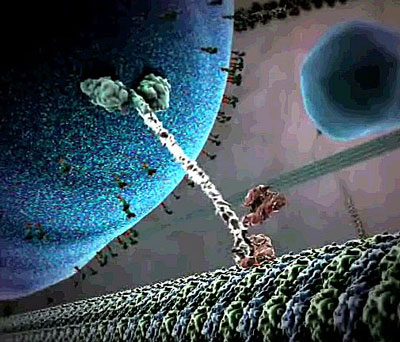
Nano tugboat
Researchers report synthesizing a molecular motor made of DNA that includes three important properties in one molecule. Although still limited in its forward motion, this mechanism could eventually transport cargo in real nanotech devices.
November 24, 2008 Read more
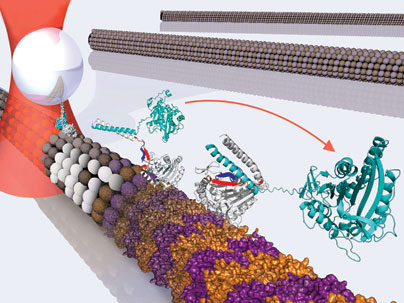
Researchers show how cell motor proteins 'walk'
MIT researchers have shown how a cell motor protein exerts the force to move, enabling functions such as cell division.
November 24, 2008 Read more
 Subscribe to our Nanotechnology News feed