

Nanotechnology News – Latest Headlines
International group addresses lack of consensus on nanotoxicology test procedures
A team of materials scientists and toxicologists announced the formation of a new international research alliance to establish protocols for reproducible toxicological testing of nanomaterials in both cultured cells and animals.
September 9, 2008 Read more
Schneller speichern auf gerundeten Nanomagneten
Bis zu zehnmal schneller koennten magnetische Datenspeicher schalten, wenn sie aus einer Grundsubstanz aufgebaut werden, die nicht wie bisher aus flachen, sondern aus runden Bauteilen besteht.
September 9, 2008 Read more
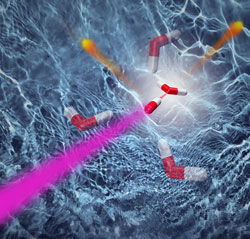
Scientists find new mechanism for hydrogen bonds
Bernd Winter and colleagues, from BESSY, Max-Born-Institut, Uppsala University, and MPI fuer Dynamik und Selbstorganisation, report how water solvates its intrinsic hydroxide (OH-) anion. Unraveling this behavior is important to advance the understanding of aqueous chemistry and biology.
September 9, 2008 Read more
Nanotechnology images - thrilling and unsual insights
Thrilling and unsual insights. BASF Research has posted images on its website that allow the viewer to explore structures that would otherwise only be seen by analytical chemists.
September 9, 2008 Read more
Widespread use of nanosilver challenges regulatory agencies
Widespread use of nanoscale silver will challenge regulatory agencies to balance important potential benefits against the possibility of significant environmental risk, highlighting the need to identify research priorities concerning this emerging technology, according to a new report.
September 9, 2008 Read more
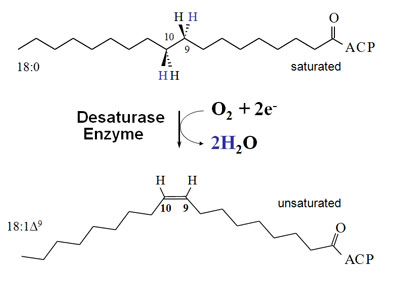
New chemical reactions have implications for biofuels and replacement for petro-chemicals
If your experiment doesn?t go the way you expect, take a closer look - something even more interesting may have happened. That strategy has led scientists at the Brookhaven National Laboratory to discover a fundamental shift in an enzyme?s function that could help expand the toolbox for engineering biofuels and other plant-based oil products.
September 8, 2008 Read more
Researchers find that polarization changes at the nanoscale
How small is too small to be useful? Researchers at North Carolina State University have done nanoscale analysis on ferroelectric thin films - materials that are used in electronic devices from computer memories to iPhones and polarize when exposed to an electric charge - and found that when it comes to polarization, both size and location matter.
September 8, 2008 Read more
New area of fullerene chemistry could drive tomorrow's molecular semiconductors
Virginia Tech chemistry Professor Harry Dorn has developed a new area of fullerene chemistry that may be the backbone for development of molecular semiconductors and quantum computing applications.
September 8, 2008 Read more
First congress dedicated to the emerging field of neuroinformatics
The emerging neuroinformatics field combines neuroscience and informatics research to develop advanced tools and approaches to understanding the structure and function of the brain.
September 8, 2008 Read more
Watchdog group slams FDA for continued delay and inaction
The Food and Drug Administration came under heavy fire today at a meeting it held to once again solicit comments regarding the agency?s oversight of nanomaterials. A coalition of nonprofit consumer and environmental groups accused the agency of being derelict in its duty to protect Americans from harmful products.
September 8, 2008 Read more
Neural nanomachines project funded by NIH's EUREKA program
Fueled by a new initiative at the National Institutes of Health called the EUREKA program, two Arizona State University (ASU) teams have received million-dollar grants to pursue the next frontiers in biomedical research.
September 8, 2008 Read more
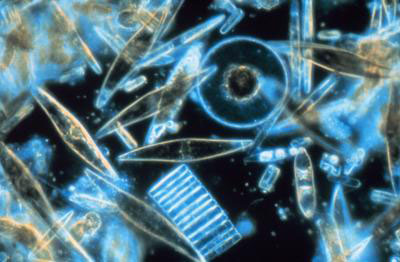
Proteins from marine diatoms hold vast potential for improved antibiotics
Researchers in Florida are reporting an advance toward tapping the enormous potential of an emerging new group of antibiotics identical to certain germ-fighting proteins found in the human immune system.
September 8, 2008 Read more
Using neutron computed tomography techniques helps scientists understand plant root function
The McClellan Nuclear Radiation Center (MNRC) in Sacramento, CA was developed by the U.S. Air Force to detect corrosion and defects in aircraft structure using an imaging technique called neutron radiography. This technique is currently helping soil scientists understand the function of plant roots and their uptake of water and nutrients.
September 8, 2008 Read more
UK Nanotechnology Knowledge Transfer Network reaches 2000 member milestone
The Nanotechnology Knowledge Transfer Network (NanoKTN), the UK?s primary knowledge-based network for Micro and Nanotechnologies, today announced that it has exceeded 2000 registered national and international members, since being launched by the Technology Strategy Board in 2007.
September 8, 2008 Read more
Throwing a monkey wrench in the machinery of future nanoelectronics
Researchers are showing that there is a limit to nanoelectronics. When the size of the components approaches the nanometer level, all information will disappear before it has time to be transferred.
September 8, 2008 Read more
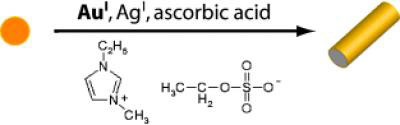
Production of gold nanorods without the use of cytotoxic additives
A German-American research team at Carnegie Mellon University in Pittsburgh, Hunter College in New York, and the RWTH Aachen has developed a new method for the production of nanoscopic gold rods. In contrast to previous methods, they have achieved this without the use of cytotoxic additives.
September 8, 2008 Read more
 Subscribe to our Nanotechnology News feed