

Nanotechnology News – Latest Headlines
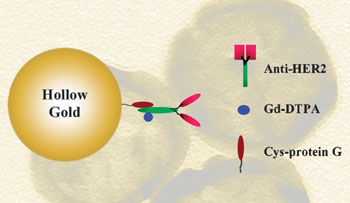
Nanoparticles hunt down cancer cells
Cancer cells can be detected then destroyed using a nanostructure designed by South Korean researchers.
September 4, 2008 Read more
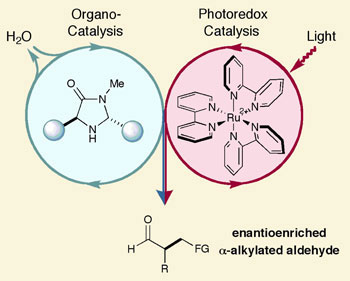
Two catalysts better than one
US researchers have cracked a long standing problem in chemical synthesis - the catalytic alpha-alkylation of aldehydes - by combining two catalysts in one pot.
September 4, 2008 Read more
How to effectively manage innovation like nanotechnology
How does one predict and direct something that is by nature unpredictable and, by necessity, often undirected? According to David Guston, who is co-director of ASU?s Consortium for Science, Policy and Outcomes and a professor of political science, it is by strengthening society?s ability to nurture and guide innovation within socially acceptable frameworks.
September 4, 2008 Read more
Sub-nanometer size gold cluster responsible for vital oxidation reaction
Scientists peel away the mystery behind gold's catalytic prowess.
September 4, 2008 Read more
Azaya licenses University of Texas nanotechnology to develop cancer treatment
A drug delivery system the size of a millionth of a centimeter could hold the key to more effective treatments of cancerous tumors. San Antonio researchers at the University of Texas Health Science Center and homegrown biotech firm Azaya Therapeutics Inc. have teamed up to test the new technology in humans and to bring it to the market.
September 4, 2008 Read more
FDA public meeting to assists implementing the FDA Nanotechnology Task Force Report
On September 8, FDA is holding a public meeting to gather comments and data to assist the agency in the development of agency guidance that would clarify what information industry needs to provide FDA about nanoproducts, and also when the use of nanoscale materials may change the regulatory status of products..
September 4, 2008 Read more
New $18.5 m projects seeks to develop biodegradable metal implant devices
The devices will be designed to adapt to physical changes in a patient's body and dissolve once they have healed, reducing the follow-up surgeries and potential complications of major orthopedic, craniofacial, and cardiovascular procedures and sparing millions of patients worldwide added pain and medical expenses.
September 4, 2008 Read more
Do 68 molecules hold the key to understanding disease?
Why is it that the origins of many serious diseases remain a mystery? In considering that question, a scientist at the University of California, San Diego School of Medicine has come up with a unified molecular view of the indivisible unit of life, the cell, which may provide an answer.
September 4, 2008 Read more
Germany funds 32 nm, mask lithography project for next generation chip production
The project CDuR32 (Critical Dimensions and Registration for 32nm Mask Lithography) is funded in part by the German Federal Ministry of Education and Research. Of the total budget of ?16.7 million (about $24.3 million), the government contributes ?7.9.
September 4, 2008 Read more

Nanotechnology will lead to more efficient and reliable solar cells
New ECS Professor Darren Bagnall manages an energetic research group within the Nano Group that is investigating new types of solar cell based on nanotechnology.
September 4, 2008 Read more
1.internationaler Nanotoxikologie Fachkongress: Nanoforscher bewerten Risiken der neuen Technologie
Wie sicher ist Nano? Der Antwort wollen Wissenschaftler aus 29 Laendern beim Kongress Nanotox2008 vom 7. bis 10. September an der ETH Zuerich naeher kommen, der bislang groessten internationalen Tagung von Nanotoxikologen.
September 4, 2008 Read more
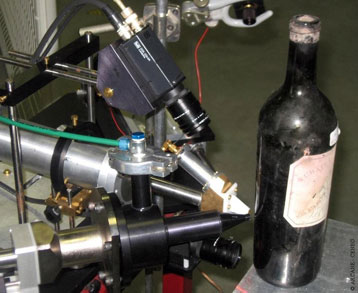
Vintage of rare wines authenticated by high energy ion beam
Just like works of art, wine is now being subjected to advanced testing to establish its authenticity: after measuring caesium 137 radioactivity levels to test the age of the wine, the glass in vintage wine bottles is now being tested by particle acceleration.
September 4, 2008 Read more
Nineteen European research centers launch nanotechnology project for Alzheimer's diagnosis and therapy
The NAD (Nanoparticles for therapy and diagnosis of Alzheimer's disease) Project is based on the use of nanoparticles for Alzheimer's diagnosis and therapy. The research, costing 14.6 million euros over 5 years, is financed by the European Union's 7th Framework Program and includes 19 European research centers.
September 4, 2008 Read more
EU FP7 call for proposal on nanotechnology use for developing biorefineries
The European Commission has published a number of calls for proposals under the specific programmes Cooperation and Capacities of the Seventh Framework Programme (FP7). One of them is a 'Biorefinery' joint call (two sections), including energy; environment (including climate change); food, agriculture and fisheries, and biotechnology; and nanosciences, nanotechnology, materials and new production technologies.
September 3, 2008 Read more
Rockefeller University professor awarded inaugural EUREKA grant for project developing bacteria-based nanosyringe
C. Erec Stebbins, associate professor at The Rockefeller University, has been awarded an inaugural EUREKA grant from the National Institutes of Health for a project aimed at exploiting a bacteria-based ?nanosyringe? as a means of delivering proteins into specific cells for therapeutic purposes.
September 3, 2008 Read more
The Sixth Annual National Nanoengineering Conference returns to Boston on November 12 and 13
The NNEC returns to Boston on November 12th and 13th at the Colonnade Hotel and will include technical presentations and exhibits from companies leading the nanotechnology industry.
September 3, 2008 Read more
 Subscribe to our Nanotechnology News feed