Flash Joule Heating: Definition, Process, Materials, and Applications
What is Flash Joule Heating?
Flash Joule heating (FJH) is a solid-state synthesis method in which a short, high-current electrical pulse passes through a resistive feedstock and heats it directly to extreme temperature in milliseconds, followed by rapid cooling when the pulse ends.
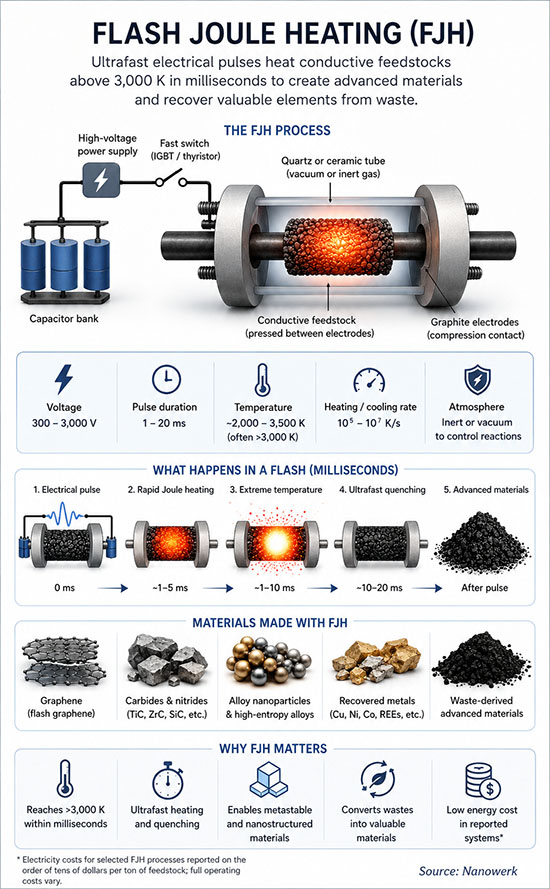
The principle is the same one that warms a toaster wire: electrical energy dissipates as heat inside any conductor with finite resistance, following P = I2R. What makes FJH distinctive is the intensity and speed of the pulse. A typical apparatus discharges a capacitor bank through a sample compressed between two conductive electrodes, delivering hundreds of amperes for tens to hundreds of milliseconds. In many reported graphene syntheses, the sample reaches roughly 2,000–3,500 K, often above 3,000 K, with heating and cooling rates that can exceed 104 K per second.
The modern form of FJH emerged from work by the group of James Tour at Rice University, whose 2020 Nature paper showed that cheap carbon sources—coal, petroleum coke, biochar, carbon black, food waste, rubber tires, and selected plastic wastes—could be converted into graphene within seconds. A closely related strategy called carbothermal shock, reported by Liangbing Hu's group at the University of Maryland in 2018, used current pulses through a carbon nanofiber support to make high-entropy alloy nanoparticles. Today, both approaches are often discussed under the broader umbrella of ultrafast electrothermal synthesis.
Key takeaways:
- Flash Joule heating uses electrical current to heat a feedstock from the inside instead of heating it from the outside in a furnace.
- The ultrafast pulse can preserve kinetically favored or metastable structures that would often relax, coarsen, or phase-separate during longer heat treatments.
- FJH is best known for making turbostratic flash graphene, but it has also been applied to carbides, nitrides, alloy nanoparticles, catalysts, and waste-derived materials.
- Reported electricity costs for selected FJH processes can be low, sometimes estimated in the range of tens of dollars per ton of treated feedstock, but full costs depend on feedstock preparation, reactor design, electrodes, gas handling, and scale.
How Flash Joule Heating Works
A flash Joule heating reactor has only a few essential components: a capacitor bank, a high-voltage power supply, a fast switch, and a sample chamber. The chamber is usually a quartz or ceramic tube with conductive end caps that compress the feedstock between two electrodes. When the switch closes, stored electrical charge flows through the sample, and the sample's own resistance turns that electrical energy into heat throughout its volume.
For carbon feedstocks, the main transformation is rapid graphitization. At sufficiently high temperature, carbon atoms gain enough mobility to reorganize into stacked sp2 sheets. Because the pulse ends quickly, adjacent layers often do not have time to settle into the regular AB stacking of ordinary graphite. Instead, successive graphene layers are rotationally misaligned. The product is turbostratic flash graphene, with an interlayer spacing of about 3.45 Å versus 3.35 Å in graphite and weaker coupling between layers.
The same short thermal excursion can volatilize or remove many non-carbon components. Demonstrations have shown that some mixed plastic and biomass-derived feedstocks can be processed with minimal sorting, although composition, additives, moisture, halogens, and inorganic fillers still affect product quality, residue, and gas-handling requirements.
Carbothermal shock variant
In the carbothermal shock variant, the resistive heating element is a carbon nanofiber mat or another porous carbon support loaded with metal-salt precursors. The current pulse heats the carbon support, the salts decompose, and the metals form droplets or nanoparticles that quench as the support cools. Because the heating window is extremely short—about 55 ms in the original demonstration—elements that would otherwise phase-separate during a long anneal can be kinetically trapped in a single solid solution.
Key Process Parameters
Three process variables dominate the outcome of a flash. The charging voltage and total stored energy largely determine the peak temperature. Pulse duration, set by the discharge circuit and feedstock resistance, controls how long the sample remains hot. Cooling rate, governed by radiative and conductive losses after the pulse, determines whether kinetically trapped phases survive or relax toward equilibrium.
Sample preparation is just as important as the electrical settings. The feedstock must be packed to a controlled density because resistance and contact quality depend strongly on compression. A sample that is too loose may not draw current uniformly. Non-conductive feedstocks such as many plastics or biomass samples often require a small amount of carbon black to create an initial conductive pathway; that carbon black can also be converted during the flash.
Many protocols use more than one pulse. A lower-energy preheat can remove volatile species and densify the carbon-rich residue, while a higher-energy pulse completes graphitization or phase formation. The exact sequence depends on the feedstock, target product, and reactor geometry.
Materials Made by Flash Joule Heating
Flash graphene is the best-known product, but the same ultrafast electrothermal logic has been extended to several classes of nanomaterials and waste-derived products.
| Material class | Examples | Why FJH helps |
|---|---|---|
| Turbostratic graphene | Flash graphene from coal, biochar, carbon black, food waste, plastics, and tires | Rapid graphitization followed by fast cooling preserves rotationally misaligned layers that disperse more easily than graphite. |
| Transition-metal carbides and nitrides | TiC, ZrC, HfC, Mo2C, MoC1-x, SiC, B4C, and nitride arrays | Extreme temperature enables rapid carbothermal or nitridation reactions from inexpensive precursors. |
| Alloy and metallic-glass nanoparticles | High-entropy alloy nanoparticles and amorphous metallic nanoparticles | Short pulses and fast quenching can trap mixed or amorphous structures before phase separation or crystallization. |
| Catalyst materials | Heteroatom-doped graphene and single-atom catalysts on carbon supports | Rapid heating can combine carbon restructuring, dopant incorporation, and metal dispersion in a single step. |
| Waste-derived products | Recovered precious metals, rare-earth oxides, regenerated battery materials, and silicon carbide from glass-fiber-reinforced plastic | Selective volatilization, phase conversion, or carbothermal reduction can make valuable elements easier to recover. |
The broad design rule is simple: FJH is attractive when a reaction benefits from very high temperature but suffers during long thermal exposure. It is less useful when the desired product requires slow equilibration, long-range single-crystal growth, or carefully controlled thin-film deposition.
Comparison With Conventional Graphene Synthesis
Flash Joule heating is most often compared with established graphene production routes. The trade-offs are clearest across feedstock cost, scale, product form, throughput, and quality.
| Method | Typical scale | Time per batch | Product form | Quality | Feedstock |
|---|---|---|---|---|---|
| Mechanical exfoliation (Scotch-tape method) | Microgram | Minutes | Single, large flakes | Highest crystalline quality | Highly oriented pyrolytic graphite |
| Chemical vapor deposition | Square meters of film | Hours | Continuous monolayer film on metal | High; often suitable for electronic or optical devices after transfer | Methane or other hydrocarbon, Cu or Ni substrate |
| Liquid-phase exfoliation | Gram to kilogram | Hours | Few-layer flakes in dispersion | Moderate; depends on solvent, sonication, and post-processing | Graphite plus solvents, surfactants, or shear media |
| Hummers/oxidation route (graphene oxide) | Kilogram | Days, including reduction | Graphene oxide or reduced graphene oxide flakes | Defective; residual oxygen functionalities often remain | Graphite plus strong acids and oxidants |
| Flash Joule heating | Gram per flash; kilogram-per-day demonstrations reported | Milliseconds to seconds | Turbostratic flash graphene flakes as powder | Low defect density for a powder product; not a continuous electronic-grade film | Coal, plastic, biomass, food waste, tires, and other carbon-rich feedstocks |
No single method is best for every use. CVD remains the route of choice when large, continuous graphene films are needed for electronics, transparent conductors, or device research. Mechanical exfoliation remains the gold standard for fundamental studies on individual high-quality flakes. Reduced graphene oxide remains useful when oxygen-containing functional groups are part of the design.
Flash Joule heating is different. It is not a replacement for CVD or exfoliation when large single-crystal graphene domains are needed; it is a high-throughput route to bulk, particulate, often turbostratic carbon materials. Its strongest targets are composite fillers, electrodes, cement additives, polymer additives, coatings, and other applications where graphene powder is the useful product form.
Applications and Waste Upcycling
Many high-impact uses of flash Joule heating are tied to waste conversion. The original flash graphene work showed that several carbon-rich waste streams, including food waste, rubber tires, and plastics, could be converted into graphene-containing powders. Some demonstrations report processing mixed plastics with minimal sorting, but practical deployment still has to manage feedstock variability, halogenated polymers, moisture, inorganic fillers, additives, gas cleanup, and product consistency.
Urban mining is another major application. When printed circuit boards and related electronic wastes are flashed to very high temperature, the supporting glass and polymer matrix decomposes and valuable metals can evaporate, condense, and be recovered. Reported studies have recovered substantial fractions of rhodium, palladium, silver, and gold. Toxic metals can also be reduced in the remaining residue, although whether that residue is suitable for disposal depends on jurisdiction, leaching tests, and further treatment.
FJH has also been applied to coal fly ash and other metal-rich residues. In those cases, the pulse can convert rare-earth phosphates or other refractory phases into oxides that dissolve more readily in mild acid. Related work has explored regeneration of lithium-ion battery cathode materials and graphite anodes, mineralization of per- and polyfluoroalkyl substances on carbon supports, and the synthesis of doped graphene for cement and composite applications.
Limitations and Scale-Up Challenges
Flash Joule heating products are not automatically application-ready. Powders may require purification, size classification, dispersion, oxidation control, or surface treatment before they can be used in composites, inks, electrodes, or cement. Product quality can vary with feedstock composition, particle size, moisture, packing density, and electrode contact.
Measuring the true peak temperature inside a rapidly changing, glowing sample is also difficult. Many studies infer the thermal history from electrical traces, optical emission, high-speed imaging, or final product structure rather than from direct thermometry. This makes process control and comparison between laboratories more challenging than in conventional furnace synthesis.
Scale-up is mainly an engineering problem. Laboratory reactors often treat hundreds of milligrams to a few grams per flash, so continuous or semicontinuous operation requires automated feeding, compression, pulsing, gas handling, product removal, and diagnostics. Capacitor-bank lifetime, electrode wear, sample-to-sample uniformity, and safe management of off-gases all become more important at larger scale. Real-time current, voltage, pressure, and optical-emission monitoring will likely be central to industrial quality control.
FAQ: Flash Joule Heating
What is flash Joule heating in simple terms?
Flash Joule heating is a synthesis technique that sends a short, high-current electrical pulse through a resistive material so the material heats itself from the inside. In many graphene syntheses, the temperature can rise to roughly 2,000–3,500 K, often above 3,000 K, in milliseconds and then fall rapidly when the pulse ends. The short thermal pulse can drive reactions without the long ramp and dwell times of a conventional furnace.
Who invented flash Joule heating?
Pulsed Joule heating of solids has a long history in metallurgy and electrical engineering, but the modern flash graphene process was reported by the group of James Tour at Rice University in a 2020 Nature paper led by Duy Luong. A related carbothermal shock method was demonstrated by Liangbing Hu's group at the University of Maryland in 2018 to make high-entropy-alloy nanoparticles.
What materials can be made by flash Joule heating?
Flash Joule heating has been used to make turbostratic flash graphene from carbon-rich feedstocks such as coal, biomass, plastics, food waste, and tires. It has also been applied to transition-metal carbides and nitrides, high-entropy-alloy nanoparticles, metallic-glass nanoparticles, single-atom catalysts, recovered precious metals from electronic waste, and rare-earth extraction from industrial residues.
How does flash Joule heating compare to chemical vapor deposition for graphene production?
Chemical vapor deposition produces large, continuous graphene films on metal substrates and remains the preferred route for many electronic and transparent-conductor uses. Flash Joule heating produces graphene as a powder of turbostratic flakes in seconds from inexpensive carbon feedstocks. It is aimed mainly at bulk uses such as composites, electrodes, cement additives, and other applications where powder form is acceptable.
Why is graphene from flash Joule heating called turbostratic?
In ordinary graphite, neighboring graphene layers follow a registered stacking pattern. In turbostratic graphene, the layers are rotationally misaligned, so the interlayer spacing is slightly larger than in graphite, about 3.45 Å versus 3.35 Å, and the coupling between layers is weaker. Rapid cooling during flash Joule heating can freeze this disordered stacking before the layers relax into graphite-like registry.
Further Reading
The following papers cover the original carbothermal shock and flash graphene demonstrations, waste-to-graphene processing, urban mining, carbide synthesis, and recent reviews of the field.
Science (2018), Carbothermal shock synthesis of high-entropy-alloy nanoparticles
Nature (2020), Gram-scale bottom-up flash graphene synthesis
ACS Nano (2020), Flash graphene from plastic waste
Nature Communications (2021), Urban mining by flash Joule heating
Nature Communications (2021), Phase controlled synthesis of transition metal carbide nanocrystals by ultrafast flash Joule heating
Nature Reviews Clean Technology (2024), Flash Joule heating for synthesis, upcycling and remediation