

High-Entropy Alloys: Multi-Element Materials with Exceptional Properties
What Are High-Entropy Alloys?
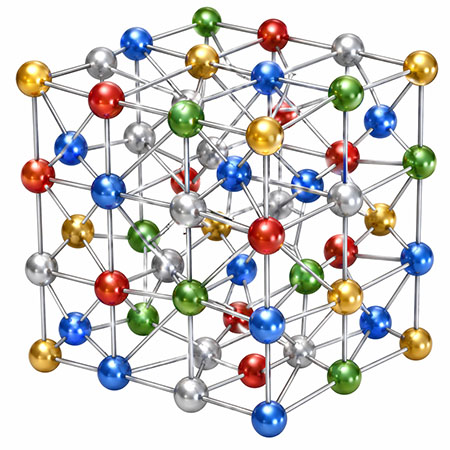
High-entropy alloys (HEAs) are a class of metallic materials composed of five or more principal elements mixed in near-equal atomic proportions, typically between 5 and 35 atomic percent each. Unlike conventional alloys such as steel or bronze, which rely on one dominant base element with small additions of others, HEAs contain multiple elements in comparable concentrations. This design strategy produces a high configurational entropy of mixing, which can stabilize simple solid-solution crystal structures – such as face-centered cubic (FCC) or body-centered cubic (BCC) phases – even in the presence of many different atomic species.
Principle Behind High-Entropy Alloys
The central idea behind HEAs is that high configurational entropy can overcome the enthalpic driving forces that typically lead to the formation of ordered intermetallic compounds. For an ideal solid solution of n elements in equiatomic proportions, the configurational entropy of mixing is ΔSmix = R·ln(n), where R is the gas constant. In a five-element equiatomic alloy, ΔSmix reaches approximately 1.61R, which becomes thermodynamically significant at elevated temperatures and can lower the Gibbs free energy enough to favor disordered solid solutions over intermetallic phases.
Four core effects have been proposed to describe the distinctive behavior of HEAs: the high-entropy effect (favoring solid-solution formation), severe lattice distortion (arising from the different atomic sizes of the constituent elements), sluggish diffusion (due to the complex local atomic environments), and the cocktail effect (whereby synergistic interactions among elements produce properties not predictable from any single constituent). While some of these effects remain subjects of active investigation, they provide a useful framework for understanding why HEAs behave differently from conventional alloys.
Types of High-Entropy Alloys
HEAs span several families defined by the types of constituent elements and the resulting crystal structures:
3d Transition Metal HEAs
The most extensively studied HEA family is based on 3d transition metals such as Cr, Mn, Fe, Co, and Ni. The equiatomic CrMnFeCoNi alloy, often called the Cantor alloy, forms a single-phase FCC solid solution and exhibits exceptional fracture toughness at cryogenic temperatures. Variants of this system with aluminum additions can promote BCC phase formation, enabling dual-phase microstructures that balance strength and ductility.
Refractory HEAs
Refractory HEAs contain elements with high melting points, such as W, Mo, Nb, Ta, and V. These alloys typically adopt BCC crystal structures and retain high strength at temperatures exceeding 1000 °C, making them candidates for applications where conventional superalloys reach their service limits. Their density remains a challenge, though lightweight refractory HEA compositions using Ti, Zr, and Al are actively being explored.
High-Entropy Ceramics
The high-entropy concept has expanded beyond metals to include ceramics such as high-entropy oxides, carbides, borides, and nitrides. These materials combine multiple cations or anions in a single crystal structure, producing enhanced hardness, thermal stability, and resistance to oxidation. High-entropy ceramic coatings and powders are being developed for extreme-environment applications including thermal barrier systems and cutting tools.
Significance at the Nanoscale
When HEAs are processed into nanoparticles or nanostructured forms, the interplay between compositional complexity and high surface-to-volume ratio creates unique opportunities. At the nanoscale, the large fraction of surface atoms amplifies the cocktail effect, and the multi-element surface composition provides a near-continuous distribution of binding energies for adsorbed species. This makes HEA nanoparticles particularly attractive as catalysts, where the diversity of active sites can lower energy barriers for chemical reactions more effectively than single- or binary-element catalysts.
Synthesis of nanoscale HEAs presents distinct challenges because the high temperatures typically required for bulk HEA processing can cause particle coarsening. Nonequilibrium methods such as carbothermal shock – where precursors are rapidly heated and quenched on a carbon support – have enabled the production of uniform, single-phase HEA nanoparticles with diameters below 10 nm. Other approaches include laser ablation, sol-gel synthesis, and sputtering from multi-element targets onto substrates.
Key Properties of High-Entropy Alloys
Mechanical Properties
HEAs can achieve remarkable combinations of strength and ductility that are difficult to obtain in conventional alloys. The severe lattice distortion caused by atomic size mismatch among the constituent elements impedes dislocation motion, contributing to solid-solution strengthening. Some FCC-based HEAs, such as the CrCoNi medium-entropy alloy, exhibit simultaneous increases in strength and toughness at cryogenic temperatures – a behavior opposite to most metals, where low temperatures typically promote brittleness. This unusual property stems from deformation mechanisms including mechanical twinning and phase transformations that activate at low temperatures.
Corrosion and Oxidation Resistance
Many HEAs, particularly those containing Cr, demonstrate excellent resistance to corrosion and high-temperature oxidation. The multi-element composition can promote the formation of dense, adherent protective oxide layers on the alloy surface. Certain HEA compositions rival or exceed the corrosion performance of commercial stainless steels and nickel-based superalloys in aggressive environments, including acidic and chloride-containing solutions.
Catalytic Properties
HEA nanoparticles have shown promising catalytic activity for reactions including water splitting, CO2 reduction, and alcohol oxidation. The random distribution of multiple elements on the particle surface creates a diverse landscape of active sites with varying electronic environments. This diversity enables HEA catalysts to bind reactants across a range of adsorption energies, potentially circumventing the scaling relations that limit single-metal catalysts. Single-atom and cluster-level variations within the HEA surface further enhance selectivity toward desired products.
Thermal and Magnetic Properties
Sluggish diffusion in HEAs contributes to enhanced thermal stability of nanocrystalline microstructures, as grain growth is retarded compared to conventional alloys. Certain HEA compositions also exhibit unusual magnetic behavior, including tunable Curie temperatures and Invar-like properties (near-zero thermal expansion), which are valuable for precision instruments and electronic packaging.
Applications of High-Entropy Alloys
Structural and Aerospace Applications
The combination of high strength, fracture toughness, and thermal stability makes HEAs candidates for structural components in aerospace and energy systems. Refractory HEAs could serve as turbine blade materials or thermal protection systems for hypersonic vehicles, where operating temperatures exceed the capabilities of nickel-based superalloys. Thin-film HEA coatings are also being developed as wear- and corrosion-resistant protective layers for industrial tooling and biomedical implants.
Energy Conversion and Storage
HEA nanoparticles are being explored as electrocatalysts for hydrogen production via water electrolysis and as electrode materials for batteries and supercapacitors. Their multi-element surfaces provide numerous active sites that can be optimized for oxygen evolution, oxygen reduction, and hydrogen evolution reactions. Some HEA compositions also show promise for hydrogen storage, where the diverse interstitial environments created by multiple elements can accommodate hydrogen atoms in high concentrations.
Catalysis and Environmental Remediation
Beyond electrochemistry, HEA nanoparticles have demonstrated activity in thermal catalysis for ammonia decomposition, CO oxidation, and environmental pollutant degradation. The compositional flexibility of HEAs allows researchers to tune the electronic structure of active sites by substituting elements, providing a systematic route to catalyst optimization that is difficult to achieve with conventional alloy catalysts.
Biomedical Applications
Certain HEA compositions based on biocompatible elements such as Ti, Zr, Nb, Ta, and Mo are under investigation for orthopedic implants and dental prosthetics. These alloys can achieve elastic moduli closer to that of human bone than conventional titanium or cobalt-chromium alloys, reducing the stress-shielding effect that leads to bone resorption around implants. Surface functionalization of HEA implants with nanoscale coatings can further enhance biocompatibility and antibacterial properties.
Challenges and Future Perspectives
Despite their promise, HEAs face several challenges that must be addressed for widespread adoption. The vast compositional space – a five-element system drawn from 30 candidate metals offers millions of possible combinations – makes systematic exploration through traditional trial-and-error experimentation impractical. Machine learning and density functional theory (DFT) calculations are increasingly being combined with high-throughput experimental methods to accelerate the identification of promising compositions.
Processing of HEAs also remains complex. Achieving compositional homogeneity across multiple elements with differing melting points and vapor pressures requires careful control of synthesis conditions. For nanofabrication, nonequilibrium processing routes such as rapid solidification, mechanical alloying, and vapor deposition are essential but add cost and complexity relative to conventional material processing.
Future research will focus on establishing clearer links between composition, processing, microstructure, and properties through integrated computational and experimental workflows. The extension of the high-entropy concept to functional materials – including thermoelectrics, superconductors, and metamaterials – is expected to open additional application spaces. As characterization tools such as scanning transmission electron microscopy (STEM) and atom probe tomography continue to improve in resolution, the atomic-level understanding of element distributions and local chemical ordering in HEAs will deepen, guiding the design of next-generation multi-element materials with tailored properties.
Further Reading
Nature Reviews Materials, High-entropy alloys
Acta Materialia, A critical review of high entropy alloys and related concepts
