| Jun 06, 2025 |
New nanomaterial combines copper and antimicrobial peptides to fight infections
Researchers developed an innovative artificial complex, Cu@G-antimicrobial peptides, which shows great potential in antibacterial therapy, especially against drug-resistant bacteria like methicillin-resistant Staphylococcus aureus (MRSA).
(Nanowerk News) In a latest research reported in Engineering ("Incorporating Single-Copper Sites and Host Defense Peptides into a Nanoreactor for Antibacterial Therapy by Bioinspired Design"), researchers from Fuzhou University and Hunan Agricultural University have developed an innovative artificial complex, Cu@G-AMPs, which shows great potential in antibacterial therapy, especially against drug-resistant bacteria like methicillin-resistant Staphylococcus aureus (MRSA).
|
|
The development of Cu@G-AMPs is inspired by natural host defense mechanisms. Antimicrobial peptides (AMPs) are considered ideal alternatives to traditional antibiotics due to their unique antibacterial activity. The amino-terminal copper-nickel binding motif (ATCUN) in AMPs plays a crucial role in immune regulation. Leveraging this, the researchers incorporated single-atom Cu catalysts into an ATCUN - motif AMP complex, creating Cu@G - AMPs.
|
|
The preparation of Cu@G-AMPs involves a multi - step process. First, single Cu atoms were anchored to a guanine-derived sheet substrate through coordination pyrolysis, forming Cu@G. Then, ATCUN - motif AMPs were modified onto Cu@G via an amide reaction to obtain Cu@G-AMPs.
|
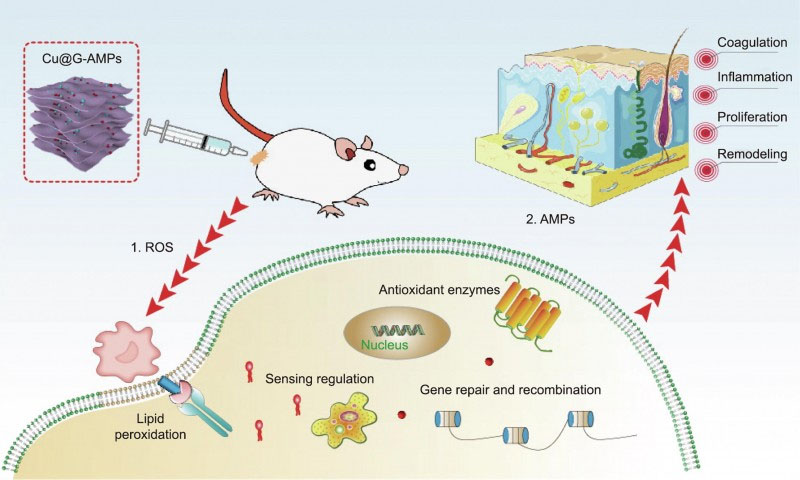 |
| Schematic illustration of Cu@G-AMPs’s functional mechanism for healing methicillin-resistant Staphylococcus aureus (MRSA) wound infection.
|
|
The characterization of Cu@G - AMPs was carried out using various advanced techniques. High - angle annular dark-field scanning transmission electron microscopy (HAADF - STEM) revealed highly dispersed single Cu atoms in the complex. Multiple molecular-structure-identification techniques such as Fourier-transform infrared spectroscopy (FTIR), Zeta potential tests, and X-ray diffraction (XRD) further confirmed the successful formation of Cu@G-AMPs, an antibiotic-free nanomaterial.
|
|
The antibacterial properties of Cu@G-AMPs were thoroughly investigated. In vitro experiments showed that it exhibited antibacterial activity against MRSA, especially under acidic conditions, which is consistent with the Fenton-like reaction mechanism. The complex generated reactive oxygen species (ROS) from H2O2, and as the concentration of Cu@G-AMPs increased, so did the amount of ROS. The toxicity tests indicated that Cu@G-AMPs had low cytotoxicity to MC3T3-E1 cells and did not cause red blood cell lysis within the antibacterial concentration range, demonstrating its ideal biocompatibility.
|
|
The study also explored the bacteriostatic mechanisms of Cu@G - AMPs. Proteomics analysis revealed that it disrupted the stress response systems of MRSA, including quorum sensing regulation, antioxidant enzymes, and gene repair and recombination.
|
|
Moreover, the in vivo performance of Cu@G-AMPs was evaluated using a mouse wound - resistant bacterial infection model. The results showed that Cu@G-AMPs effectively promoted wound healing. It pulled edge closure, stabilized granulation tissue, promoted collagen fiber proliferation, alleviated inflammation, and promoted neovascularization in wound areas infected by MRSA.
|
|
This research on Cu@G-AMPs provides a new perspective on addressing the global challenge of antibiotic resistance. As drug-resistant bacteria continue to threaten public health, the development of such novel antibacterial agents could pave the way for more effective and sustainable antibacterial therapies in the future.
|