| Jun 03, 2026 |
Nanoparticles toughen ceramic matrix composites for hypersonic heat shields
Zirconium carbide nanoparticles trigger crystal-structure changes that make brittle ceramic matrix composites stronger and more resistant to extreme-heat ablation.
(Nanowerk News) Researchers in China have made brittle ceramic matrix composites both stronger and more resistant to extreme-heat erosion by seeding them with zirconium carbide nanoparticles. The materials are used to shield aerospace and hypersonic vehicles from intense heat, where the ceramic body's brittleness has been the limiting factor.
|
|
By triggering controlled changes in the material's internal crystal structure, the method raises the plasticity of both the ceramic matrix and the protective oxide layer that forms during use.
|
Key Findings
- Zirconium carbide nanoparticles were dispersed through a carbon-carbon ceramic composite using a meltable organic-inorganic infiltration method.
- The nanoparticles set off two structural transformations that strengthen and toughen both the matrix and the oxide scale formed during ablation.
- The optimized material reached a flexural strength of 207.5 MPa, a fracture toughness of 7.12 MPa·m^(1/2), and a linear ablation rate of just 0.15 μm·s⁻¹ under plasma testing.
|
|
Thermal protection systems face rising performance demands as aerospace and hypersonic vehicle technologies advance. These systems must endure mechanical wear, ablation at ultrahigh temperatures, and the scouring force of intense airflow. Ceramic matrix composites are strong candidates because they offer high melting points, low thermal expansion, and good resistance to thermal shock.
|
|
Their main drawback is the inherent brittleness of the ceramic matrix, which limits atom movement and undermines both mechanical stability and ablation resistance.
|
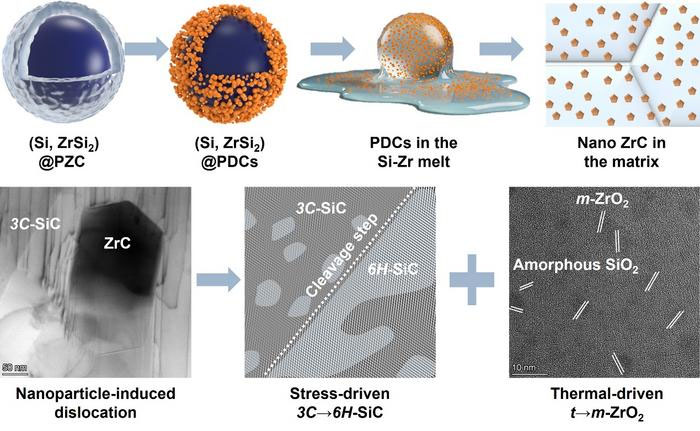 |
| The meltable organic precursor coats the surface of Si-Zr particles, pyrolyzes into nanoparticles adsorbed on the surface, and infiltrates into the porous C/C preform along with the molten Si-Zr. Subsequent carbothermal reduction reaction yields nano-dispersion-strengthened C/C-ZrC-SiC composites. During loading, ZrC nanoparticles induce dislocation nucleation and stress-driven 3C→6H-SiC phase transformation, achieving effective matrix strengthening and toughening. Meanwhile, during ablation, these nanoparticles are oxidized to form nano ZrO2, which acts as pinning phases in the amorphous SiO2 scale and triggers martensitic transformation, significantly enhancing resistance to plasma flame erosion. (Image: Reproduced from DOI:10.26599/JAC.2026.9221308, CC BY)
|
|
To address that brittleness and better balance strength against high-temperature ablation resistance, researchers need dependable ways to modify the matrix. Phase transformation toughening is one practical option. It absorbs fracture energy, eases local stress concentration, and slows crack growth through stress-induced changes in the material's structure, offering a route to improve the overall performance of brittle ceramics.
|
|
A team led by Prof. Jia Sun at Northwestern Polytechnical University in China reported the fabrication, mechanical behavior, and ablation performance of zirconium carbide nanoparticle reinforced carbon-carbon composites containing zirconium carbide and silicon carbide. The nanoparticles trigger a 3C→6H-SiC polytypic transformation in the silicon carbide and a martensitic transformation in zirconium dioxide, which together raise the plasticity of the matrix and the oxide layer.
|
|
The team published its work in the Journal of Advanced Ceramics ("Nanoparticle-induced phase transformation boosts mechanical and ablation performance for C/C–ZrC–SiC composites").
|
|
The fabrication route relies on a hybrid infiltration step. A meltable organic precursor coats the surface of silicon-zirconium particles, then breaks down under heat into nanoparticles that cling to those surfaces. As the molten silicon-zirconium flows into a porous carbon-carbon preform, it carries the nanoparticles with it. A following carbothermal reduction reaction produces the nano-dispersion-strengthened composite.
|
|
Describing the process, Jia Sun, professor at the School of Materials Science and Engineering at Northwestern Polytechnical University and a specialist in ultra-high temperature ceramics for modified carbon-carbon composites, said: "In this report, we fabricated the ZrC nanoparticle reinforced C/C-ZrC-SiC composites by a meltable organic-inorganic hybrid infiltration strategy. During melting, organic zirconium acetylacetonate converts to ZrC nanoparticles and uniformly disperses into the matrix driven by the Si-Zr melt."
|
|
Two distinct mechanisms explain the gains. Under mechanical load, the nanoparticles pin defects and seed dislocations, prompting the silicon carbide to shift its crystal structure and form deformation twins. During ablation, the same nanoparticles oxidize in place into zirconium dioxide, which lodges within the glassy silica scale and undergoes its own transformation, making the protective layer better able to deform rather than crack under a plasma flame.
|
|
Sun detailed both effects: "These ZrC nanoparticles induce abundant dislocation tangles, cross-slip and cutting in the SiC matrix via pinning effects, trigger the formation of deformation twins and gradual 3C→6H-SiC phase transformation in the ceramic matrix, which realizes matrix strengthening and toughening.
|
|
Meanwhile, during ablation, the ZrC nanoparticles are oxidized in situ to form nano ZrO2, which pinning in amorphous SiO2-based oxide scale and occurring martensitic transformation, further enhancing the plastic deformation capacity of the oxide layer to resist plasma flame erosion. The nano-dispersion-strengthened strategy effectively enhances plasticity, mechanical strength, and ablation resistance for C/C-ZrC-SiC composites."
|
|
The measured properties point to the payoff. "The optimized composite exhibits a flexural strength of 207.5 MPa, a fracture toughness of 7.12 MPa·m^(1/2) and a linear ablation rate of only 0.15 μm·s⁻¹ under plasma ablation. This nanoparticle-induced phase transformation strategy provides a new route for designing tough, anti-ablation CMCs used in extreme thermal environments," Sun said.
|
|
The work explains how the nanoparticle reinforced composites form and why they hold up under extreme heat, and it points to a general method for raising plasticity in ceramics and building advanced nano-dispersion-strengthened composites.
|
|
Sun noted that further study is still needed on how different nanoparticles interact with the ceramic matrix in reinforced composites intended for thermal protection. He identified two priorities for follow-up work: ablation resistance at ultrahigh temperatures and the high-temperature mechanical properties of the composites.
|
|
Additional contributors include Yuyu Zhang, Dingcong Cui, Xuemeng Zhang, Hongkang Ou, and Qiangang Fu from the School of Materials Science and Engineering at Northwestern Polytechnical University, along with Xin Yang and Qizhong Huang from Central South University in China. Jia Sun, a professor and doctoral supervisor at the university, has published more than 100 SCI papers and holds 20 national invention patents.
|
|
The nanoparticle method shows that controlling a material's internal structure can deliver strength, toughness, and erosion resistance together, rather than trading one against another.
|



