| Jun 17, 2026 |
Graphene neural interface enables two-way communication with the brain
Flexible graphene neural interface records and modulates brain activity, enabling two-way communication for future neurological treatments.
(Nanowerk News) Neural interfaces are devices that can detect or modulate neuronal activity when placed in contact with the brain. They are already used to treat various conditions related to the nervous system. However, current technologies still have limitations that can reduce their effectiveness.
|
|
One example of this is their unidirectional function. While most existing interfaces can stimulate the brain, they cannot accurately detect or decode brain activity simultaneously. Even when they can do so, they often face limitations in the detection of certain signals, particularly those at very low frequencies.
|
|
Now, a study led by researchers at Institute of Microelectronics of Barcelona (IMB-CNM-CSIC) and Catalan Institute of Nanoscience and Nanotechnology (ICN2), recently published in Nature Communications ("An artefact-resilient wide bandwidth bidirectional graphene neural interface"), presents a device capable of overcoming these barriers, which has already been successfully tested in mouse models.
|
|
The study introduces a graphene-based neural interface. Graphene is a flexible nanomaterial and an excellent electrical conuctor. The device was developed in response to the challenge of integrating two complementary graphene technologies into a single platform. This enables the device to simultaneously record and decode neural signals, interpret this information, and modulate brain activity in response. This bidirectional capacity could pave the way for new, real-time, patient-specific therapies for neurological disorders.
|
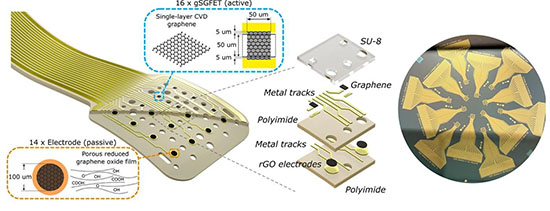 |
| On the left: a graphical representation of the interface tip, where the transistors (active) and electrodes (passive) can be distinguished. On the right: a detail of the wafer, the substrate on which the devices are manufactured, showing the production of twelve interfaces with the same shape as seen in the main image. (Image: Reproduced from DOI:10.1038/s41467-026-73790-x, CC BY)
|
Integrating two key elements
|
|
As Prof. Jose A. Garrido, one of the study's lead authors, explains: "Most clinical implants used for conditions such as Parkinson's disease or epilepsy are currently unidirectional. They are based on electrodes that operate with fixed parameters and do not adapt to dynamic changes in brain activity. This results in therapies that are not very specific and cannot adapt."
|
|
The new device addresses this challenge by combining two graphene-based technologies. Firstly, it incorporates monolayer graphene transistors (gFETs), which can record brain activity with sensitivity to ultra-low frequencies. It also integrates microelectrodes made from nanoporous reduced graphene oxide (rGO), a graphene derivative, that can modulate nerve cell activity through electrical pulses.
|
|
The challenge was both conceptual and technical. Previous studies by this team had already involved the development of graphene electrodes capable of establishing bidirectional communication with neural tissue. However, these devices presented problems of signal interference, known as 'artefacts'. More specifically, modulation pulses could interfere with the recording of brain signals, masking or altering the real activity.
|
|
Dr Anton Guimerà, another of the study's lead authors and a researcher at IMB-CNM, notes that "integrating both transistors and electrodes makes bidirectional communication more sensitive and precise. The results showed that monitoring brain activity, including ultra-low frequency activity, is not affected by modulation. For this reason, we can say that the device is able to listen and speak."
|
|
Fabrication of the device took place in the Micro and Nanofabrication Clean Room facilities at IMB-CNM-CSIC and ICN2. The interfaces were validated in Dr Rob Wykes' laboratory at University College London using in vivo mouse models. These tests demonstrated the technology's potential to detect biomarkers in real time and respond with specific and adjusted modulation.
|
A consolidated collaboration
|
|
This advance is not an isolated result, but a new milestone in the long-standing collaboration between IMB-CNM-CSIC and ICN2. The graphene electrodes and transistors, which are key components of the device, had already been validated in previous studies carried out by this team.
|
|
One of the first milestones in this line of research was an article published in Nature Materials in 2018. Led by Dr Anton Guimerà and ICREA Prof. Jose A. Garrido, this study demonstrated the first graphene-based implant capable of recording brain activity at extremely low frequencies. This was followed by a more recent study, also published in Nature Nanotechnology, which focused on nanoporous graphene technology.
|
|
Close collaboration between IMB-CNM-CSIC and ICN2 has also driven the transfer of these technologies towards biomedical applications. In this context, INBRAIN Neuroelectronics was created. Founded in 2019 with the support of ICN2, IMB-CNM and ICREA, this spin-off licenses graphene transistor and electrode technologies developed in this area of research. The company is developing graphene-based neural interfaces for clinical use and has already completed the first human trial to evaluate their safety and efficacy.
|
|
Other collaborators involved in the present study include the Biomedical Research Networking Centre in Bioengineering, Biomaterials and Nanomedicine (CIBER-BBN), the University of Manchester, University College London and the Bernstein Center for Computational Neuroscience in Munich, Germany.
|