Ten Things You Should Know About Nanotechnology
Part 1 of 10 | View all topics
 |
1) The Concept |
The Vision: "Plenty of Room at the Bottom" (1959)
On December 29, 1959, physicist and future Nobel laureate Richard Feynman delivered a lecture titled "There's Plenty of Room at the Bottom" at the annual meeting of the American Physical Society at Caltech. This talk is widely considered the conceptual birth of nanotechnology—though Feynman never used that term.
"Why cannot we write the entire 24 volumes of the Encyclopædia Britannica on the head of a pin?"
Feynman challenged scientists to think about manipulating matter at the atomic scale. He envisioned machines that could build smaller machines, which in turn could build even smaller ones—all the way down to arranging individual atoms. He wasn't just talking about miniaturization; he was proposing an entirely new way of manufacturing.
To spur innovation, Feynman offered a $1,000 prize "to the first guy who makes an operating electric motor—a rotating electric motor which can be controlled from the outside and, not counting the lead-in wires, is only 1/64 inch cube."
He had hoped this reward would stimulate new fabrication technologies. Instead, just one year later, engineer Bill McLellan built the motor by hand using tweezers and a microscope—no new technology required, just extraordinary patience and skill. McLellan's 2000 rpm motor weighed 250 micrograms and consisted of 13 parts.
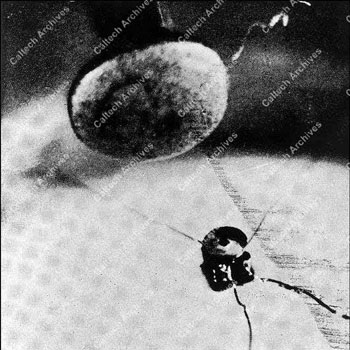
The McLellan micromotor photographed under a microscope. The large blob on top is a pinhead. (Image: Caltech Archives)
While McLellan's achievement didn't advance fabrication techniques as Feynman had hoped, the vision Feynman articulated that evening would eventually inspire generations of scientists and engineers.
Naming and Theorizing (1974–1986)
1974 – The term "nanotechnology" is born. Japanese scientist Norio Taniguchi of Tokyo Science University coins the word "nanotechnology" in a paper on precision machining. He used it to describe manufacturing processes achieving nanometer-level tolerances—a top-down approach of carving materials with extreme precision.
1986 – Nanotechnology enters public consciousness. American engineer K. Eric Drexler publishes "Engines of Creation: The Coming Era of Nanotechnology," popularizing the concept and introducing the idea of molecular assemblers—nanoscale machines that could build virtually anything atom by atom. While some of Drexler's more radical visions remain controversial, his book sparked widespread interest in the field.
Seeing and Manipulating Atoms (1981–1989)
Feynman's vision required tools that didn't exist in 1959. Two breakthroughs in the 1980s changed everything:
1981 – The Scanning Tunneling Microscope (STM). Gerd Binnig and Heinrich Rohrer at IBM's Zurich Research Laboratory invent the STM, which uses quantum tunneling to image surfaces at atomic resolution. For the first time, scientists could "see" individual atoms.
1986 – Nobel Prize recognition. Binnig and Rohrer receive the Nobel Prize in Physics for the STM. The award validated that atomic-scale science was not only possible but transformative.
1989 – Atoms spelled "IBM." Using an STM, IBM researchers Don Eigler and Erhard Schweizer positioned 35 individual xenon atoms on a nickel surface to spell out "IBM." This iconic image proved that Feynman's dream of manipulating individual atoms was achievable.
Nobel Prize Validations
Perhaps the strongest evidence that nanotechnology has moved from concept to reality is the remarkable number of Nobel Prizes awarded for nanotechnology-related discoveries. These prizes span both Physics and Chemistry, underscoring the interdisciplinary nature of the field:
| Year | Field | Discovery | Nano Relevance |
|---|---|---|---|
| 1986 | Physics | Scanning Tunneling Microscope | Enabled imaging and manipulation of individual atoms |
| 1996 | Chemistry | Fullerenes | New carbon allotropes (C₆₀ "buckyballs") |
| 2000 | Physics | Heterostructures | Layering materials for high-speed electronics |
| 2007 | Physics | Giant Magnetoresistance (GMR) | Nanoscale magnetic layers for data storage |
| 2010 | Physics | Graphene | Single-atom thick 2D materials |
| 2014 | Chemistry | Super-resolved fluorescence microscopy | Breaking the optical diffraction limit |
| 2016 | Chemistry | Molecular Machines | Mechanical motion at the molecular level |
| 2023 | Chemistry | Quantum Dots | Size-dependent quantum properties |
The 2016 Nobel Prize for molecular machines is particularly significant—it represents the realization of Feynman's original vision of machines operating at the molecular scale. And the 2023 prize for quantum dots demonstrates that nanoscience continues to yield breakthrough discoveries.
From Concept to Reality
In just over six decades, nanotechnology has evolved from a provocative idea in a physicist's lecture to a Nobel Prize-winning field with real-world applications in electronics, medicine, energy, and materials science. The field of microelectromechanical systems (MEMS) has long surpassed McLellan's hand-built motor, and researchers now work at an even smaller scale with nanoelectromechanical systems (NEMS).
But what exactly do we mean when we say "nanotechnology" today? The term has become remarkably broad. In the next section, we'll explore the definition and usage of the term nanotechnology.