

Ten Things You Should Know About Nanotechnology
Part 5 of 10 | View all topics
 |
5) Nanomanufacturing |
The State of Nanomanufacturing
The semiconductor industry is the only sector where nanoscale manufacturing technologies are employed on a truly massive scale. Device structures have now reached the 3 nanometer node, with 2nm in development. Of course, the chemical industry has long been working with nanoscale particles and pigments, but this falls more into the realm of chemistry than nanomanufacturing.
Proponents of "atomically precise manufacturing" and "molecular manufacturing" love to talk about the mind boggling possibilities that these technologies would offer. These visions range from the modest, such as improved materials and more efficient production methods for chemicals (already happening), to the outrageous, such as molecular desktop fabs (still far out).
Articles about revolutionary nanotechnology almost always skip the hard part: the tremendous amount of research breakthroughs required to get from where we are today to the promised land. It's as if some flight enthusiasts in 1903, when Orville Wright took off on the first powered flight, would have debated first class cabin design of 600 seat jet airliners flying New York to Tokyo nonstop.
Nanoparticle Synthesis
As Bubba in Forrest Gump pointed out, there are lots of possibilities with shrimp: "You can barbecue it, boil it, broil it, bake it... there's pineapple shrimp, lemon shrimp, pepper shrimp, shrimp soup, shrimp stew, shrimp salad, shrimp burger, shrimp sandwich... that's about it." It sounds pretty much the same when you listen to researchers talking about the numerous strategies for synthesizing nanoparticles: you can barbecue it (well, kind of), boil it, broil it, bake it... there's sonochemical processing, cavitation processing, microemulsion processing, high energy ball milling, and many more.
While significant progress has been made, nanoparticle synthesis remains a sophisticated process that requires considerable expertise to obtain high quality particles of well controlled size and shape. Modern techniques like atomic layer deposition (ALD) now allow for precise control at the atomic level, and automation has improved reproducibility. Still, there is a long way from nanoparticle production to nanomanufacturing of complex structures or fully functioning nanodevices.
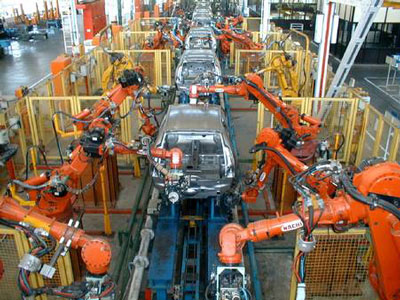
Fully automated assembly line.
The term manufacturing generally conjures up industrial production facilities with more or less fully automated assembly lines. Henry Ford's development of the assembly line in 1907 to 1908 for his Model T automobile revolutionized not only industry but also society, because it allowed mass production of industrial goods at much lower cost than before. At its core, an assembly line is a manufacturing process in which interchangeable parts are added to a product in a sequential manner to create a finished product.
In many ways, nanotechnology techniques today are still evolving toward this kind of scalable, reproducible manufacturing.

Lab space at a nanoimprint lithography prototyping facility.
Top-Down vs. Bottom-Up
There are different ways of manipulating matter at the nanoscale. The two approaches you hear most about are top-down and bottom-up methods.
Michelangelo was a top-down artist. He took one big, raw block of Carrara marble and after years of chiseling away produced a spectacular statue like David. In the process he reduced the original block of marble to half its original volume and left the other half as waste.
This is the nanotechnology equivalent of lithography and other top-down methods where you start by taking a block of material and remove the bits and pieces you don't want until you get the shape and size you do want. In the process you spend (relatively much) energy, use (sometimes very toxic) chemicals, produce (often quite a bit of) waste, need patience (these processes can be slow), and the results are not always easily replicable.
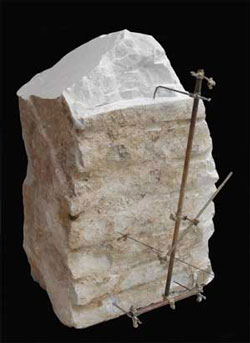

Marble: before and after Michelangelo's top-down approach.
Bottom-up methods are more elegant and potentially more efficient. Think of LEGO blocks. Just pick the shapes and sizes you need and, one by one, build more or less anything you want with them. Replace your hands with a tiny machine or some other assembly process, and the LEGOs with atoms or molecules, and you have molecular assembly. Unfortunately, this analogy is too simplistic.
To make things more complicated, there are two fundamentally different ways of fabricating things from the bottom up. And this is where much of the confusion about nanotechnology terminology comes from.
Self-Assembly
One bottom-up method is nature's way: self-assembly. Self-organizing processes are common throughout nature and involve components from the molecular scale (protein folding) to the planetary scale (weather systems) and even beyond (galaxies).
The key to using self-assembly as a controlled and directed fabrication process lies in designing components that will self-assemble into desired patterns and functions. Self-assembly reflects information coded as shape, surface properties, charge, polarizability, magnetic dipole, mass, and other characteristics in individual components; these characteristics determine the interactions among them.
On a very small scale you wouldn't even use the term "self-assembly" but rather "chemical synthesis," the processes chemists have refined over many years. However, the stability of covalent bonds enables the synthesis of almost arbitrary configurations of only up to about 1000 atoms. Larger molecules, molecular aggregates, and forms of organized matter more extensive than molecules cannot be synthesized bond by bond. Self-assembly is one strategy for organizing matter on these larger scales.
The principle of self-assembly: Certain atoms and molecules will spontaneously organize themselves into ordered structures under the right conditions. Once we can initiate and control this process, we can use it to build structures from the bottom up.
Self-assembly has become an especially important concept in nanotechnology. As miniaturization reaches the nanoscale, conventional manufacturing technologies struggle because it has not yet been possible to build machinery that assembles nanoscale components into functional devices with the same precision. Until robotic assemblers capable of true nanofabrication can be built, self-assembly, together with chemical synthesis, remains essential for bottom-up fabrication (read: "Mind the gap: nanotechnology robotics vision versus lab reality").
DNA Origami: Self-Assembly in Action
One of the most successful examples of programmable self-assembly is DNA origami. First demonstrated by Paul Rothemund in his landmark 2006 Nature paper, this technique uses the predictable base pairing of DNA strands to fold long DNA molecules into precise two dimensional and three dimensional nanostructures.
DNA molecules can serve as precisely controllable and programmable scaffolds for organizing functional nanomaterials. Researchers have used DNA origami to create nanoscale containers for drug delivery, templates for arranging nanoparticles, molecular machines, and even tiny circuit boards for nanoelectronics. What was once a laboratory curiosity has matured into a robust platform technology with real applications on the horizon.
Self-assembly is also the reason why nanotechnologies have such a profound impact on the chemical industry. One example is the huge area of polymers used for industrial products. Chemists are using molecules' tendency to self-align to design molecular structures with specific properties, a much more efficient approach than traditional trial and error chemistry.
Molecular Assembly
The other way of doing bottom-up nanotechnology is the engineered approach: molecular assembly. It sounds like self-assembly but is a very different concept. The following animation illustrates the vision of "Molecular Desktop Manufacturing: Productive Nanosystems":
This is the vision that proponents of revolutionary nanotechnology put forward: molecular assembly as a factory concept, assembly lines and all, just scaled down to the nanolevel. The notion of "self-assembly" becomes relevant in this context with regard to "self-replicating" nanomachines, that is, machines that self-assemble themselves; but this is very different from the type of self-assembly found in nature.
There is one very big catch though: universal molecular assembly remains a vision. In a scientific sense it is not yet even a fully developed theoretical framework, let alone a practical technology.
With our technical capabilities today, the most advanced bottom-up nanotechnologies combine chemical synthesis and self-assembly. But they already allow us to perform atomically precise manufacturing on a modest scale, and this is leading to vastly improved materials, much more efficient manufacturing processes, and entirely new medical procedures.
Perhaps we will never have, and never need, molecular assembly modeled after today's factories. Nature's approach, refined over billions of years, may prove to be the more practical path forward.
With an understanding of how nanomaterials are made, let's look at the numbers behind nanotechnology: investments, research output, and patents.
