

Ten Things You Should Know About Nanotechnology
Part 4 of 10 | View all topics
 |
4) New Materials: The Rise of Carbon Nanostructures |
Carbon: An Element Transformed
There are plenty of examples of nanomaterials we could write about: nanoparticles, quantum dots, nanowires, nanofibers, ultrathin films, and more. One example, though, that is exemplary of how an "old" material gets an exciting new life through nanoscale technologies is the element carbon.
Carbon, a nonmetallic solid element that occurs in all organic life, is the basis of organic chemistry. It has the interesting chemical property of being able to bond with itself and a wide variety of other elements, forming nearly 10 million known compounds. Natural carbon exists in two well known forms: graphite and diamond. These different structural forms of the same element are called allotropes. Three additional carbon allotropes discovered between 1985 and 2004 have caused tremendous excitement among researchers: fullerenes, carbon nanotubes, and graphene. Two of these discoveries have been recognized with Nobel Prizes.
Fullerenes
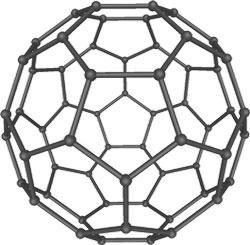
Fullerene (C60), also known as a buckyball
Fullerenes are spherical carbon cage molecules with sixty (C60) or more carbon atoms. They measure about 0.7 to 1.5 nm in diameter. The discovery of fullerenes was recognized with the 1996 Nobel Prize in Chemistry, awarded to Robert Curl, Harold Kroto, and Richard Smalley.
Fullerenes show unusual properties for carbon materials. They are studied for potential medical use: they are strong antioxidants, and researchers have explored binding specific antibiotics to the structure to target resistant bacteria or even certain cancer cells such as melanoma. Heat resistance and superconductivity are some of the more heavily studied properties of fullerenes in materials science and engineering.
Interestingly, fullerenes have been found to exist in interstellar dust as well as in geological formations on Earth. The discovery that carbon could form stable, ordered structures other than graphite and diamond stimulated researchers worldwide to search for other new forms of carbon. This led to the discovery of carbon nanotubes (CNTs).
Carbon Nanotubes
Here is a short introduction to carbon nanotubes:
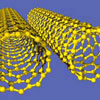
Carbon nanotubes (CNTs) range from single to tens of nanometers in diameter and several micrometers in length. They have outstanding mechanical and electronic properties and are excellent thermal conductors.
The tensile strength of carbon nanotubes is 6 to 7 times that of steel. They are among the stiffest and strongest fibers known to science.
CNTs can be metallic or semiconducting depending on their structure. Some CNTs are the most efficient electrical conductors ever made, while others behave more like silicon. These properties, coupled with the lightness of carbon nanotubes, give them great potential for use in reinforced composites, nanoelectronics, sensors, and nanomechanical devices.
CNTs can have one or more walls. Single walled CNTs exhibit different electrical properties than multiwalled CNTs and are prime candidates for applications in nanoelectronics. Commercial applications have developed more slowly than initially hoped, primarily because of the relatively high production costs of the best quality nanotubes, especially single walled ones. However, CNTs are now used in specialized applications including high performance sporting goods, aerospace components, and conductive additives for batteries.
One of the more ambitious proposed applications of carbon nanotubes is the Space Elevator, the idea that a cable based transport system could become an alternative to rockets for launching people and payload into space:
Graphene
The newest member of the carbon nanomaterial family is graphene. First isolated in 2004 by Andre Geim and Konstantin Novoselov at the University of Manchester, graphene is a flat, one atom thick sheet of carbon atoms arranged in a hexagonal lattice. Their work earned them the 2010 Nobel Prize in Physics.
Existing forms of carbon basically consist of sheets of graphene, either stacked on top of each other to form a solid material like the graphite in your pencil, or rolled up into carbon nanotubes (think of a single walled carbon nanotube as a graphene cylinder), or folded into fullerenes.
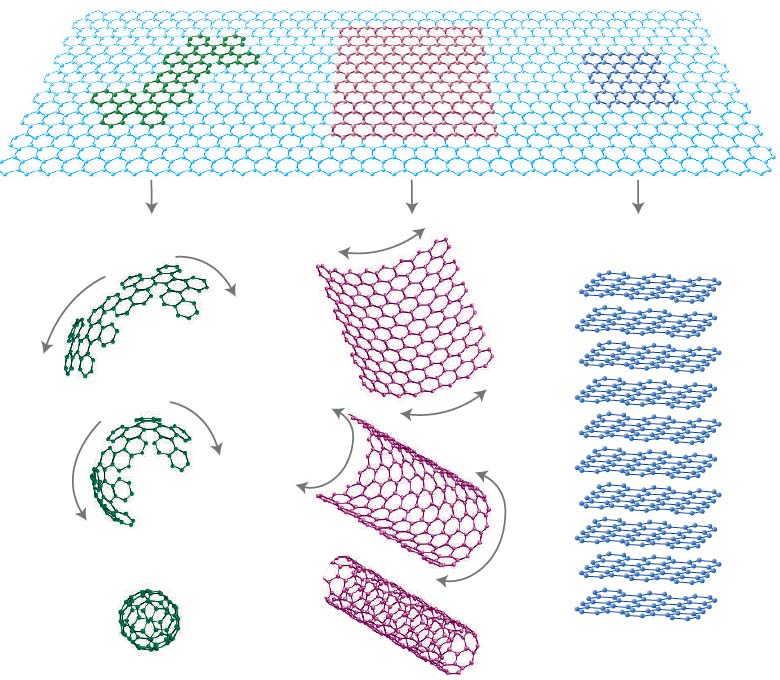
Graphene sheets are building blocks for other graphitic materials. Left: Cut and folded into a spherical shape they make a C60 fullerene molecule. Middle: Rolled up they make a carbon nanotube. Right: Bonded on top of each other they make the bulk material graphite. (Adapted from Nat. Mater., 6:183–191, 2007)
Physicists had long considered a free standing form of planar graphene impossible; the conventional wisdom was that such a sheet would always roll up. Remarkably, Geim and Novoselov first isolated graphene using ordinary sticky tape to peel layers from graphite.
Graphene's remarkable properties: It is the thinnest material known (one atom thick), the strongest material ever measured, an excellent conductor of electricity (better than copper), nearly transparent, and extremely flexible.
Two decades after its discovery, graphene has moved from laboratory curiosity to commercial reality. Applications now include flexible displays, high speed transistors, advanced batteries and supercapacitors, water filtration membranes, and composite materials for aerospace and automotive industries. Graphene oxide, a chemically modified form, is particularly useful for coatings and membranes.
Beyond Graphene: The 2D Materials Revolution
Graphene's discovery opened the door to an entire class of two dimensional materials. Scientists call them 2D because they extend in only two dimensions (length and width); as these materials are only one or a few atoms thick, the third dimension (height) is essentially zero.
Other 2D materials now being explored include hexagonal boron nitride (an excellent insulator often used alongside graphene), transition metal dichalcogenides like molybdenum disulfide (MoS2) with promising semiconductor properties, and MXenes (compounds of metal carbides and nitrides) for energy storage applications. This growing family of 2D materials offers researchers a toolkit for designing next generation electronics, sensors, and energy devices.
Carbon nanomaterials represent just one area of nanotechnology. Next, we'll look at how these and other nanomaterials are actually manufactured.
