| Posted: Jun 15, 2011 | |
Nanofoams are promising materials for radiation shielding |
|
| (Nanowerk Spotlight) Radiation damage to materials is a major issue for builders of nuclear power plants as well as spacecraft engineers. The former have to worry about material failure due to the destructive radiation created within the reactor; the later are concerned about the exposure to space radiation of both materials and humans during long-term space missions. NASA says that the risks of exposure to space radiation are the most significant factor limiting humans' ability to participate in long-duration space missions. A lot of research therefore focuses on developing countermeasures to protect astronauts from those risks. | |
| "There is a consensus that interface engineering is the way to go to to improve resistance to extreme conditions in general and to reach radiation tolerance in particular – interfaces are places where defects created by energetic collision in solids can annihilate each other and thus render the material immune to irradiation" Jose Alfredo Caro, a researcher in the Structure/Property Relations Group (MST-8) at Los Alamos National Laboratory, tells Nanowerk. "All kind of interfaces are being explored, in particular those formed by the contact between two different solid state phases." | |
| Caro points out that, so far, nobody has studied the (probably) best interface of all to annihilate defects: matter-void interface, i. e. free surfaces. | |
| "Foams are materials with a large amount of interfaces – free surfaces in this case – with the potential to show radiation resistance due to the ideally unsaturable sink strength represented by free surfaces" says Caro. "Nanocomposites, nanophase materials, and nanofoams could be unusually resistant to radiation because radiation-induced point defects cannot accumulate in the presence of the high density of defects sinks provided by interfaces and surfaces in these materials." | |
| In new work, published in the June 9, 2011, online edition of Nano Letters (Are Nanoporous Materials Radiation Resistant?) Caro and his group, working with collaborators from Lawrence Livermore National Laboratory and the Department of Materials Sciences at Virginia Tech, conclude that nanofoams can be tailored to become radiation tolerant. | |
 |
|
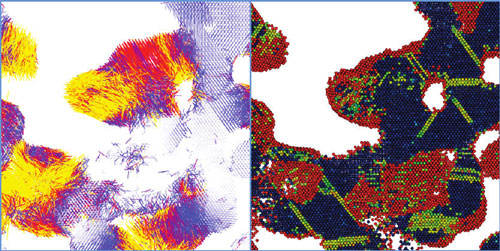
| Irradiation of nanofoams, computer simulation. Small region of the sample with 45% porosity and a ∼5 nm ligament size, ∼110 ps after a cascade began, melted and recrystallized the tip of a ligament. (Left) Atomic displacements larger than the lattice parameter a0 are shown with red indicating more than 4 a0. (Right) Atoms colored by centro-symmetry parameter: blue indicates normal fcc material, green indicates SFs and twins, and red indicates highly disordered regions. Note the planar defects surrounding the void close to the cascade. (Reprinted with permission from American Chemical Society) | |
| "Our work is a combination of simulations and experiments together with some simple models that show for the first time the possibility of existence of a window in the foam parameter space where such materials would show radiation tolerance" explains Caro. "In some sense our work opens the door to a promising approach to radiation resistance." | |
| The team's motivation came from speculations that, since voids are extremely good to capture and annihilate irradiation created defects, foams should be tolerant if they survive the initial damage event – the collision cascade – without undergoing melting. | |
| "These ideas led us to run simulations and make experiments and apparently we found, at least one case, where there seems to be a window of radiation tolerance" says Caro. "Actually, we were playing with this subject in our free time, with a summer student visiting Livermore a couple years ago, and when me and colleagues from the simulations team discovered that here at Los Alamos, people had done precisely an experiment that showed radiation tolerance of nanofoams, we simply put all observations together and wrote that article." | |
| Caro points out that the team's combined experiments, simulations, and modeling results suggest then the existence of a window in the parameter space of foams under irradiation where this nanostructured materials show radiation resistance. | |
| This indicates that further investigating the radiation behavior of nanofoams has therefore high payoff potential in the search for materials with radiation endurance. | |
| Nanoscale foams are today research materials, too complex and expensive to create at an industrial scale. But if materials engineers find ways to create these foams on a commercial scale, then applications for light-weight, strong, and radiation tolerant materials can be found in aerospace industry, nuclear fuels, and nuclear structural materials. | |
 By
Michael
Berger
– Michael is author of three books by the Royal Society of Chemistry:
Nano-Society: Pushing the Boundaries of Technology,
Nanotechnology: The Future is Tiny, and
Nanoengineering: The Skills and Tools Making Technology Invisible
Copyright ©
Nanowerk LLC
By
Michael
Berger
– Michael is author of three books by the Royal Society of Chemistry:
Nano-Society: Pushing the Boundaries of Technology,
Nanotechnology: The Future is Tiny, and
Nanoengineering: The Skills and Tools Making Technology Invisible
Copyright ©
Nanowerk LLC
|
|
|
Become a Spotlight guest author! Join our large and growing group of guest contributors. Have you just published a scientific paper or have other exciting developments to share with the nanotechnology community? Here is how to publish on nanowerk.com. |
|
