
| Posted: Sep 12, 2006 | |
Bioinspired polymer-inorganic hybrid materials |
|
| (Nanowerk Spotlight) The use of design concepts adapted from nature is a promising new route to the development of advanced materials, with biominerals providing an ample source of examples. For instance, Nature’s ability to manipulate poor engineering materials such as calcium carbonate to produce skeletal materials with considerable fracture resistance is an ideal inspiration for this approach. Researchers in the UK now report a simple and general approach to single crystal growth, employing structured films of generic polymers to direct the growth of single crystals. By using straightforward patterning techniques they are able to access a large variety of patterns with a continuous range of length scales from the macroscopic to the nanometer level. | |
| While a number of techniques have been used previously to pattern the gross morphology of calcite single crystals, including growth in lithographically created moulds, templates derived from biominerals or on colloidal particle monolayers, the method described by the scientists in the UK is significantly more flexible and general. | |
| Dr. Sabine Ludwigs, who is currently holding a postdoc position in the Thin Films and Interfaces Group at the University of Cambridge's Cavendish Laboratory, explained these recent findings to Nanowerk: "We developed a straightforward route to patterning crystal growth. Structured polymer templates are employed as substrates to support calcite crystal growth, resulting in translation of the polymer film pattern into the crystal nucleation face." | |
| The researchers demonstrated that these structured polymer films provide a versatile new route to patterning crystal growth and generating inorganic/organic hybrid materials. Accessing a wide variety of patterning techniques (top-down and bottom-up approaches) and matrix materials, use of structured films of generic polymers to direct the crystal growth provides a procedure that incorporates the organic phase into a growing single crystal and spans a wide range of pattern sizes and periodicities. | |
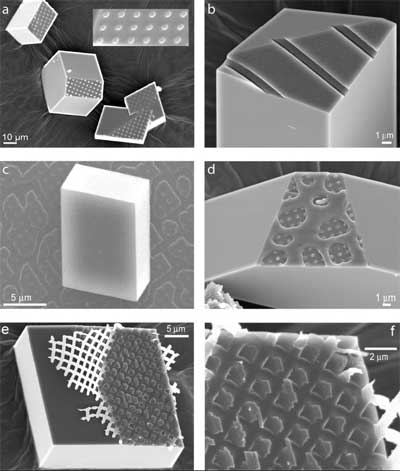 |
Scanning electron microscopy (SEM) images of calcite crystals grown via the ammonia-diffusion technique for 12–15 h on thin PS films that were prepared by nanoimprint lithography. a) The nucleation faces of the crystals are patterned with an array of 1 µm wide posts, as directed by the polymer template, which consisted of a regular array of 1 µm wide holes. The inset shows a higher magnification of the posts. b) Calcite crystal face patterned with stripes. c,d) Top and bottom view of crystals grown on a combined pattern with irregular large and regular small features. e) Calcite crystal with the polymer grid pattern still attached to the crystal face, f) shows a magnification of this feature: The outgrowths show preferred facets which are coaligned with the parent crystal. This is an indication that the parent single crystal continued growing through the polymer template. (Reprinted with permission from Wiley) |
| Ludwigs and coworkers report their results which resulted from a collaboration between Cambridge and Dr. Meldrum’s group in the University of Bristol's School of Chemistry, report their research in a recent paper in Advanced Materials with the title: "Bioinspired Polymer-Inorganic Hybrid Materials". | |
| Ludwigs points out that their way of patterning single crystals with polymer template is quite generic and can therefore easily be expanded to other materials. Since standard lithographic methods were employed, this allows the use of any organic material that can be lithographically patterned as a template for crystal growth. | |
| In the process employed by the UK scientists, polymer films selectively lift off the supporting substrate and get fully embedded into the inorganic matrix during crystal growth thereby forming a synthetic polymer/inorganic composite material. Using a nanoporous polymer template the scientists can produce a synthetic polymer/inorganic composite material that closely resembles abalone nacre in structure. | |
| "Crystallisation initiated on a nanostructured polymer film not only provides easy access to unprecedented length scales (as small as 10 nm), but for the first time offers an organic film which is structurally very similar to an organic matrix directly involved in biomineralization, the organic sheets separating the aragonite tablets in abalone nacre" Ludwigs explains. | |
| Since the template is transferred onto a growing crystal by the growth process itself, it should be possible to iterate this process and thereby generate three-dimensional hybrid materials with sub-micrometer internal dimensions. | |
| "Our methodology is also quite general and could be applied to many other inorganic crystals produced under ambient conditions" Ludwigs concludes. | |
 By
Michael
Berger
– Michael is author of three books by the Royal Society of Chemistry:
Nano-Society: Pushing the Boundaries of Technology,
Nanotechnology: The Future is Tiny, and
Nanoengineering: The Skills and Tools Making Technology Invisible
Copyright ©
Nanowerk LLC
By
Michael
Berger
– Michael is author of three books by the Royal Society of Chemistry:
Nano-Society: Pushing the Boundaries of Technology,
Nanotechnology: The Future is Tiny, and
Nanoengineering: The Skills and Tools Making Technology Invisible
Copyright ©
Nanowerk LLC
|
|
Become a Spotlight guest author! Join our large and growing group of guest contributors. Have you just published a scientific paper or have other exciting developments to share with the nanotechnology community? Here is how to publish on nanowerk.com.