

Nanotechnology News – Latest Headlines
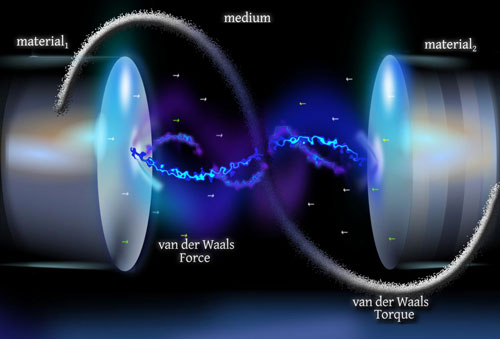
Characterizing the forces that hold everything together
Physicists have unveiled a project known as Gecko Hamaker, a new computational and modeling software tool plus an open science database to aid those who design nano-scale materials.
September 22, 2015 Read more
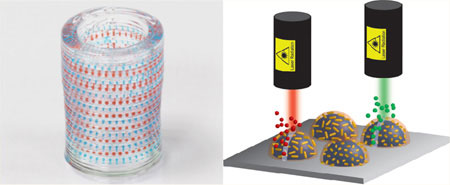
3D-printed scaffolds could enable the release biomolecules into the body with exceptional control (w/video)
Tissue development is guided by gradients of biomolecules that direct the growth, migration, and differentiation of cells. Biomedical engineers are interested in recreating these developmental gradients in adults to aid the growth of new tissue in areas that have sustained damage. Now, researchers are one step closer to this goal thanks to the creation of new 3D-printed scaffolds that enable researchers to release biomolecules into the body with exceptional control.
September 22, 2015 Read more

Pioneering research develops new way to capture light - for the computers of tomorrow
The key breakthrough will allow large quantities of data to be stored directly on an integrated optical chip, rather than being processed and stored electronically, as happens today.
September 22, 2015 Read more
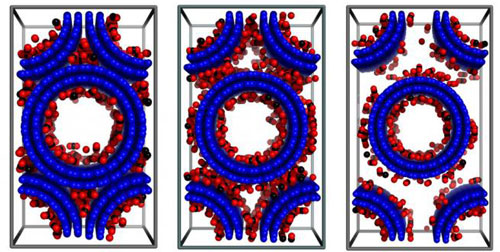
Carbon nanotubes as a trap for greenhouse gases
Vertically aligned carbon nanotubes can chemically trap and store greenhouse gases more effectively than typical adsorption materials.
September 22, 2015 Read more
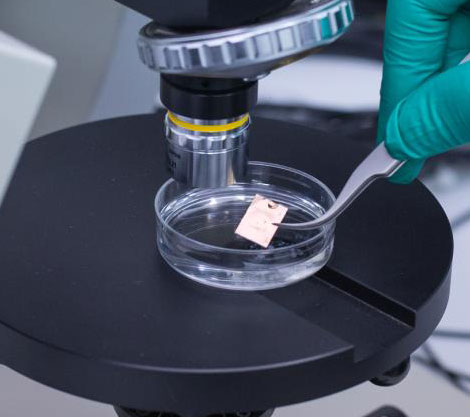
New graphene oxide biosensors may accelerate nanotechnology to cure HIV and cancer
Researchers have devised a novel type of graphene oxide-based biosensor that could potentially significantly speed up the process of drug development. The outstanding properties of this carbon allotrope help to improve significantly the biosensing sensitivity, which in future may enable the development of new drugs and vaccines against many dangerous diseases including HIV, hepatitis and cancer.
September 22, 2015 Read more
Nanoscaffolds as a modular platform for biosensor assembly
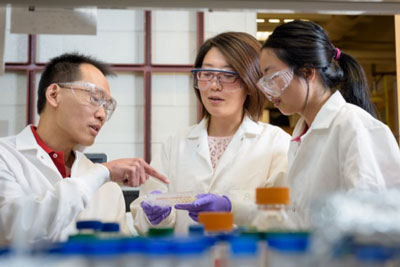
Modern nanofabrication methods have contributed to recent progress in biosensor technology, but challenges remain in developing biosensor assembly platforms that meet important preparation and performance criteria. Now, a team of researchers has developed a new approach that meets at least three of these criteria: system modularity, good signal amplification, and easy purification.
September 22, 2015 Read more
First circularly polarized light detector on a silicon chip
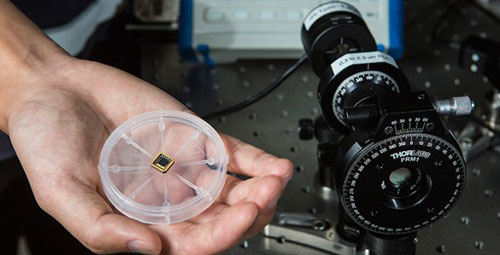
Invention of the first integrated circularly polarized light detector on a silicon chip opens the door for development of small, portable sensors that could expand the use of polarized light for drug screening, surveillance, optical communications and quantum computing, among other potential applications.
September 22, 2015 Read more
Laser pulses for ultrahigh molecular sensitivity
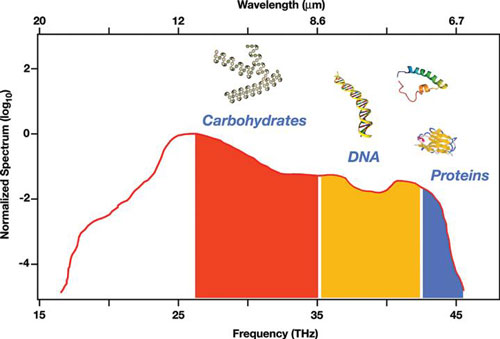
Scientists have developed a worldwide unique broadband and coherent infrared light source. The record peak brilliance of the light source makes it an ultrasensitive detector for the infrared molecular finger print region, ideal to detect minute changes in the spectral features from cells or tissue which are tell-tale signs of DNA mutation or the presence of cellular malfunctions such as cancer.
September 22, 2015 Read more
Diverse set of Turing nanopatterns coat corneae of insects
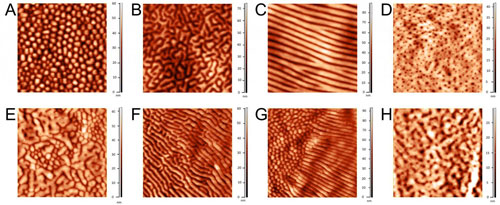
In 1952, the legendary British mathematician and cryptographer Alan Turing proposed a model, which assumes formation of complex patterns through chemical interaction of two diffusing reagents. Russian scientists managed to prove that the corneal surface nanopatterns in 23 insect orders completely fit into this model.
September 22, 2015 Read more
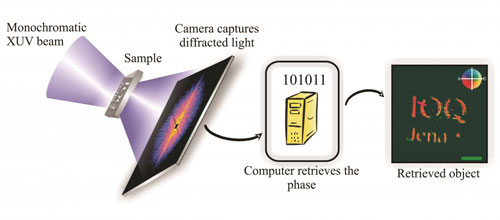
Pushing the limits of lensless imaging
Researchers describe a custom-built ultrafast laser that could help image everything from semiconductor chips to cells in real time.
September 22, 2015 Read more
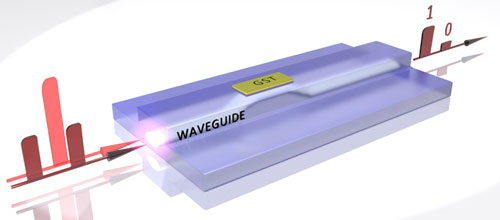
Permanent data storage with light
Researchers have developed the first all-optical permanent on-chip memory. This is an important step on the way towards optical computers.
September 22, 2015 Read more
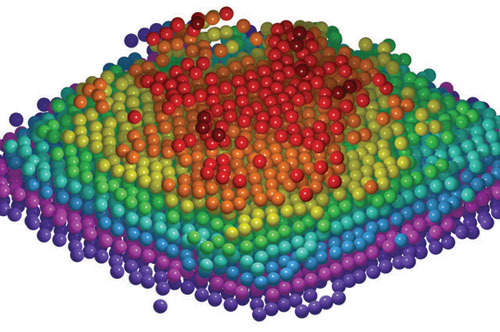
Physicists determine the three-dimensional positions of individual atoms for the first time
Scientists have used a powerful microscope to image the three-dimensional positions of individual atoms to a precision of 19 trillionths of a meter, which is several times smaller than a hydrogen atom.
September 21, 2015 Read more
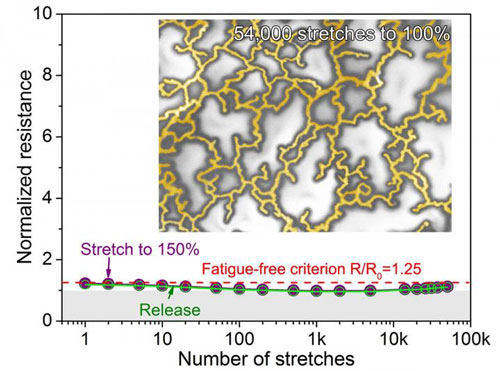
Researchers create fatigue-free, stretchable conductor
Material moves foldable electronics, new implantable medical devices a step closer.
September 21, 2015 Read more

Engineers invent transparent coating that cools solar cells to boost efficiency
The quandary: The hotter solar cells get, the less efficiently they convert sunlight to electricity; The fix: A new transparent overlay allows light to hit the cells while shunting heat away.
September 21, 2015 Read more
NNI Launches Nanotechnology Signature Initiative Webinar Series
The National Nanotechnology Coordination Office (NNCO) will host a series of webinars from October to December 2015 sponsored by Federal agencies participating in the Nanotechnology Knowledge Infrastructure (NKI) and the Nanotechnology for Sensors and Sensors for Nanotechnology (Sensors) Signature Initiatives.
September 21, 2015 Read more

A thermal invisibility cloak actively redirects heat
Researchers have rendered electronic components thermally invisible, thanks to thermoelectric modules.
September 21, 2015 Read more
 Subscribe to our Nanotechnology News feed