

Nanotechnology News – Latest Headlines
Elucidation of bandgap factors for graphene nanoelectronics
Success in actualization of missing gap and elucidation of indeterminacy factors.
September 6, 2010 Read more
'Slow light' on a chip holds promise for optical communications
A tiny optical device built into a silicon chip has achieved the slowest light propagation on a chip to date, reducing the speed of light by a factor of 1,200.
September 5, 2010 Read more
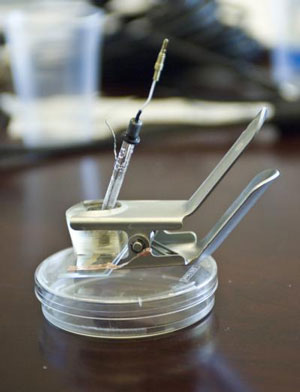
Researchers create new self-assembling photovoltaic technology that repairs itself
Molecules can turn sunlight into electricity and can be broken down and quickly reassembled.
September 5, 2010 Read more
Institute for NanoBioTechnology's international research program sends second team of students to Belgium
Johns Hopkins Institute for NanoBioTechnology supports university students to conduct research in an international setting. Their work, travel and housing expenses are funded through INBT with a National Science Foundation's International Research Experience for Students (IRES) program and through a partnership with The Inter-University MircroElectronics Centre (IMEC) in Leuven, Belgium.
September 4, 2010 Read more

Google logo shows a buckyball today
How cool is that - Google marks the discovery of the fullerene 25 years ago today, September 4, 1985, with a special Google logo on its site that includes a C60 structure.
September 4, 2010 Read more
Magnetism's subatomic roots
A new conceptual model, which was created to learn more about the quantum quirks of high-temperature superconductors and other high-tech materials, has also proven useful in describing the origins of ferromagnetism -- the everyday 'magnetism' of compass needles and refrigerator magnets.
September 3, 2010 Read more
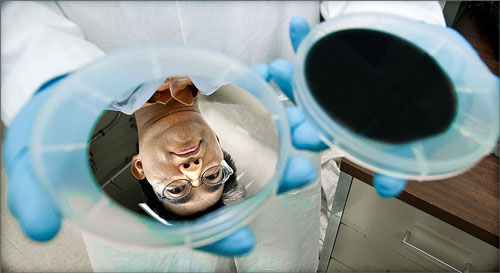
Cheaper, better solar cell Is full of holes
A new low-cost etching technique developed at the U.S. Department of Energy's National Renewable Energy Laboratory can put a trillion holes in a silicon wafer the size of a compact disc.
September 3, 2010 Read more
German Federal Institute for Risk Assessment publishes three new reports on nanotechnology
The German Federal Institute for Risk Assessment (BfR) has recently published three new reports on nanotechnology: a Delphi study on nanotechnology, a report on Perception of Nanotechnology in Internet-based Discussions, and Risk Perception of Nanotechnology - Analysis of Media Coverage.
September 3, 2010 Read more
Swiss study on nanotechnology in the food sector now available in English
The study 'Nanotechnology in the Food Sector', commissioned by the Swiss Centre for Technology Assessment TA-SWISS, is now available in English. The study provides an overview of nanomaterials already used in the food sector with a focus on the Swiss market and an analysis of the existing legal framework.
September 3, 2010 Read more
Chemists, engineers fabricate the fastest graphene transistor to date
A UCLA team, led by professor of chemistry and biochemistry Xiangfeng Duan, has developed a new fabrication process for graphene transistors using a nanowire as the self-aligned gate.
September 3, 2010 Read more
Mapping state lines
A network of filamentary conducting paths is behind the transition between insulating and conducting states in complex oxides.
September 3, 2010 Read more
Electronics from a printer - of electronic radio tags and lighting wallpapers
Glucose meters and the appropriate test strips for diabetics are expensive. This however might change, since scientists at the Institute of Printing Science and Technology (IDD) at TU Darmstadt are working on a sensor making the electronic devices considerably cheaper. The new sensor is not based on silicon as conducting material, but on plastics.
September 3, 2010 Read more
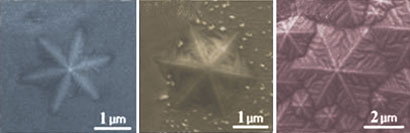
Zinc oxide snowflakes
Modelling zinc oxide nanoparticle formation could provide new insights into how snowflakes form as well as aiding nanoscale device research, say Chinese scientists.
September 3, 2010 Read more
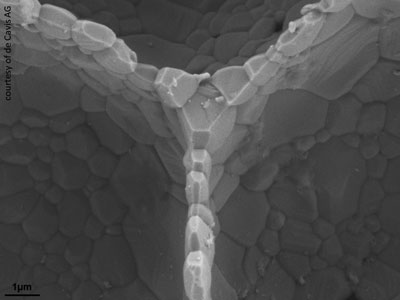
Ceramic foam for efficient thermal insulation
The Institut for Nonmetallic Inorganic Materials develops ceramic foams intended for use as energy-efficient thermal insulations in blast furnaces, as bone substitutes and for the controlled release of active ingredients in medicine.
September 3, 2010 Read more
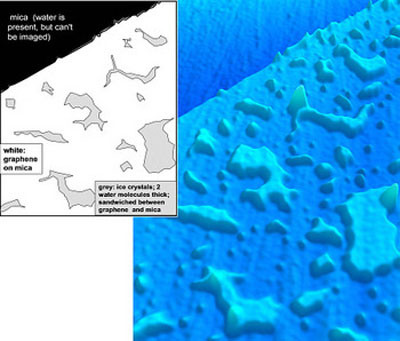
Chemists use graphene to visualize atomic-scale structures
Researchers at the California Institute of Technology (Caltech) have devised a new technique - using a sheet of carbon just one atom thick - to visualize the structure of molecules. The technique, which was used to obtain the first direct images of how water coats surfaces at room temperature, can also be used to image a potentially unlimited number of other molecules, including antibodies and other biomolecules.
September 2, 2010 Read more
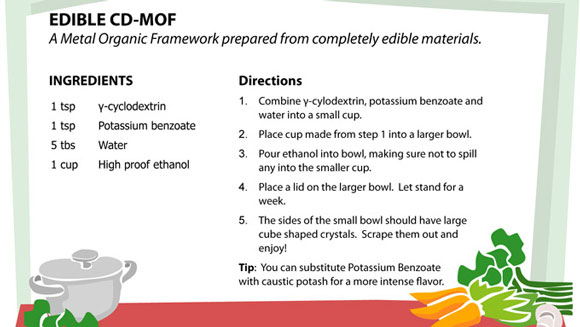
Edible nanostructures
Compounds made from renewable materials could be used for gas storage, food technologies.
September 2, 2010 Read more
 Subscribe to our Nanotechnology News feed