

Nanotechnology News – Latest Headlines
Physicists play Lego with photons
By manipulating a mysterious quantum property of light known as entanglement, researchers are able to mount up to two photons on top of one another to construct a variety of quantum states of light - that is, build two-story quantum toy houses of any style and architecture.
February 14, 2010 Read more
Seeking papers and artworks on the intersections of chemistry, nanotechnology and art
2011 is the International Year of Chemistry! To celebrate Leonardo is seeking to publish papers and artworks on the intersections of chemistry, nanotechnology and art for their on-going special section on nanotechnology and the arts.
February 14, 2010 Read more
Science at the nanoscale: An introductory textbook
This book provides a very detailed and interesting overview of the fundamental principles of nanoscience, discusses the background of several nanoscience experimental techniques, and sheds light on some of the visionary and important applications in the truly interdisciplinary area of nanotechnology.
February 14, 2010 Read more
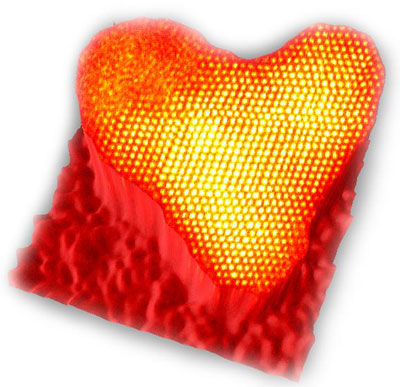
Nanotechnology Valentine's
Scientists at the University of Birmingham have made a Valentine card of pure palladium - it is only 8 nanometres in size; you can even see the atoms.
February 14, 2010 Read more
Nanoelectronic research turns light into electricity with gold molecules
Material scientists at the Nano/Bio Interface Center of the University of Pennsylvania have demonstrated the transduction of optical radiation to electrical current in a molecular circuit.
February 12, 2010 Read more
Novel sensor exploits traditional weakness of nano-devices
By taking advantage of a phenomenon that until now has been a virtual showstopper for electronics designers, a team led by Oak Ridge National Laboratory's Panos Datskos is developing a chemical and biological sensor with unprecedented sensitivity
February 12, 2010 Read more
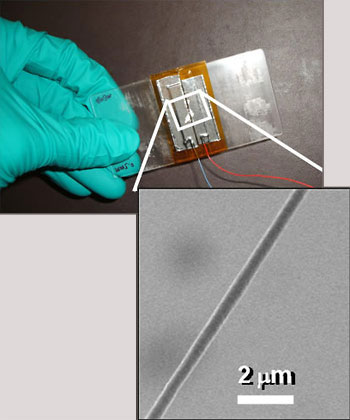
New fiber nanogenerators could lead to electric clothing
The nano-sized generators hav epiezoelectric properties that allow them to convert into electricity the energy created through mechanical stress, stretches and twists.
February 12, 2010 Read more
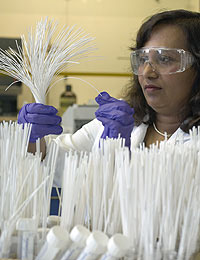
Green technology spin-out receives major funding boost
The funding will enable nano-porous solutions Ltd (n-psl), established in July 2007, to commercialise new ground-breaking nano-porous adsorbent hollow fibre technology.
February 12, 2010 Read more
Researchers envision high-tech applications for 'multiferroic' crystals
Two of The Florida State University's most accomplished scientists recently joined forces on a collaborative research project that has yielded groundbreaking results involving an unusual family of crystalline minerals. Their findings could lay the groundwork for future researchers seeking to develop a new generation of computer chips and other information-storage devices that can hold vast amounts of data and be strongly encrypted for security purposes.
February 12, 2010 Read more
In vivo engineering of organs
Scientists have developed a fast and cost-efficient method for producing sufficient amounts of bone and cartilage tissue using the body's own cells.
February 12, 2010 Read more
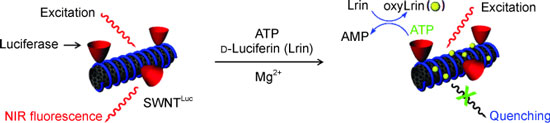
Carbon nanotube/luciferase conjugate for ATP detection in living cells
Researchers at MIT have developed a more sensitive, higher-resolution, and more robust method for the detection of ATP.
February 12, 2010 Read more
Developing materials with large specific surface areas by using single-walled carbon nanotubes
Researchers at AIST in Japan have developed a fibrous material with a specific surface area of 2240 m2/g by using single-walled carbon nanotubes. Materials with large specific surface areas are used for energy storage as electricity storage devices including capacitors. They are also used for storage, purification and separation of substances.
February 12, 2010 Read more
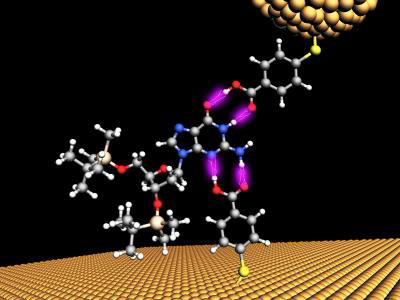
First universal DNA reader to advance faster, cheaper sequencing efforts
Arizona State University scientists have come up with a new twist in their efforts to develop a faster and cheaper way to read the DNA genetic code. They have developed the first, versatile DNA reader that can discriminate between DNA's four core chemical components - the key to unlocking the vital code behind human heredity and health.
February 11, 2010 Read more
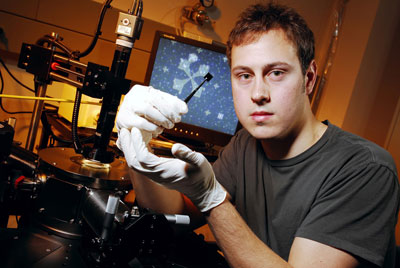
Single-step technique produces both p-type and n-type doping for future graphene devices
A simple one-step process that produces both n-type and p-type doping of large-area graphene surfaces could facilitate use of the promising material for future electronic devices. The doping technique can also be used to increase conductivity in graphene nanoribbons used for interconnects.
February 11, 2010 Read more
Synthesizing a molecule with promising semiconductor properties
A team of chemists from the University of New Hampshire has synthesized the first-ever stable derivative of nonacene, creating a compound that holds significant promise in the manufacture of flexible organic electronics such as large displays, solar cells and radio frequency identification tags.
February 11, 2010 Read more
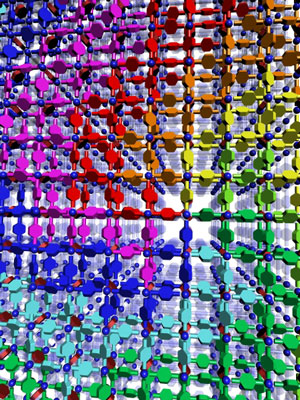
Chemists create synthetic 'gene-like' crystals for carbon dioxide capture
UCLA chemists report creating a synthetic 'gene' that could capture heat-trapping carbon dioxide emissions, which contribute to global warming, rising sea levels and the increased acidity of oceans.
February 11, 2010 Read more
 Subscribe to our Nanotechnology News feed