

Nanotechnology News – Latest Headlines
UAlbany NanoCollege and JSC Innovative Technopark in Republic of Tatarstan to Collaborate
The College of Nanoscale Science and Engineering (CNSE) and the JSC Innovative Technopark (IDEA) in the Republic of Tatarstan today signed a Memorandum of Understanding to establish a framework for collaboration in nanotechnology education, research and commercialization.
January 28, 2010 Read more
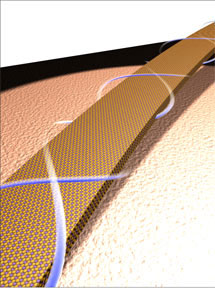
Decorated with electric current, nanoribbons align with expectations
A bizarre substance predicted to shrink electronics and give quantum physicists a new tabletop toy behaves pretty much as its designers expected.
January 28, 2010 Read more
Graphene specialist Jeanie Lau receives national honor at White House
Lau is a recipient of the 2009 Presidential Early Career Award for Scientists and Engineers.
January 27, 2010 Read more
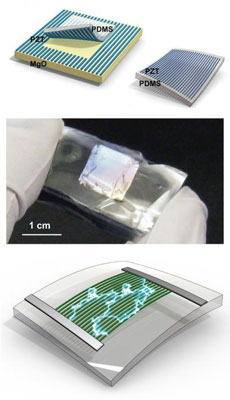
Energy-harvesting rubber sheets could power pacemakers, mobile phones
The material, composed of ceramic nanoribbons embedded onto silicone rubber sheets, generates electricity when flexed and is highly efficient at converting mechanical energy to electrical energy.
January 27, 2010 Read more
Blood proteins may hold key to developing instruments for rapid detection of radiation dose
To develop a fast, cheap and accurate technology for determining the level of radiation exposure victims might suffer in a nuclear incident, Stanford is leading a new federally funded consortium of academic, government and industry researchers.
January 27, 2010 Read more
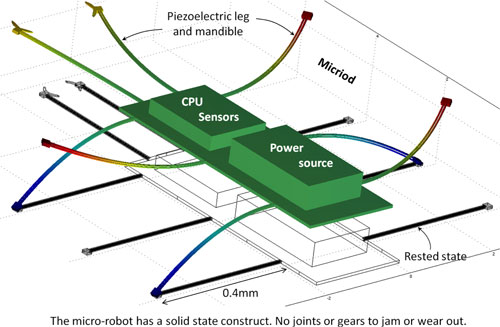
Insectlike 'microids' might walk, run, work in colonies
A new approach in the design of miniature, insectlike robots could lead to 'microids' the size of ants that move their tiny legs and mandibles using solid-state 'muscles'.
January 27, 2010 Read more
Review of key developments in 2009 in nanotechnology safety research
In its first feature article of 2010, SAFENANO provides a summary of key nanoEHS developments from 2009, and considers how these are likely to shape 2010 in nano.
January 27, 2010 Read more
Researchers develop new nanomedicine tool for gene delivery
The tool, a peptide called PEG-POD, provides a vehicle for therapeutic genes and may help researchers develop therapies for degenerative eye disorders such as retinitis pigmentosa and age-related macular degeneration.
January 27, 2010 Read more
Stopping bacterial infections with biochemical 'nanofactories' instead of antibiotics
New research at the A. James Clark School of Engineering could prevent bacterial infections using tiny biochemical machines that can confuse bacteria and stop them from spreading, without the use of antibiotics.
January 27, 2010 Read more
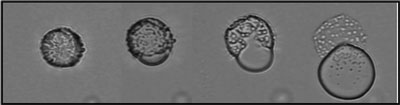
Smart capsules that release their contents at a selected temperature
How can an active principle be delivered in a controlled way? Until now, there was no obvious answer to this question. Now however, researchers at the CNRS Paul Pascal Research Center in Bordeaux have designed smart capsules that are able to release their contents on demand, simply by raising the temperature.
January 27, 2010 Read more
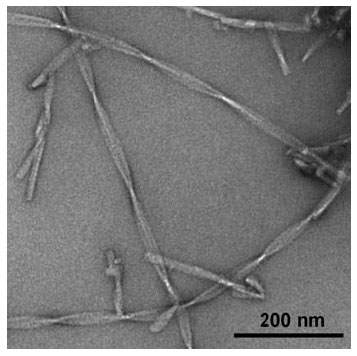
Electron microscopic examination of Alzheimer's amyloid fibrils
Flash frozen under the electron microscope: examining the mechanical properties of Alzheimer's amyloid fibrils.
January 27, 2010 Read more
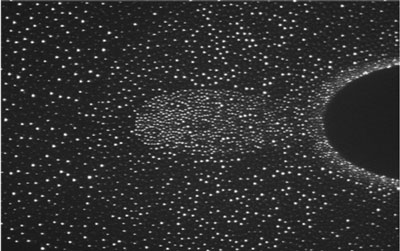
Plasma Experiment celebrates Max-Planck-Institute anniversary on board ISS
On 27th January 2010 the 25th series of experiments studying complex plasmas will start on board the international space station ISS. Physicists from the Max-Planck-Institute for extraterrestrial Physics in Garching, Germany, will use them to study fundamental structure forming processes to better understand what happens in liquids and solids.
January 27, 2010 Read more
Micromeritics introduces materials characterization webinar series
In 2010 Micromeritics will begin presenting a series of webinars that will highlight applications, theory, and instrumentation for a variety of materials characterization techniques.
January 27, 2010 Read more
Supercomputing time awarded to design transformational lithium air battery
The Department of Energy announced today that 24 million hours of supercomputing time out of a total of 1.6 billion available hours at Argonne and Oak Ridge National Laboratories have been awarded to investigate materials for developing lithium air batteries, capable of powering a car for 500 miles on a single charge.
January 26, 2010 Read more
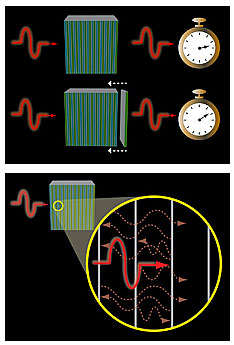
Single photons observed at seemingly faster-than-light speeds
Researchers at the Joint Quantum Institute (JQI), a collaboration of the National Institute of Standards and Technology and the University of Maryland at College Park, can speed up photons (particles of light) to seemingly faster-than-light speeds through a stack of materials by adding a single, strategically placed layer.
January 26, 2010 Read more
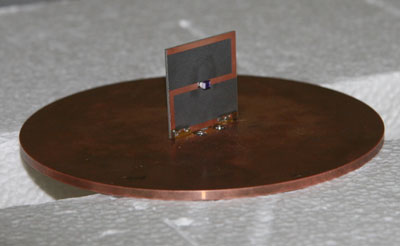
Engineered metamaterials enable remarkably small antennas
In an advance that might interest Q-Branch, the gadget makers for James Bond, the National Institute of Standards and Technology (NIST) and partners from industry and academia have designed and tested experimental antennas that are highly efficient and yet a fraction of the size of standard antenna systems with comparable properties.
January 26, 2010 Read more
 Subscribe to our Nanotechnology News feed