

Nanotechnology News – Latest Headlines
Modelling the nano-devices of the future
Modelling the fabrication processes for integrated circuits can slash production development time and costs by up to 40%. But as transistors, already at nano-scales, become ever smaller, researchers are modelling new worlds.
August 8, 2009 Read more
Holley to operate UALR's Nanotechnology Center
After more than 20 years with the Arkansas Small Business and Technology Development Center, Mildred Holley, manager of technology programs at the Arkansas Small Business Technology Development Center, is the new operations director of the University of Arkansas at Little Rock?s Nanotechnology Center.
August 7, 2009 Read more
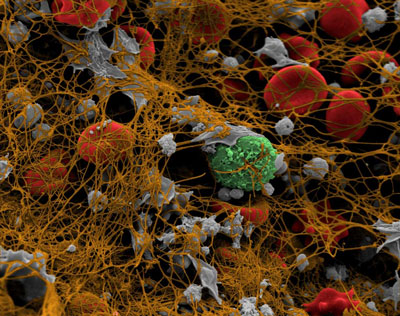
Protein unfolding is key for understanding blood clot mechanics
Fibrin, the chief ingredient of blood clots, is a remarkably versatile polymer. On one hand, it forms a network of fibers -- a blood clot -- that stems the loss of blood at an injury site while remaining pliable and flexible. On the other hand, fibrin provides a scaffold for thrombi, clots that block blood vessels and cause tissue damage, leading to cardiovascular disease. The answer is a process known as protein unfolding.
August 7, 2009 Read more
Carbon nanoparticles toxic to older fruit flies, not to young
In a series of experiments, researchers at Brown University sought to determine how carbon nanoparticles would affect fruit flies - from the very young to adults.
August 7, 2009 Read more
Japan rebuilds for the upturn - Exhibition Micromachine/MEMS in Tokyo sets signals for Green MEMS
Topics dealing with cost savings or subjects like 'Green MEMS' were popular in Tokyo. The fusion of microsystems technology with bio- and nanotechnology to hetero-functional, integrated devices is in focus of Japanese companies and institutes.
August 7, 2009 Read more
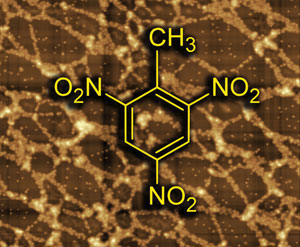
Nanoparticles take on terrorism
Chinese scientists have used sunlight and DNA to make bimetallic nanoparticles that can detect tiny amounts of explosives.
August 7, 2009 Read more
Neue Werkzeuge mit DNA
Wissenschaftler der TU Muenchen und der Harvard University haben neue Werkzeuge entwickelt, um aus kurzen DNA-Molekuelen Strukturen mit komplexen Windungen und Kruemmungen zu formen.
August 7, 2009 Read more

First time observation of 'strong coupling' between light and a micromechanical object
Physicists at the Institute for Quantum Optics and Quantum Information (IQOQI) in Vienna and Innsbruck, Austria, have created an interaction between light and a micromechanical resonator that is strong enough to transfer quantum effects.
August 7, 2009 Read more
Registration for 2009 UK NanoForum now open
In its fourth year running, this year's annual UK NanoForum and Emerging Technologies 2009 comprises a two-day conference and exhibition bringing over 100 senior international delegates and 350 UK delegates together to network and identify potential business and collaboration opportunities.
August 7, 2009 Read more

New MOCVD reactor sparks the beginning of a new nanofabrication research center
A dedicated laboratory space on the UC Riverside campus moves Bourns College of Engineering another step closer to a more comprehensive nanoengineering center. The space at Pierce Hall is now home to an advanced metal, organic, chemical, vapor, deposition (MOCVD) reactor.
August 7, 2009 Read more
New possibilities for bottom-up nanotechnology with DNA on gold nanoparticles
Researchers from RIKEN Advanced Science Institute in Wako have developed a method to immobilize oligonucleotides on gold nanoparticle surfaces with precise control over their number and geometric arrangement.
August 7, 2009 Read more
Medical expert will coordinate a new CNSE initiative on nanotechnology in health and safety applications
The College of Nanoscale Science and Engineering of the University at Albany announced today that it has selected an accomplished physician to head a next-generation NanoHealth initiative that will focus on education, research, and deployment of nanotechnology enabled improvements in occupational, public, and environmental health and safety.
August 6, 2009 Read more
Laboratory experiments and theoretical research aimed at reducing the Casimir force between nano-objects
To study the Casimir force, UC Riverside physicists have received funding of $1.6 million for two years from DARPA and SPAWAR.
August 6, 2009 Read more
Nanoscale origami from DNA: Researchers develop a new toolbox for nano-engineering
Scientists at the Technische Universitaet Muenchen (TUM) and Harvard University have thrown the lid off a new toolbox for building nanoscale structures out of DNA, with complex twisting and curving shapes.
August 6, 2009 Read more
Sustained quantum information processing a step toward building quantum computers
Raising prospects for building a practical quantum computer, physicists at the National Institute of Standards and Technology (NIST) have demonstrated sustained, reliable information processing operations on electrically charged atoms (ions).
August 6, 2009 Read more
DOE awards $377 million in funding for 46 energy frontier research centers
In a major effort to accelerate the scientific breakthroughs needed to build a new 21st-century energy economy, U.S. Energy Secretary Steven Chu announced the delivery of $377 million in funding for 46 new multi-million-dollar Energy Frontier Research Centers (EFRCs) located at universities, national laboratories, nonprofit organizations, and private firms across the nation.
August 6, 2009 Read more
 Subscribe to our Nanotechnology News feed