

Nanotechnology News – Latest Headlines
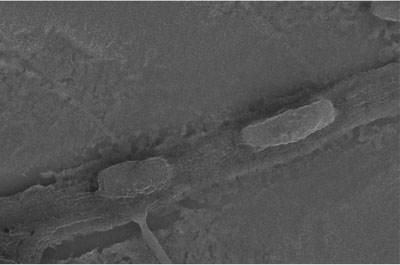
New bio-hybrid materials could be used as sensors, catalysts, drug-delivery systems, more
Researchers have devised a way to encapsulate bacteria in a synthetic polymer hydrogel. These new, stable, bio-hybrid materials maintain the microbes' ability to exchange nutrients and metabolic products with their environment, and could find widespread applications, for example, as biosensors, catalysts, drug-delivery systems, or in wastewater treatment
August 3, 2009 Read more
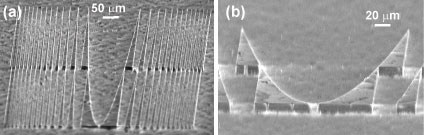
Sculpting an intricate x-ray focusing lens out of diamond
This new technique could prove extremely valuable in the study of nanomaterials at future synchrotron light sources.
August 3, 2009 Read more
European Commission launches six new FP7 calls in nanotechnology
On July 30, 2009, the European Commission has launched six new FP7 calls in Theme 4 NMP 'Nanosciences, Nanotechnologies, Materials and new Production Technologies'.
August 3, 2009 Read more
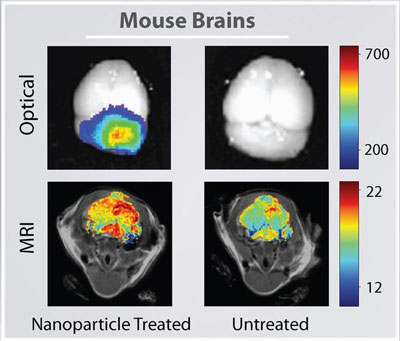
Nanoparticles cross blood-brain barrier to 'paint' brain tumors
Researchers have been able to illuminate brain tumors by injecting fluorescent nanoparticles into the bloodstream. The tiny particles can safely cross the blood-brain barrier, an almost impenetrable barrier that protects the brain from infection.
August 3, 2009 Read more
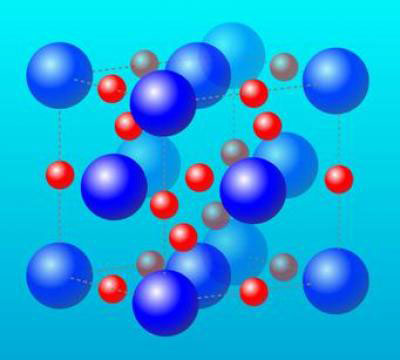
On the path to metallic hydrogen
Hydrogen, the most common element in the universe, is normally an insulating gas, but at high pressures it may turn into a superconductor. Now, scientists at the Carnegie Institution in Washington D.C., US, have discovered a hydrogen-based compound that could be helpful in the search for metallic and superconducting forms of hydrogen.
August 3, 2009 Read more

A code without restrictions for the fragile realm of quantum
The future of quantum computing depends on engineers being able to develop quantum error-correction codes that allow quantum devices to compute reliably in a world so fragile that information is destroyed or altered as soon as it is measured or read.
August 3, 2009 Read more
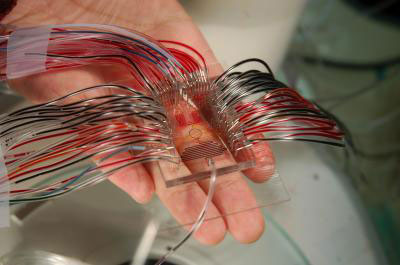
New microchip technology may accelerate drug discovery for cancer, other diseases
UCLA researchers have developed technology to perform more than a thousand chemical reactions at once on a stamp-size, PC-controlled microchip, which could accelerate the identification of potential drug candidates for treating diseases like cancer.
August 3, 2009 Read more
New technique eliminates grain boundary defects in zeolite membranes
Thin-film zeolite membranes with tiny, molecule-sized pores are one step closer to replacing the energy-intensive processes now used in industrial separations, a group of academic researchers is reporting.
August 3, 2009 Read more
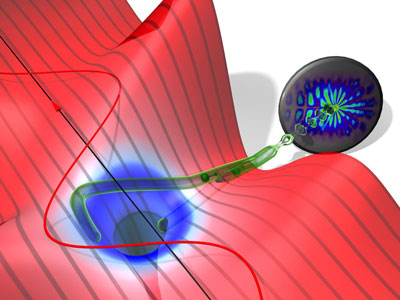
Investigating helium atom with electron holography
Researchers of the Max Planck Institutes for Nuclear Physics and Quantum Optics investigate for the first time helium atoms by means of electron holography in ultra-short laser pulses.
August 3, 2009 Read more
Smallest electric motor runs on only two atoms
The principle is easy: one starter and one motor atom in a ring of laser light - and a bit of fine tuning, in order to move always into the right direction.
August 3, 2009 Read more
UAlbany NanoCollege to host National Conference on Nanoscale Science and Engineering Education
The College of Nanoscale Science and Engineering of the University at Albany, in partnership with the National Center for Learning and Teaching in Nanoscale Science and Engineering headquartered at Northwestern University, will host a national conference this week to assess the current state of nanoscale science and engineering education and chart a course for the future.
August 3, 2009 Read more
International SEMATECH Manufacturing Initiative announces keynote speaker lineup for 6th Annual Symposium
Recognized leaders to discuss state of the economy and growth opportunities at leading conference for manufacturers.
August 3, 2009 Read more
Nanomedicine researchers effectively treat tumors with use of carbon nanotubes
By injecting man-made, microscopic tubes into tumors and heating them with a quick, 30-second zap of a laser, scientists have discovered a way to effectively kill kidney tumors in nearly 80 percent of mice.
August 3, 2009 Read more
DNA computing gets more 'user friendly'
The world's smallest computers, made of DNA and other biological molecules, just got more 'user friendly' thanks to research at the Weizmann Institute of Science.
August 3, 2009 Read more
Synthetic biology - opportunities and risks
The new research field of synthetic biology will, in the medium term, open up a great deal of potential for combining novel genetic methods with engineering principles.
August 3, 2009 Read more
University College London forges new research links with China in nanospintronics
The London Centre for Nanotechnology - a joint venture between UCL and Imperial College London - is taking a strategic lead in the emerging field of nanospintronics, by initiating collaborative projects with research groups at China's top two universities, Peking University and Tsinghua University.
August 3, 2009 Read more
 Subscribe to our Nanotechnology News feed