

Nanotechnology News – Latest Headlines
Governance of research and reforms in the German research system
What is the effect of the current reforms on the German research system? How should sustainable reforms be designed? For five years now the research group 'Governance of Research' has been examining these questions.
September 16, 2008 Read more
Potential problems with using carbon nanotubes as interconnects
Researchers at the University of Surrey's Advanced Technology Institute (UK) have used scanning tunnelling microscopy to confirm remarkable changes in the fundamental electronic behaviour when double-walled carbon nanotubes are subject to radial deformations and torsional strain.
September 16, 2008 Read more
Graphene shows promise of storing large quantities of renewable electrical energy
Engineers and scientists at The University of Texas at Austin have achieved a breakthrough in the use of a one-atom thick structure called graphene as a new carbon-based material for storing electrical charge in ultracapacitor devices, perhaps paving the way for the massive installation of renewable energies such as wind and solar power.
September 16, 2008 Read more
Carbon nanotube coating improves electrical stimulation therapy
Researchers at UT Southwestern Medical Center have designed a way to improve electrical stimulation of nerves by outfitting electrodes with the latest in chemically engineered fashion: a coating of basic black, formed from carbon nanotubes.
September 16, 2008 Read more
Wie funktioniert Nano?
Saarbruecker Kompetenzzentren veranstalten einwoechigen Kurs "Chemische Nanotechnologie".
September 16, 2008 Read more
Practical Guide to EU funding opportunities for Research and Innovation
In the multifaceted field of EU funding, this guide is intended to help stakeholders find the right funding program for their projects in a user-friendly and comprehensive way.
September 15, 2008 Read more
Nanotechnology teams up with a decades-old drug to beat atherosclerosis
Scientists have found that drug-laced nanoparticles plus a statin could stop the growth of tiny blood vessels that feed arterial plaques.
September 15, 2008 Read more
Carbon nanotube composites bring bio-mimicking artificial muscles, skin closer
Jonghwan Suhr at the University of Nevada says his study of continuous reinforced carbon nanotube composites brings him a step closer to his hope of bio-mimicking artificial muscles or skins, which can be applied to a wide variety of fields.
September 15, 2008 Read more
Nanomedical approach targets multiple cancer genes, shrinks tumors more effectively
Nanoparticles filled with a drug that targets two genes that trigger melanoma could offer a potential cure for this deadly disease, according to cancer researchers.
September 15, 2008 Read more
Nanotechnology used in making solar control window films
Advanced ceramics have been used by NASA to thermally protect the Space Shuttle Orbiter. Now, due to nanotechnology, they are being used by window film suppliers in the manufacture of solar control window film.
September 15, 2008 Read more
Microbiological treatment can remove selenium nanoparticles from environment
A new study funded by the European Union has demonstrated that unsafe levels of selenium, sometimes referred to as an 'essential toxin', can be reduced by a microbiological treatment
September 15, 2008 Read more
Experiments confirm calculations of the ideal strength of graphene
The ideal strength refers to the highest achievable strength of a defect-free crystal at 0 K. It is a crucial theoretical parameter because it plays a critical role in characterizing the nature of chemical bonding of the crystal.
September 15, 2008 Read more
New findings on how cancer cells develop chemotherapy drug resistance
Researchers have shown that increased expression of a gene called SIRT1 in cancer cells plays a significant role in the development of resistance to the chemotherapy drug cisplatin.
September 15, 2008 Read more
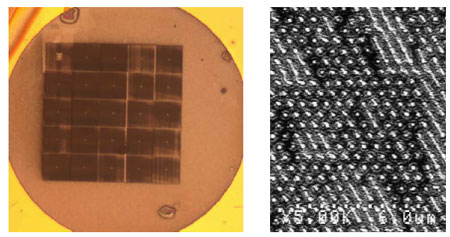
Cientificos espanoles patentan una celula solar un 30% mas eficiente
Un equipo de investigadores del Consejo Superior de Investigaciones Cienificas (CSIC) ha patentado un nuevo tipo de celula solar cuya eficiencia es hasta un 30% superior a las celulas solares convencionales.
September 15, 2008 Read more
Brandeis is smallest university to join elite group of universities with a materials research center
Brandeis University has won a highly competitive $7.8 million grant from the National Science Foundation to establish a Materials Research Science and Engineering Center (MRSEC).
September 15, 2008 Read more
First three-dimensional synchronization circuitry runs at 1.4 gigahertz
The next major advance in computer processors will likely be the move from today's two-dimensional chips to three-dimensional circuits, and the first three-dimensional synchronization circuitry is now running at 1.4 gigahertz at the University of Rochester.
September 15, 2008 Read more
 Subscribe to our Nanotechnology News feed