

Nanotechnology News – Latest Headlines
Austin IEEE Wireless Conference focuses on the impact of emerging device technology
Dr. Walt Trybula, director of the Nanomaterials Application Center at Texas State University, will lead off the Friday sessions with a presentation on the impact of nanotechnology in low-cost hive networks.
July 29, 2008 Read more
Nanoparticles + light = dead tumor cells
Medical physicists at the University of Virginia have created a novel way to kill tumor cells using nanoparticles and light.
July 29, 2008 Read more
German report proposes policy options for converging technologies including nanotechnology
The Office of Technology Assessment at the German Parliament (TAB) just released an English summary to a recent report on Converging Technologies.
July 29, 2008 Read more
Nanoforum and bioforum - the annual meetings for science and business in Italy
Nanoforum will take place on September 17-18 and Bioforum on October 1-2, both in Milan, Italy.
July 29, 2008 Read more
PhD positions in micro- and nanoengineering in Ireland
An ICGEE scholarship of ?24,000 per year over 4 years will be offered to all successful applicants to include a stipend (?16,000), travel and the equivalent of an EU Higher Education Institution fee.
July 29, 2008 Read more
OECD issues final report for nanotechnology standards workshop
The International Workshop on Documentary Standards for Measurement and Characterisation in Nanotechnologies was held February 26-28, 2008 at the National Institute of Standards and Technology, Gaithersburg (USA), in co-ordination with ISO, IEC, NIST and the OECD. The participants discussed the development, efficacy, harmonisation and uptake of documentary standards broadly relevant to the field of measurement and characterisation for nanotechnologies.
July 28, 2008 Read more
'Nanoblades' simplify assembly of magnets used in many advanced weapon systems
Ultra-strong, high-temperature, high-performance permanent magnet compounds, such as Samarium Cobalt, are the mainstay materials for several industries that rely on high-performance motor and power generation applications, including the Department of Defense (DOD) and the automotive industry. Until now, producing Samarium Cobalt has been a difficult and expensive multi-step process. Northeastern University researchers have broken new ground with an innovative invention of a rapid, high-volume and cost-effective one-step method for producing pure Samarium Cobalt rare earth permanent magnet materials.
July 28, 2008 Read more
Local officials move toward monitoring nanotechnologies
Massachusetts city health officials urge adoption of unique voluntary program.
July 28, 2008 Read more
New Pennsylvania Advanced Textile Research and Innovation Center will focus on nanofiber technology
The Pennsylvania Department of Community and Economic Development (DCED) through the Ben Franklin Technology Development Authority awarded $1,255,500 to Philadelphia University to establish the Pennsylvania Advanced Textile Research and Innovation Center (PATRIC).
July 28, 2008 Read more
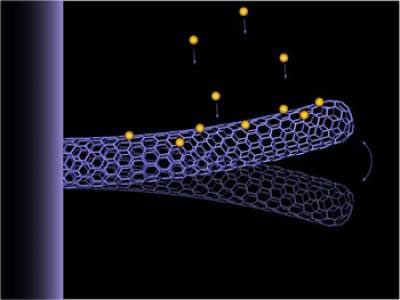
Golden scales
Using the same technology with which they created the world's first fully functional nanotube radio, researchers with Berkeley Lab and the University of California (UC) at Berkeley have fashioned a nanoelectromechanical system (NEMS) that can function as a scale sensitive enough to measure the mass of a single atom of gold.
July 28, 2008 Read more
Scaling down to diamond quantum electronics
La Trobe physicist Chris Pakes is aiming to scale the technology down further into the realm of quantum physics. He and co-researchers are talking about one-dimensional nano-wires and individual atoms performing the tasks of transistors, not using silicon, but diamond.
July 28, 2008 Read more
NanoKTN launches HiPerNano focus group
This new venture will raise awareness and promote developments in nanomaterials for the high performance engineering industry. Members of the HiPerNano group have the opportunity to discuss materials challenges and developments with end-users and industry professionals.
July 28, 2008 Read more
EPA Nanotechnology Voluntary Program risks becoming a 'black hole'
Six months after launching its voluntary reporting program for nanomaterial producers, EPA has made virtually no information public about the limited number of submissions it has received.
July 28, 2008 Read more
ACS National Meeting Aug. 17-21 offers bounty of news and features
Thousands of scientists from around the world will gather in Philadelphia, PA, August 17-21 to report new discoveries in medicine, energy, environment, food science, and other fields that involve chemistry during the 236th National Meeting & Exposition of the American Chemical Society (ACS).
July 28, 2008 Read more
Future challenges in the nanotechnology food and packaging sector
The packaging sector offers the potential for a variety of nanotechnology applications. Among others, the ethically and economically wasteful use of food could be reduced by increasing its self life.
July 28, 2008 Read more
Report urges Cambridge not to enact nanoparticle regulations
The City of Cambridge should not enact an ordinance to regulate the use of nanoparticles, according to a report to be released today by the city's public health department.
July 28, 2008 Read more
 Subscribe to our Nanotechnology News feed