

Nanotechnology News – Latest Headlines

DNAzymes - how active DNA molecules with therapeutic potential work
DNAzymes are precision biocatalysts that destroy unwanted RNA molecules. However, major obstacles to their use in medicine remain. Scientists have now investigated with atomic resolution how DNAzymes work in real time.
December 22, 2021 Read more

Integrated photonics meets electron microscopy
In a new study, researchers have successfully demonstrated extremely efficient electron beam modulation using integrated photonic microresonators.
December 22, 2021 Read more

New technique tunes into graphene nanoribbons' electronic potential
Breakthrough could lead to high-speed, low-power nanoscale data storage.
December 22, 2021 Read more

New graphene-based neural probes improve detection of epileptic brain signals
A new study shows that flexible brain probes made of graphene micro-transistors can be used to record pathological brain signals associated with epilepsy with excellent fidelity and high spatial resolution.
December 22, 2021 Read more

Solids with special symmetries for quantum and spintronics applications
Physicists have made an important advance in the development of novel materials for spintronics components. These materials may also be the key to quantum computers that are less susceptible to interference.
December 22, 2021 Read more
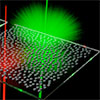
Miniaturization of optical diffusers based on silicon nanoparticles
To overcome the bulkiness of conventional optical diffusers, researchers have applied a layer of specifically designed silicon nanoparticles to a substrate and arranged the particles in a disordered, but carefully planned manner.
December 22, 2021 Read more
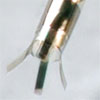
World's smallest microelectronic catheter for minimally invasive surgery of the future
Researchers present a completely new type of biomedical tool with a tiny biocompatible, microelectronic micro-catheter equipped with sensor and actuator functions.
December 22, 2021 Read more

Machine learning models quantum devices
A novel algorithm allows for efficient and accurate verification of quantum devices.
December 22, 2021 Read more

Trapping vortices in thin superfluid films
Physicists have shed light upon how tiny whirlpools (vortices) get stuck to obstacles in superfluids.
December 22, 2021 Read more

Birds' dazzling iridescence tied to nanoscale tweak of feather structure
This insight could help researchers understand how and when iridescence first evolved in birds, as well as inspire the development of new materials that can capture or manipulate light.
December 21, 2021 Read more

A new platform for controlled design of printed electronics with 2D materials
Scientists have shown how electricity is transported in printed 2D materials, paving the way for design of flexible devices for healthcare and beyond.
December 21, 2021 Read more

Sensor based on quantum physics could detect SARS-CoV-2 virus
Mathematical simulations show the new approach may offer faster, cheaper, and more accurate detection, including identifying new variants.
December 21, 2021 Read more

Creating invisibility with superconducting materials
A new simulation shows that a unique 2D superconducting material could make light-bending devices cheaper and easier to produce.
December 21, 2021 Read more
Biosensors using carbon nanotube field-effect transistors show great promise
Electrolyte-gated carbon nanotube field-effect transistor biosensors detect a wide range of biomolecules but have a few challenges to overcome.
December 21, 2021 Read more

DNA-FAIRYLIGHTS: Decorating DNA sequences with colourful nano-light for improving data storage
The DNA-FAIRYLIGHTS project aims to lift the digital data storage onto a new level by increasing the binary zero/one concept to the broad spectrum of different colours, where multiple colours integrated in the DNA sequence can encode information in a more compact fashion.
December 21, 2021 Read more

Developing the next generation of artificial vision aids
Researchers discovered that injecting elements of the soft metal, indium, into a two-dimensional material called molybdenum disulphide, could improve electrical conductivity and reduce power consumption of the optical synapses used in the development of bionic eyes.
December 21, 2021 Read more
 Subscribe to our Nanotechnology News feed