

Nanotechnology News – Latest Headlines
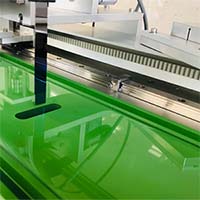
Ion-selective smart porous membranes
A research group has developed an ion-selective smart porous membrane that can respond to outer stimuli, potentially paving the way for new applications in molecular separation and sensing applications.
May 13, 2021 Read more

An atomically precise graphene nanoribbon heterojunction sensor
Researchers have succeeded for the first time in connecting several atomically precise nanoribbons made of graphene, a modification of carbon, to form complex structures.
May 12, 2021 Read more
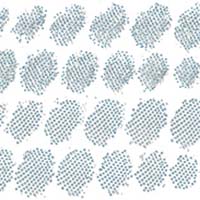
Observing individual atoms in 3D nanomaterials and their surfaces
Researchers observed the 3D atomic structure of a nanoparticle at the atom level via neural network-assisted atomic electron tomography.
May 12, 2021 Read more
Self-healing gels could power future electronics
Ion-conducting gels that repair themselves following damage are under development for wearable electronics.
May 12, 2021 Read more

Manufacturing electronic circuits made easy with one-step printing
A new printing method can make fabricating integrated circuits and other tiny devices easier and cheaper. The approach overcomes issues in conventional micro-manufacturing processes, which require multiple steps, advanced equipment and highly trained personnel, and are prone to errors.
May 12, 2021 Read more

Putting a spin on Heusler alloys
Heusler alloys are promising contenders for faster and more energy-efficient computing and memory storage devices.
May 12, 2021 Read more

Scientists create a new type of intelligent material
Researchers have created a new class of intelligent materials. It has the structure of a two-dimensional material, but behaves like an electrolyte - and could be a new way to deliver drugs within the body.
May 12, 2021 Read more
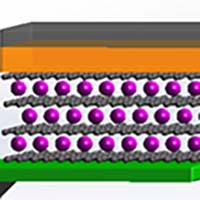
Scaling down ionic transistors to the ultimate limit
Researchers have developed an atomic-scale ion transistor based on electrically gated graphene channels of around 3 angstrom width which demonstrated highly selective ion transport. They also found that ions move a hundred times faster in such a tiny channel than they do in bulk water.
May 12, 2021 Read more

Bringing the green revolution to electronics
From biomemory to implants, researchers are looking for ways to make more eco-friendly electronic components.
May 12, 2021 Read more
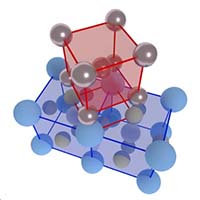
Harnessing the hum of fluorescent lights for more efficient computing
The property that makes fluorescent lights buzz could power a new generation of more efficient computing devices that store data with magnetic fields, rather than electricity.
May 12, 2021 Read more

Physicists refute brand new physics of superconducting metals
Scientists have demonstrated that other physicists' recent 'discovery' of the field effect in superconductors is nothing but hot electrons after all.
May 12, 2021 Read more
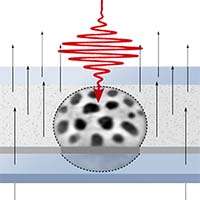
Shaken, not stirred: Reshuffling skyrmions ultrafast
Scientists investigated in detail how laser-based creation and annihilation of skyrmions can be controlled to promote application of the process in devices.
May 12, 2021 Read more

Remarkably fast engine that taps into a new kind of fuel - information
The development of this engine, which converts the random jiggling of a microscopic particle into stored energy, could lead to significant advances in the speed and cost of computers and bio-nanotechnologies.
May 12, 2021 Read more
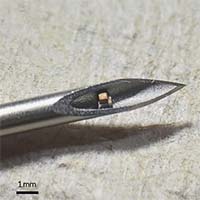
Tiny, wireless, injectable chips use ultrasound to monitor body processes
Engineers develop the smallest single-chip system that is a complete functioning electronic circuit; implantable chips visible only in a microscope point the way to developing chips that can be injected into the body with a hypodermic needle.
May 12, 2021 Read more
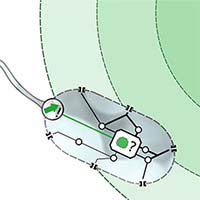
Reaching your life goals as a single-celled organism
How do simple creatures manage to move to a specific place? Artificial intelligence and a physical model can now explain this.
May 11, 2021 Read more

Electromagnetic levitation whips nanomaterials into shape
To deliver reliable mechanical and electric properties, nanomaterials must have consistent, predictable shapes and surfaces, as well as scalable production techniques. Engineers are solving this problem by vaporizing metals within a magnetic field to direct the reassembly of metal atoms into predictable shapes.
May 11, 2021 Read more
 Subscribe to our Nanotechnology News feed