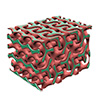
Researchers have created ultra-porous, lightweight polymer nanostructures with the highest surface area to date, enabling advances in catalysis, energy and optics.
The first self-powered programmable metasurfaces for wireless communications harvest ambient energy, adaptively tuning signals without external power cords.
A trailblazing metasurface computer architecture solves intricate matrix equations orders of magnitude faster than conventional processors by performing complex math intrinsically using scattered light waves.
Researchers design novel meta-atoms with tailored responses that enable nearly ideal transparency customizable to arbitrary shapes across the electromagnetic spectrum.
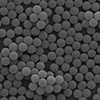
Researchers have developed a dramatically faster, simpler nanoparticle assembly technique using an ultrasonic spray nozzle to generate a nanoparticle-laden aerosol. This facilitates rapid fabrication of highly ordered nanoparticle monolayers over large surface areas, unlocking applications from flexible electronics to next-gen solar cells.
Resonance-based sensors can be used as an advanced tool for gas sensing as they show several advantages as compared to conventional gas sensors like metal-oxide semiconductor and electro-chemical gas sensors. With the introduction of an additional metamaterial layer over the sensor, the selectivity of these sensors can be improved. These article focuses mainly on metamaterial-based split ring resonators (SRR) and complementary SRRs (CSRRs) structures used in several sensing applications.