

Spin Hall Effect: Definition, Mechanism, Materials and Applications
What is the Spin Hall Effect?
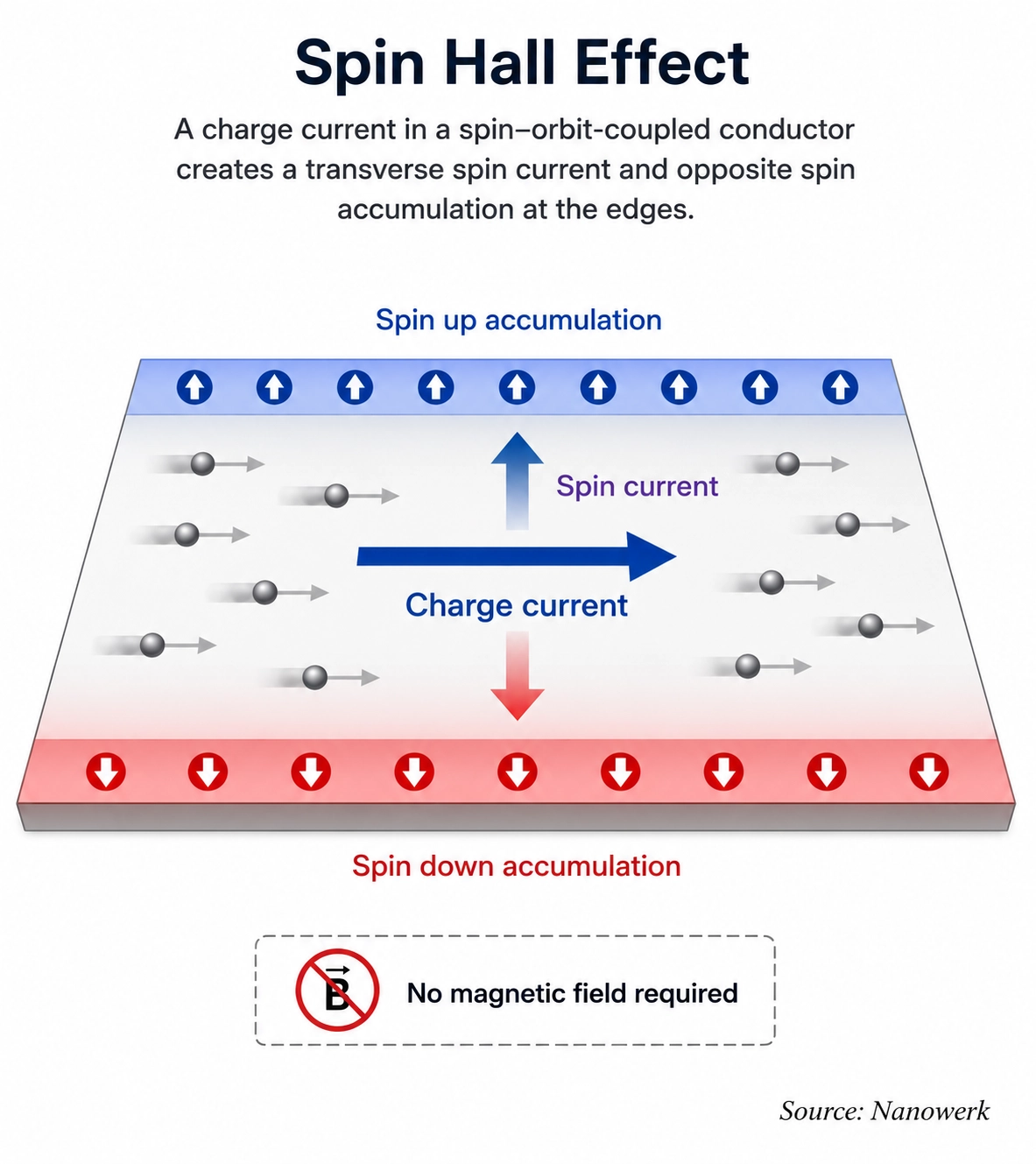
In one sentence: The spin Hall effect is a phenomenon in which an ordinary electric current flowing through a non-magnetic conductor with strong spin-orbit coupling creates a sideways spin current, causing opposite spin orientations to accumulate at opposite edges without any applied magnetic field.
The spin Hall effect (SHE) is a charge-to-spin conversion effect: a longitudinal charge current is converted into a transverse spin-orbit-coupled spin current, deflecting electrons with opposite spin toward opposite edges of a conductor.
An electron carries both an electric charge and an intrinsic angular momentum called spin. In simple terms, a spin Hall material acts as a spin separator: electrons travelling along the conductor are nudged sideways in opposite directions depending on their spin. The result is a net spin current flowing perpendicular to the driving charge current, and a steady-state accumulation of opposite spin orientations on the two edges of the sample. Strictly speaking, a spin current has both a direction of flow and a direction of spin polarization; glossary diagrams often simplify this as “spin-up” electrons moving to one edge and “spin-down” electrons moving to the other. Ideally, the opposite spin deflections cancel in charge, so the direct effect produces spin accumulation rather than the classical transverse Hall voltage, and no external magnetic field is required.
The effect was predicted in 1971 by Mikhail Dyakonov and Vladimir Perel, who described how spin-dependent scattering could separate spins in a current-carrying semiconductor. The phenomenon was largely overlooked until 1999, when Jorge Hirsch reintroduced and named it the “spin Hall effect,” proposing a concrete experiment to generate and detect a spin current in a paramagnetic metal. An intrinsic, band-structure-driven version was predicted in 2003 and 2004, and clear modern experimental observations followed in 2004 using optical detection in semiconductor systems. Today the spin Hall effect is one of the most widely used tools in spintronics for generating and detecting spin currents at the nanoscale.
Key takeaways:
- The spin Hall effect converts a charge current into a transverse spin current through spin-orbit coupling, with no applied magnetic field.
- It arises from an intrinsic band-structure (Berry curvature) contribution and extrinsic skew-scattering and side-jump contributions.
- The spin Hall angle is an effective measure of charge-to-spin conversion efficiency; the spin diffusion length sets the active length scale.
- The reciprocal inverse spin Hall effect turns a spin current back into a measurable charge voltage and is the standard spin-current detector.
- Its main technological payoff is spin-orbit torque switching of magnetic memory and logic.
Not to Be Confused With Other Hall Effects
| Effect | What flows sideways? | Magnetic field required? | Typical system |
|---|---|---|---|
| Ordinary Hall effect | Charge | Yes | Conductors and semiconductors |
| Spin Hall effect | Spin current and edge spin accumulation | No | Spin-orbit-coupled conductors |
| Inverse spin Hall effect | Charge current or voltage generated from a spin current | No external field required | Pt, W, Ta, and related spin-orbit materials |
| Quantum spin Hall effect | Protected spin-polarized edge channels | No | Two-dimensional topological insulators |
The Physics Behind the Spin Hall Effect
The microscopic origin of the spin Hall effect lies in spin-orbit coupling, the relativistic interaction that links an electron's spin to its orbital motion. When an electron moves through the electric field of an atomic nucleus or an impurity, that field appears in the electron's rest frame partly as a magnetic field that acts on its spin. This coupling makes the electron's trajectory depend on its spin orientation, so a charge current that is unpolarized on average still carries a hidden, spin-dependent transverse motion. Physicists distinguish two broad families of mechanisms, usually labelled intrinsic and extrinsic.
The intrinsic mechanism is a property of the perfect crystal itself. In a solid with strong spin-orbit coupling the electronic bands acquire a momentum-space geometric quantity known as Berry curvature, which acts like an effective magnetic field in momentum space. Under an applied electric field this Berry curvature drives spin-up and spin-down electrons in opposite transverse directions, producing a spin current that, in the cleanest limit, does not depend on impurity scattering at all. The intrinsic contribution is closely related to the mechanism behind the anomalous Hall effect in ferromagnets and is governed by the detailed band structure of the material.
The extrinsic mechanisms come from scattering off impurities and defects whose potential carries spin-orbit coupling. Two processes dominate. In skew scattering, the scattering angle itself depends on spin, so spin-up and spin-down electrons are preferentially deflected to opposite sides. In the side-jump mechanism, an electron's wave packet undergoes a small spin-dependent lateral displacement each time it scatters. Both processes accumulate over many scattering events into a transverse spin current. Which mechanism dominates depends on the host material, the impurity species, and the level of disorder, and disentangling them remains an active experimental and theoretical question.
Key Parameters: Spin Hall Angle and Spin Diffusion Length
The efficiency with which a material converts charge current into spin current is usually summarized by the spin Hall angle, θSH. In the simplest bulk picture it is the ratio of the spin Hall conductivity to the ordinary charge conductivity, but in experiments it is often used as an effective charge-to-spin conversion ratio. A value of 0.1 means that the transverse spin-current response is roughly one tenth of the longitudinal charge-current drive, using the conventional normalization for spin current. Extracted values depend on film thickness, spin diffusion length, interface transparency, current shunting, and measurement geometry. Light metals such as copper and aluminium have very small values, of order 0.001 or less. Heavy metals with strong spin-orbit coupling are far more effective: platinum, β-phase tungsten, and tantalum show spin Hall angles ranging from a few percent up to roughly 0.3 depending on phase, thickness, and interface quality.
A second key parameter is the spin diffusion length, the average distance a non-equilibrium spin can travel before its orientation is randomized. It sets the thickness over which the edge spin accumulation builds up and the length scale over which an injected spin current survives. In strong spin-orbit metals such as platinum the spin diffusion length is short, on the order of one to a few nanometres, whereas in light metals and some semiconductors it can extend to tens or hundreds of nanometres. Device design always involves a trade-off: strong spin-orbit coupling boosts the spin Hall angle but shortens the spin diffusion length, so the active layers in real devices are typically only a few nanometres thick. These are precisely the dimensions where engineered thin films and interfaces dominate behaviour.
The Inverse Spin Hall Effect
Every spin Hall effect has a reciprocal partner called the inverse spin Hall effect (ISHE). If a pure spin current is injected into a strong spin-orbit material, the same spin-dependent deflection that normally separates spins now steers the two spin populations so that their charge contributions add up into a transverse charge current, producing a measurable voltage. The forward and inverse effects are linked by Onsager reciprocity, the general thermodynamic symmetry between coupled transport processes.
The inverse spin Hall effect is technologically as important as the direct one because it provides a simple, all-electrical way to detect spin currents that carry no net charge. When a spin current is generated by spin pumping from a precessing ferromagnet, by a thermal gradient through the spin Seebeck effect, or by other means, a thin platinum or tungsten layer converts it into a voltage that can be read directly. This has made the inverse spin Hall effect the standard quantitative probe of spin transport in magnetic thin films and heterostructures.
Materials with Strong Spin Hall Effects
Material choice is the single biggest lever on device performance, because the spin Hall angle and spin diffusion length vary by orders of magnitude across material classes. Heavy transition metals were the first practical spin Hall materials and remain the industrial baseline. Beyond them, topological materials and atomically thin crystals have pushed charge-to-spin conversion efficiencies dramatically higher, at the cost of more demanding fabrication. The table below summarizes the main families.
| Material class | Representative examples | Typical / effective charge-to-spin conversion | Notable features |
|---|---|---|---|
| Heavy transition metals | Pt, β-Ta, β-W, Pd | ~0.02 to 0.3 | Robust, CMOS-compatible, industrial baseline for spin-orbit torque |
| Topological insulators | Bi2Se3, (Bi,Sb)2Te3 | Near or above unity in some reports; strongly method- and interface-dependent | Spin-momentum-locked surface states give very high conversion efficiency |
| Weyl and Dirac semimetals | WTe2, TaIrTe4 | High and anisotropic in selected reports; strongly geometry-dependent | Symmetry-allowed unconventional torque components |
| 2D materials and heterostructures | MoS2, van der Waals stacks | Tunable | Atomically sharp interfaces, gate- and strain-tunable response |
| Antiferromagnets and alloys | PtMn, IrMn, CuBi | Moderate to high | Combine spin-current generation with magnetic functionality |
The non-obvious trade-off is that headline efficiency figures are not directly comparable. Heavy-metal spin Hall angles describe a bulk effect that scales cleanly with thickness, while the very large effective values quoted for topological surface states and Weyl semimetals mix bulk and interface contributions and depend strongly on how the spin current is defined and measured. A modest but reproducible platinum film can outperform an exotic crystal whose record figure cannot be reliably reproduced at wafer scale, which is why heavy metals remain dominant in manufacturable devices.
How the Spin Hall Effect Is Measured
Because the spin Hall effect produces a spin accumulation rather than an easily measured charge voltage, several specialized techniques have been developed to quantify it. Clear modern observations used magneto-optical Kerr microscopy to image opposite spin polarizations at the edges of a current-carrying semiconductor channel. All-electrical detection followed using nonlocal spin valve geometries, in which a ferromagnetic contact injects or detects spins a controlled distance away from the spin Hall element.
The most widely used modern methods exploit magnetization dynamics in a ferromagnet/heavy-metal bilayer. In spin pumping combined with inverse spin Hall detection, a resonantly precessing ferromagnet emits a spin current into the heavy metal, where it is converted into a dc voltage. In spin-torque ferromagnetic resonance, an alternating current drives the magnetization through the spin Hall torque and the rectified voltage encodes the torque strength. Spin Hall magnetoresistance and second-harmonic Hall measurements provide complementary, device-compatible probes. Cross-checking several techniques is standard practice, because each carries its own systematic uncertainties.
Applications in Spintronics
Spin-orbit torque memory and logic
The most important application of the spin Hall effect is the spin-orbit torque (SOT). A charge current driven through a heavy-metal track generates a spin current that is injected into an adjacent magnetic layer, where it exerts a torque strong enough to switch the magnetization. This is the operating principle of SOT magnetic random-access memory (SOT-MRAM). Because the write current flows through the metal track rather than through the thin tunnel barrier of the storage element, SOT-MRAM separates the write and read paths, which improves switching speed and endurance compared with spin-transfer-torque memory and makes it attractive as fast, non-volatile on-chip memory for energy-efficient computing and AI accelerators. The stored bit is typically read out through a magnetic tunnel junction using tunneling magnetoresistance.
Domain wall and skyrmion motion
Spin-orbit torques are also efficient at driving magnetic textures along a track. Current pulses through a heavy-metal underlayer can push domain walls and topologically protected skyrmions at high velocity, the basis of proposed racetrack memories that store data as a moving pattern of magnetic objects. The spin Hall contribution often provides the dominant driving force in these systems, and combining it with interfacial spin-orbit effects allows the direction and efficiency of motion to be engineered.
Spin Hall nano-oscillators and emerging computing
When a spin-orbit torque compensates the natural damping of a nanoscale magnet, the magnetization can enter sustained microwave-frequency oscillation, forming a spin Hall nano-oscillator. Arrays of coupled oscillators are being explored for tunable microwave sources and for neuromorphic and oscillator-based computing schemes. The same charge-to-spin conversion underlies experimental terahertz emitters built from ferromagnet/heavy-metal bilayers, where ultrafast spin currents are converted into radiated terahertz pulses by the inverse spin Hall effect.
Challenges and Current Research Directions
Several open problems shape current work. Quantitatively separating the intrinsic Berry-curvature contribution from extrinsic skew-scattering and side-jump terms remains difficult, and reported spin Hall angles for the same material can differ substantially because of interface transparency, sample quality, and differing measurement conventions. Reaching deterministic, magnetic-field-free switching of perpendicularly magnetized bits, essential for dense memory, requires deliberate symmetry breaking through engineered interfaces, composition gradients, or crystal symmetry, and is a major focus of materials design.
Research is increasingly moving toward systems that maximize and control charge-to-spin conversion: topological insulators and Dirac materials with spin-momentum-locked states, low-symmetry crystals that allow unconventional out-of-plane torques, and gate- or strain-tunable two-dimensional heterostructures. A closely related and rapidly growing direction is the orbital Hall effect, in which an electric current generates a transverse current of orbital angular momentum even without strong spin-orbit coupling; this field of orbitronics promises efficient torque generation in light, abundant elements. The spin Hall effect also sits within the broader family of Hall phenomena that includes the quantum Hall effect, the quantum anomalous Hall state, and the topologically protected quantum spin Hall insulator, all of which involve transverse transport and topology in different ways, although they arise from distinct physical mechanisms.
FAQ: Spin Hall Effect
Does the spin Hall effect need a magnetic field?
No. Unlike the ordinary Hall effect, which relies on the Lorentz force from an applied magnetic field, the spin Hall effect arises purely from spin-orbit coupling. A charge current alone is enough to deflect opposite spins toward opposite edges of the conductor. In fact, a magnetic field perpendicular to the accumulated spins tends to dephase them and suppress the signal rather than create it.
What is the difference between the spin Hall effect and the quantum spin Hall effect?
The spin Hall effect is a bulk transport phenomenon in conventional conductors: a charge current produces a transverse spin current whose magnitude depends on material parameters and scattering. The quantum spin Hall effect is a distinct topological state of matter in two-dimensional topological insulators, where dissipationless, spin-polarized edge channels are protected by time-reversal symmetry and the bulk is insulating. They share a name and both involve spin-dependent transverse transport, but they describe different physical regimes.
Which materials have the largest spin Hall angle?
Among metals, the heavy elements platinum, β-phase tungsten, and tantalum are the workhorses, with spin Hall angles ranging from a few percent to roughly thirty percent depending on phase and interface quality. Topological insulators such as bismuth selenide and bismuth antimony telluride, and some Weyl and Dirac semimetals, can show effective charge-to-spin conversion efficiencies near or above unity, although these values are sensitive to how they are defined and measured.
How is the spin Hall effect used in computer memory?
In spin-orbit torque magnetic random-access memory, a charge current passed through a heavy-metal track generates a spin current by the spin Hall effect. That spin current is injected into an adjacent magnetic layer and exerts a torque strong enough to switch its magnetization. Because the write current does not pass through the thin tunnel barrier that stores the bit, the device can be faster and more durable than conventional spin-transfer-torque memory.
What is the inverse spin Hall effect used for?
The inverse spin Hall effect converts a spin current back into a measurable transverse charge voltage. It is the standard electrical method for detecting pure spin currents, for example those produced by spin pumping from a precessing ferromagnet or by thermal gradients. This makes it a central tool for quantifying spin transport without needing a second magnetic contact.
Further Reading
Physical Review Letters, Spin Hall Effect
IEEE Transactions on Magnetics, Spin Hall Effects in Metals
Reviews of Modern Physics, Spin Hall effects
Reviews of Modern Physics, Current-induced spin-orbit torques in ferromagnetic and antiferromagnetic systems
