Orbitronics: Harnessing Orbital Angular Momentum for Next-Generation Electronics
What is Orbitronics?
Orbitronics is an emerging branch of condensed matter physics and nanoelectronics that exploits the orbital angular momentum (OAM) of electrons – the angular momentum associated with an electron's motion around the atomic nucleus – as a carrier of information and a tool for manipulating magnetic states. Unlike conventional electronics, which relies on the electron's charge, and spintronics, which uses the electron's spin, orbitronics taps into a third fundamental degree of freedom that had long been overlooked in solid-state systems.
The term "orbitronics" was coined in 2005 when researchers first predicted that an electric field could drive a dissipationless orbital current in p-doped silicon through the orbital Hall effect, analogous to the spin Hall effect exploited in spintronics. Since then, both theory and experiment have confirmed that orbital currents can be generated, transported, and converted into useful torques on magnetization, opening a pathway toward energy-efficient memory and logic devices.
How Orbitronics Works
In a crystalline solid, each electron occupies a Bloch state whose wavefunction carries information about both spin and orbital character. When an external electric field is applied, electrons can acquire a net orbital angular momentum even in materials where the equilibrium OAM is quenched by the crystal field. This nonequilibrium OAM is one of many quantum effects that arise from the wave-like nature of electrons, specifically from the quantum-mechanical mixing of different atomic orbitals (for instance, superpositions of px + ipy or dyz + idxz) as charge carriers move through the lattice.
A key distinction from spintronics is that orbital currents can be generated without spin-orbit coupling (SOC). In spintronics, the electric field interacts with spin only indirectly through SOC, which requires heavy elements such as platinum or tungsten. Because an electric field couples directly to the orbital degree of freedom, orbitronics opens up a much broader palette of materials – including lightweight 3d transition metals like titanium, chromium, and manganese – for generating angular momentum currents.
Key Phenomena in Orbitronics
Orbital Hall Effect
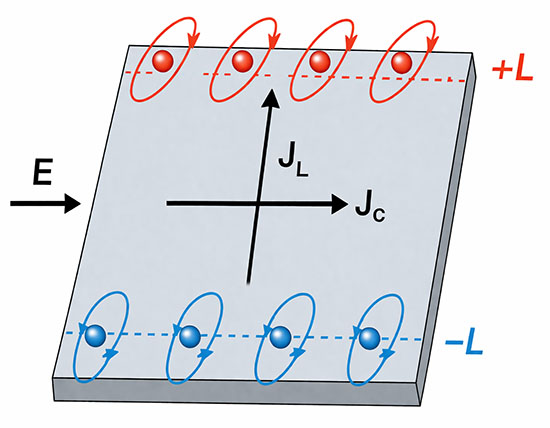
The orbital Hall effect (OHE) is the central phenomenon of orbitronics. When an electric field is applied to a conductor, electrons with opposite orbital angular momentum are deflected to opposite transverse edges of the material, generating a pure orbital current perpendicular to the charge flow. Theoretical calculations have shown that the orbital Hall conductivity in many transition metals exceeds the spin Hall conductivity by an order of magnitude – a far larger ratio than the enhancement that giant magnetoresistance brought to spin-based readout – making the OHE an exceptionally efficient source of angular momentum.
Orbital Rashba-Edelstein Effect
At surfaces and interfaces that lack inversion symmetry, an applied electric field can induce a nonequilibrium orbital polarization – a net accumulation of OAM at the interface. This orbital Rashba-Edelstein effect is the orbital analog of the spin Edelstein effect and provides an alternative route for generating orbital density in thin-film heterostructures.
Orbital Torque
When an orbital current is injected into a ferromagnetic layer, it can transfer angular momentum to the local magnetization, exerting a torque that drives magnetization switching. This orbital torque is analogous to the spin-orbit torque used in spintronic magnetic tunnel junction devices, but can be generated from lighter, more abundant elements. Experiments have confirmed orbital torque in bilayers such as nickel/tantalum, where the net torque direction opposes the prediction of the spin Hall effect alone, providing unambiguous evidence for the orbital contribution.
Orbital Seebeck Effect
The orbital Seebeck effect describes the generation of an orbital current driven by a temperature gradient rather than an electric field. This recently reported phenomenon was demonstrated using chiral phonons – collective atomic vibrations that move in circular patterns – which transfer their angular momentum directly to electrons in nonmagnetic materials. The orbital Seebeck effect enables orbital current generation without magnets, batteries, or applied voltages.
Significance at the Nanoscale
Orbitronics acquires particular significance at the nanoscale, where interfaces and surfaces dominate material behavior. As device dimensions shrink, the surface-to-volume ratio increases dramatically, amplifying interfacial effects such as the orbital Rashba-Edelstein effect. Furthermore, in two-dimensional materials and van der Waals heterostructures, the reduced dimensionality can enhance orbital textures in momentum space, providing strong orbital Hall responses even in systems composed of light elements.
The orbital diffusion length – the distance over which an orbital current can propagate before losing coherence – has been measured to be substantially longer than the spin diffusion length in many materials. In tungsten, for example, ballistic orbital currents have been observed with relaxation lengths exceeding 10 nanometers, far surpassing the spin diffusion length in the same material. This longer coherence makes orbital currents especially attractive for nanomaterial-based device architectures.
Materials for Orbitronics
Light Transition Metals
Unlike spintronics, which traditionally relies on heavy elements with strong SOC, orbitronics can exploit light 3d transition metals such as titanium, chromium, manganese, and nickel. These elements exhibit large orbital Hall conductivities because the OHE is driven by the orbital character of the d-band electrons rather than by SOC. The use of abundant, inexpensive materials lowers the cost and environmental impact of device fabrication.
Topological and Chiral Materials
Topological materials, including Weyl semimetals and chiral topological semimetals, are among the most promising platforms for orbitronics. Chiral crystals – whose atomic arrangements have a definite handedness, similar to the DNA double helix – naturally host orbital angular momentum textures as an intrinsic property of their band structure. Orbital angular momentum monopoles, where OAM radiates uniformly in all directions from a point in momentum space, have been observed experimentally in chiral semimetals made from gallium-platinum and gallium-palladium alloys. These monopoles enable orbital currents to be generated along any chosen direction simply by orienting the injected charge current.
Two-Dimensional Materials
Two-dimensional materials such as graphene and transition metal dichalcogenides offer a versatile platform for orbitronics. In these systems, the interplay between lattice symmetry, chirality, and band topology gives rise to rich orbital angular momentum textures in momentum space. Notably, orbital effects in 2D materials can clarify long-standing puzzles in valleytronics, where what was interpreted as valley-selective transport may in fact originate from orbital angular momentum dynamics.
Applications of Orbitronics
Non-Volatile Memory
Orbital torque can switch the magnetization of ferromagnetic layers, forming the basis for orbital torque magnetic random-access memory (OT-MRAM). Because orbital currents can be generated from cheap, abundant metals without requiring heavy-element spin Hall layers, OT-MRAM could offer a lower-cost and more energy-efficient alternative to current spin-orbit torque MRAM technology. Each electron state can carry orbital angular momentum unrestricted by the ħ/2 limit that applies to spin, potentially allowing higher torque efficiency per unit current.
Terahertz Emitters
When an ultrafast laser pulse excites a metallic heterostructure, the resulting orbital currents can be converted into electromagnetic radiation in the terahertz frequency range through the inverse orbital Hall effect. Orbitronic terahertz emitters have been demonstrated in materials with weak SOC, offering a compact, solid-state source of terahertz radiation for imaging, spectroscopy, and communication applications.
Energy-Efficient Computing
The combination of high orbital Hall conductivity, long orbital diffusion lengths, and compatibility with lightweight materials positions orbitronics as a candidate for ultra-low-power logic and computing components. Orbital currents could complement or replace spin currents in semiconductor technology architectures, enabling faster data processing with lower energy consumption as conventional CMOS scaling approaches its physical limits.
Challenges and Future Perspectives
Despite rapid progress, several fundamental challenges must be addressed before orbitronics can transition from laboratory demonstrations to practical technology. One central difficulty is the independent detection and quantitative measurement of orbital currents. Because orbital angular momentum can be partially converted to spin angular momentum through SOC, disentangling the orbital and spin contributions in transport experiments remains non-trivial. Advanced spectroscopic techniques such as circular dichroism in angle-resolved photoemission spectroscopy (CD-ARPES) and terahertz Faraday rotation have begun to provide direct access to orbital textures, but standardized measurement protocols are still needed.
Another open question concerns the orbital transparency at interfaces – how efficiently an orbital current generated in one material can cross into an adjacent ferromagnetic layer and exert torque. Understanding and optimizing this interface transmission is critical for maximizing orbital torque in device heterostructures. Additionally, the mechanisms governing orbital diffusion and relaxation in different classes of materials require further investigation through both theory and experiment.
Looking ahead, the integration of orbitronics with existing spintronics infrastructure offers a promising pathway. Hybrid devices that exploit both orbital and spin angular momentum could combine the material flexibility of orbitronics with the mature fabrication techniques of spintronics. Orbital physics is also extending beyond electrons to quasi-particles such as magnons, connecting orbitronics with the field of magnonics. The exploration of chiral materials, topological insulators, and heterostructures with engineered orbital textures will be a key research direction. As the field matures, orbitronics may represent the next evolutionary step in the progression from electronics to spintronics and beyond, delivering energy-efficient information technologies built on the full angular momentum landscape of the electron.
Further Reading
Nature Physics, Challenges and opportunities in orbitronics
Advanced Electronic Materials, Orbitronics: Mechanisms, Materials and Devices