| Jul 02, 2020 |
Thermophones offer new route to radically simplify array design, research shows(Nanowerk News) Scientists have pioneered a new technique to produce arrays of sound produced entirely by heat. |
| The team of researchers from the Centre for Metamaterial Research and Innovation at the University of Exeter used devices, known as thermophones, to create a fully controlled array from just a thin metal film attached to some metal wires. |
| The results, published in Science Advances ("Coupling and confinement of current in thermoacoustic phased arrays"), could pave the way for a new generation of sound technology, including home cinema systems. |
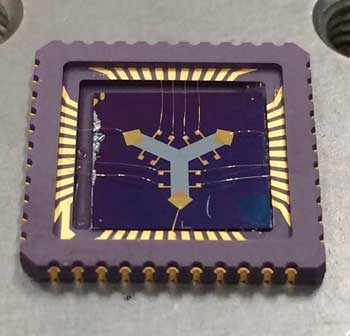 |
| Thermophones offer new route to radically simplify array design, research shows. (Image: David Tatnell) |
| Traditionally, arrays have been used in a host of every day applications, including ultrasound and sound systems. Arrays allow sounds from several sources to be 'steered' in a certain direction, to gain greater control and clarity of the sound produced. |
| Conventional speaker arrays rely on the production of sound through driven movement of some object - such as a speaker cone. The new study, however, pioneers arrays of speakers that produce sound entirely by heat: thermophones. |
| Although thermophones have been in existence for more than 100 years, they have, until now, had limited real-world application. However, they have a host of advantages from their mechanical counterparts - including no moving parts and the ability to be mass produced from inexpensive, sustainable materials. |
| Crucially, they can even be made transparent and flexible, which is desirable for the new wave of flexible technologies being produced. |
| For the study, the researchers found that, when combined into an array, thermophones are able to reproduce the same control over sound fields as traditional arrays. |
| However, they do much more than this: as they are driven by electrical currents, the sound they produce mirrors the subtle movement of the current carriers as they flow through the device and, as a result, they create a much richer sound field than traditional arrays. |
| The researchers suggest that the study opens a route to radically simplify array design, showing that with thermophone technology, it is possible to create a fully controlled array from nothing more than a thin metal film attached to some metal wires. |
| David Tatnell, lead author of the study and a PhD researchers at the EPSRC Centre for Doctoral Training in Metamaterials said: "Using heat to produce sound is a game changer as it allows us to make speaker arrays smaller than ever before. This, as well as the ability to make the speakers flexible and transparent, has a lot of exciting potential applications, such as haptic feedback systems in smartphones and other wearables." |
| Source: University of Exeter |
|
Subscribe to a free copy of one of our daily Nanowerk Newsletter Email Digests with a compilation of all of the day's news. |