| Sep 03, 2020 |
Marrying DNA nanotechnology and bioelectronics to detect illnesses including coronavirus and cystic fibrosis(Nanowerk News) A new and quicker method of diagnosing diseases in patients has been created by researchers at the University of Leeds (Nature Communications, "Rational design of DNA nanostructures for single molecule biosensing"). |
| The team has developed a system of examining individual molecules to detect the presence of disease in blood. |
| The molecules - known as biomarkers - are currently collected in their billions - if not trillions - in order to create a detectable signal of a disease. |
| The new system, which has already been used to detect a protein linked to cystic fibrosis, can compile a detectable signal from just a few biomarkers, and can be done in just a few minutes. |
| Although in its infancy, the new process could, in theory, speed up coronavirus testing and provide accurate results. |
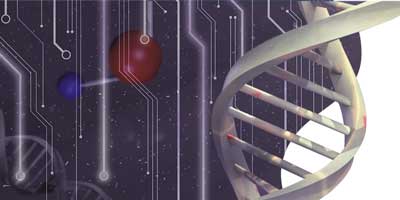 |
| Marriage of DNA nanotechnology and bioelectronics. (Image: EatFishDesign) |
| Dr Mukhil Raveendran, the lead researcher of the project said: "One of the main advantages is the minimal sample needed. |
| "We are able to isolate individual molecules from small samples to identify specific illnesses. The process is very quick, and takes just minutes to provide results." |
| The new method involves using DNA origami - a nanoscale technique that involves folding DNA into specific shapes. |
| The DNA shapes are then used to capture biomarkers, which are indicators of particular diseases. |
| Dr Raveendran said: "The captured biomarkers are then read with nanopores and we can do this one molecule at a time. |
| "By coupling DNA origami and nanopores we are able to quantitatively detect disease biomarkers with single molecule sensitivity." |
| The group, headed by Professor Christoph Wälti at Leeds' School of Electronic and Electrical Engineering, is working to adapt the technology to enable the detection of a range of illnesses, including coronavirus (COVID-19). |
| By modifying the DNA origami to capture COVID-19 molecules, the researchers are aiming to detect the proteins that the coronavirus uses to invade human cells. |
| Dr Paolo Actis, University Academic Fellow and co-supervisor of the project, said: "We have already demonstrated the detection of an inflammation marker called C-reactive protein (important for the management of many diseases including cystic fibrosis) in diluted serum. |
| "Sensitive detection of biomarkers is important for diagnosis and for disease management. Our read-out is entirely electrical so it can be miniaturized, enabling point-of-care detection." |
| Source: University of Leeds |
|
Subscribe to a free copy of one of our daily Nanowerk Newsletter Email Digests with a compilation of all of the day's news. |