| Jun 23, 2025 |
Eco-friendly hydrogen production using quantum dot PV technologyReal-time X-ray scattering analysis reveals the synthesis mechanism of eco-friendly ternary quantum dots.(Nanowerk News) A research team led by Professors Yang Ji-woong and In Su-il of the Department of Energy Science and Engineering at DGIST, through joint research with Dr. Ahn Hyung-joo of Pohang Accelerator Laboratory, has identified the synthesis principle of eco-friendly ternary quantum dots that are harmless to the human body. Using this technology, they have developed a high-efficiency, PV-based hydrogen production technology. |
| The results were published in Advanced Science ("Unveiling Formation Pathways of Ternary I–III–VI CuInS2 Quantum Dots and Their Effect on Photoelectrochemical Hydrogen Generation"). |
| The research team was the first in the world to identify the synthesis mechanism of copper indium sulfide (CuInS₂), a ternary semiconductor material that does not contain heavy metals. By precisely controlling this mechanism, they also developed a photoelectrochemical device that is capable of producing hydrogen using sunlight. Notably, this quantum dot-based device has attracted significant attention for achieving the highest level of hydrogen production activity in the world to date among eco-friendly quantum dot systems. |
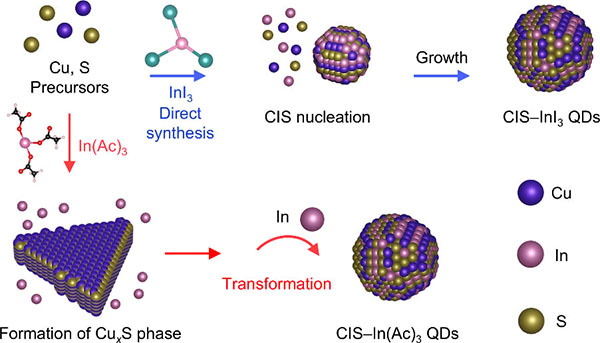 |
| Schematic illustration depicting the formation of CIS QDs with two different indium precursors. Red and blue arrows indicate synthesis pathways of CIS–In(Ac)3 and CIS–InI3 QDs, respectively. (Image: Advanced Science, CC BY) |
| Quantum dots are ultra-small semiconductor particles that measure a few nanometers in size. They are key materials in technologies such as displays, solar cells, photosensors, and hydrogen production due to their outstanding ability to absorb and emit light. However, conventional quantum dots have a major drawback: they often contain heavy metals, such as cadmium and lead, which are harmful to both the human body and the environment. |
| CuInS₂-based ternary quantum dots, which the research team focused on, are safe for both human health and the environment because they do not contain heavy metals. However, their synthesis process is difficult to control due to the complex structure, which involves the simultaneous reaction of three elements. By employing advanced analytical techniques, including real-time X-ray scattering analysis, the team uncovered the precise mechanism by which quantum dots are formed. |
| Based on their findings, the research team proposed a synthesis method that precisely controls the size and structure of quantum dots. They also developed a high-efficiency device that uses sunlight to separate hydrogen from water, utilizing these quantum dots. This device is attracting attention as a promising candidate for future hydrogen energy technology. |
| "This is a significant achievement that demonstrates the possibility of synthesizing eco-friendly quantum dots with excellent properties based on their synthesis mechanism," said Prof. Yang Ji-woong of DGIST. "We expect this technology to be applied across various semiconductor optoelectronic devices, such as displays, photosensors, and solar cells, as well as in future hydrogen production systems," he added. |
| Source: Daegu Gyeongbuk Institute of Science and Technology (DGIST) (Note: Content may be edited for style and length) |