| Jun 27, 2025 |
New electronic nose sniffs out gases with unprecedented precisionCarbon nanotube sensor array detects VOCs below 100 ppb with high selectivity, enabling electronic nose applications for precise chemical vapor identification.(Nanowerk News) A team of researchers at IMDEA Nanociencia institute and Università Cattolica del Sacro Cuore has unveiled a new class of gas sensors based on MINT-functionalized carbon nanotubes, offering unprecedented precision in detecting and distinguishing volatile organic compounds. This "electronic nose" is made of a tailored array of chemiresistors to sense gases like ammonia, nitrogen dioxide or acetone vapours at room temperature, paving the way for low-power environmental monitors and wearable breath diagnostics. |
| Single-walled carbon nanotubes are ideal materials for sensing due to their high surface area, but their extreme sensitivity has long come with a downside: poor selectivity. To address this, researchers have "dressed" carbon nanotubes with ring molecules to improve their ability to discriminate between chemical compounds. These derivatives of carbon nanotubes, known as Mechanically Interlocked Carbon Nanotubes (MINTs), provide a way to introduce chemical functionalities onto carbon nanotubes without altering their intrinsic structure. |
| The MINT-based chemiresistors responded significantly better to target gases—including NH₃, EtOH, IPA, benzene, NO₂, acetone, and NaClO—than unmodified carbon nanotubes, even at low concentrations (10–200 ppm). Researchers proved their detection limit, being below tens of parts-per-billion (ppb). |
| Assembled into an array, these sensors behave like an artificial olfactory system, able to selectively identify specific analytes despite the presence of potential interferences. For instance, ammonia was successfully distinguished from a range of other vapors. One optimized sensor layer even showed up to 10× higher sensitivity and faster response times, simply by reducing the film thickness. |
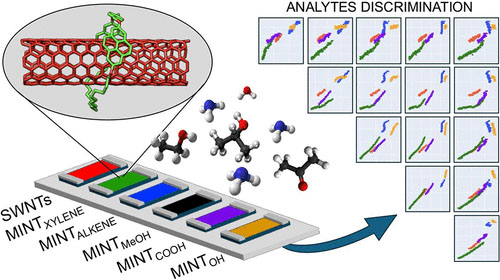 |
| Gas sensor based on MINT-functionalised carbon nanotubes. (Image: Emilio M. Pérez) |
| The research, published in the Journal of the American Chemical Society ("Efficient Implementation of MINT-Based Chemiresistor Arrays for Artificial Olfaction") constitutes a proof-of-concept e-nose, that not only demonstrates the power of MINT-based sensors for complex gas detection but also highlights their customizability. With synthetic control over the structure of the interlocked molecules, researchers can finely tune the sensor’s properties, opening a new frontier in the design of smart, selective, and scalable electronic noses. |
| This work is a collaboration between researchers at IMDEA Nanociencia, led by Prof. Emilio M. Pérez, and Università del Sacro Cuore, led by Prof. Luigi Sangaletti. |
| Source: IMDEA Nanociencia (Note: Content may be edited for style and length) |