| Jul 02, 2025 |
Nonlinear currents in symmetry-broken materials challenge Ohm's LawBreaking inversion symmetry in materials allows deviations from Ohm's law, enabling nonlinear effects that could drive future nano- and quantum-electronic devices.(Nanowerk News) The Nanodevices group at CIC nanoGUNE shows that breaking a material’s inversion symmetry can shatter Ohm’s law, unleashing powerful nonlinear phenomena. Their review maps this emerging landscape and points toward a new generation of nano- and quantum-electronic devices. |
| In a review just published in Nature Materials ("Nonlinear transport in non-centrosymmetric systems"), Manuel Suárez-Rodríguez—working under the guidance of Ikerbasque Professors Fèlix Casanova and Luis E. Hueso at CIC nanoGUNE, together with Prof. Marco Gobbi at the Materials Physics Center (CFM, CSIC-UPV/EHU)—takes aim at the oldest principle in electronics: Ohm’s law. Their article, “Nonlinear transport in non-centrosymmetric systems”, brings together rapidly growing evidence that, when a material lacks inversion symmetry, the familiar linear relation between current and voltage can break down, giving rise to striking quadratic responses. |
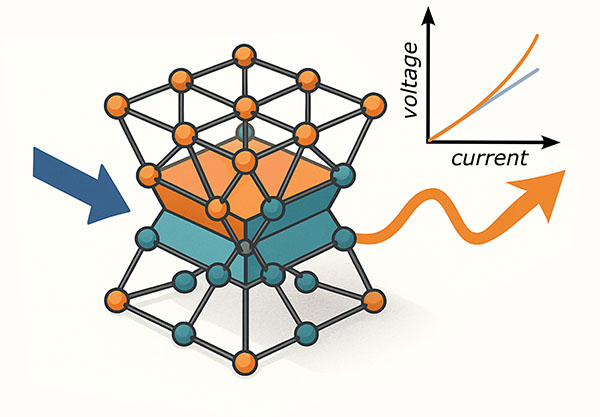 |
| Artistic representation of the breakdown of Ohm’s law and the resulting nonlinear effects in a non-centrosymmetric crystal. (Image: CIC nanoGUNE) |
| “Over the past five years we have observed numerous reports of nonlinear transport effects intimately linked to the symmetry of the host material,” explains lead author Suárez-Rodríguez. “Once we grasped this connection, our goal was to weave the disparate results into a coherent picture that condensed-matter and materials physicists can exploit to advance this promising field.” |
| Co-authors Fernando de Juan (Donostia International Physics Center, DIPC) and Ivo Souza (CFM) helped clarify how broken inversion symmetry unlocks new microscopic mechanisms—chief among them the Berry-curvature dipole and the recently proposed Berry-connection polarizability—that generate nonlinear and rectification voltages directly from an applied bias. “Because these mechanisms are intrinsic to the material itself—not to interfaces or external stimuli—they can operate across a wide frequency range and down to the single-layer limit,” adds Suárez-Rodríguez. |
| Beyond fundamental interest, the team highlights two application frontiers. First, nonlinear effects provide a versatile and powerful route to probe charge-to-spin conversion, helping identify candidate materials for next-generation spintronics. Second, these effects can be harnessed for wireless radio-frequency rectification, promising size reductions of several orders of magnitude relative to state-of-the-art devices and enabling rectification at, or even below, the microscale—opening possibilities for on-chip RF harvesters and biosensors. |
| With more than 450 accesses in just two days, the review is already serving as a roadmap for researchers developing quantum-enabled electronics—where “breaking the rules” of Ohm’s law is the key. |
| Source: CIC nanoGUNE (Note: Content may be edited for style and length) |