| Aug 04, 2025 |
Reducing material usage in light-driven energy conversionScientists developed a new synthesis route for ultrathin photoanodes, which enables a 100 nm tantalum nitride layer to outperform much thicker films fabricated through conventional oxide precursors.(Nanowerk News) In the search for sustainable energy solutions, photoelectrochemical water splitting offers a promising route to convert sunlight into hydrogen fuel. Among the semiconductor materials investigated for this purpose, tantalum nitride (Ta₃N₅) stands out due to its ideal bandgap and strong visible light absorption. |
| However, its practical application has been hindered by poor charge transport properties, which typically require thick films and large amounts of tantalum—an expensive and scarce metal. |
| In a study published in Small ("Efficient Ta₃N₅ Photoanodes via Interface Engineering of Bixbyite-Type Ta₂N₃ Precursors"), researchers from National Taiwan University report a novel strategy to construct efficient Ta₃N₅ photoanodes using a chemically engineered precursor layer, bixbyite-type Ta₂N₃. |
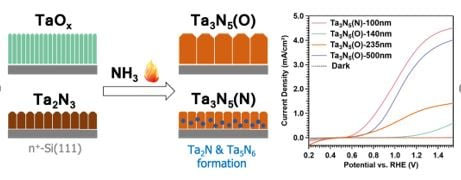 |
| Comparison of synthesis route and photoelectrochemical performance of Ta3N5 photoanodes derived from TaOx or Ta2N3. (Image: National Taiwan University) |
| Unlike conventional synthesis routes, this approach enables the formation of ultrathin, high-performance Ta₃N₅ films on silicon substrates while significantly reducing tantalum usage. The resulting photoanodes exhibit improved charge separation and enhanced photocurrent generation, achieving performance levels previously only accessible with much thicker films. |
| “Ta2N3 is a metastable material, meaning it readily transforms into Ta3N5, a semiconducting nitride widely employed in light-driven energy conversion systems,” says Chang-Ming Jiang, the study’s principal investigator. “Using Ta2N3 as a precursor also produces trace amounts of subnitride impurities at the interface with silicon. These impurity phases are highly conductive and beneficial for extracting photogenerated carriers from Ta3N5.” |
| Through a combination of structural, optical, and electrochemical characterization, the study demonstrates how interface engineering between Ta₃N₅ and silicon can overcome long-standing limitations in carrier transport. This advancement opens new directions for scalable solar-driven hydrogen production with lower material costs and improved efficiency. |
| The work not only deepens the understanding of nitride semiconductor interfaces but also offers a broadly applicable strategy for designing next-generation photoelectrodes. |
| Source: National Taiwan University (Note: Content may be edited for style and length) |