| Aug 28, 2025 |
Organic molecule reshapes quantum effect at nanoscaleA single molecule can trigger and tune the Kondo effect, challenging long-held physics assumptions and offering new paths for molecular electronics and quantum devices.(Nanowerk News) A team at the Hefei Institutes of Physical Science has shown that a single organic molecule can trigger the Kondo effect in a magnetic atom—overturning the idea that this quantum phenomenon requires a vast sea of metallic electrons. The study, published in Physical Review Letters ("Co and CoPc Molecular Kondo Box on Gold Surface"), reveals a new way to control quantum interactions at the smallest scales. |
| The Kondo effect occurs when electrons in a material collectively cancel the magnetic moment of an impurity atom. For decades, physicists believed it could only emerge in metals with a large supply of free electrons. That assumption now faces a direct challenge. |
| The researchers found that cobalt phthalocyanine molecules placed on a gold surface can act like a miniature reservoir of electrons. These molecules interact with a nearby cobalt atom in a way that mimics the behavior of metals. By combining experimental measurements with first-principles calculations, the team showed how the molecule’s π-electrons overlap with the atom’s orbitals, creating a stable quantum state known as a Kondo singlet. |
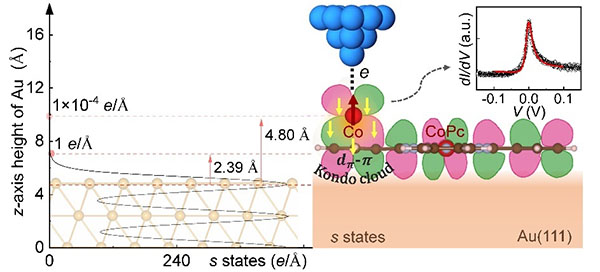 |
| Illustration of a molecular Kondo-box singlet formed by large orbital overlap between symmetry-matched dπ and π orbitals in an atomic/molecular system on a metal surface. (Image: Li Xiangyang) |
| What makes the result even more striking is the level of control. The team demonstrated that the strength of this molecular-scale effect can be tuned simply by changing the number of cobalt atoms and the symmetry of the arrangement. This tunability means the Kondo temperature—the threshold at which the effect appears—can be adjusted with precision, something not possible in bulk metals. |
| The discovery marks an important step for nanoscience and quantum technology. By proving that molecules can host and regulate complex electron interactions, the work points to new strategies for designing molecular electronics and spin-based quantum devices. It also shows how chemistry and physics can intersect to create artificial systems with tailored quantum properties, potentially guiding the development of stable, scalable components for future technologies. |
| Source: Chinese Academy of Sciences (Note: Content may be edited for style and length) |