| Sep 04, 2025 |
Bright new quantum dots could power next wave of optoelectronics
Researchers created stable, glowing BaCd2P2 quantum dots from abundant elements, opening the door to cheaper, high-performing optoelectronic materials.
(Nanowerk News) When NREL scientists Matthew Hautzinger and Sage Bauers first sat down to compare notes on overlooked materials in nanotechnology, they didn’t expect their collaboration would spark so much interest so quickly. Just a year later, their work on Zintl-phase quantum dots is shining—literally—with a bright glow, chemical resilience, and ingredients sourced from Earth-abundant elements.
|
|
The two researchers were drawn to a compound called BaCd2P2, part of a class of intermetallics known as Zintl-phase materials. Decades ago, these compounds were largely shelved by science, but Hautzinger and Bauers saw new promise. BaCd2P2 offers the right electronic structure, a long carrier lifetime, and—most importantly—a surprising tolerance to defects that usually plague semiconductors.
|
|
“Typically, we go to great lengths to keep materials pristine,” Hautzinger explained. “BaCd2P2 doesn’t demand that level of care, which makes it easier to manipulate into quantum dots.”
|
|
Quantum dots are tiny crystals only a few nanometers wide, prized for their ability to absorb and emit light. They already underpin next-generation semiconductors used in LEDs, solar cells, telecom fibers, and bioimaging tools. By shrinking BaCd2P2 down to this scale, the team unlocked size-dependent optical properties that could be tuned for a wide range of applications.
|
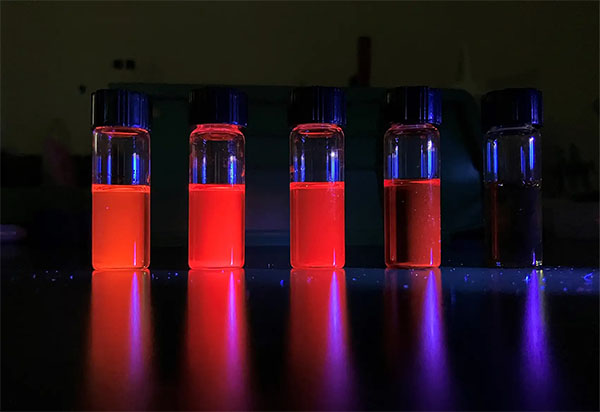 |
| The quantum dots synthesized in this study glow bright red under ultraviolet light, showcasing their unmatched photoluminescence. (Image: ) Matthew Hautzinger, NREL)
|
|
The synthesis process was a first of its kind. By injecting a phosphorus precursor into a heated solution of barium and cadmium, the researchers created BaCd2P2 quantum dots whose size could be controlled with temperature adjustments. Even without special treatments, the material glowed impressively bright under black light, registering a photoluminescence quantum yield of 21%—a solid result for an early-stage material.
|
|
Equally striking was the compound’s ability to form smooth, defect-free films, a crucial step for integrating the dots into optoelectronic devices. “We’ve shown that you can make these films with relative simplicity, without losing tunability or control,” Bauers said. That could mean cheaper and more efficient production methods compared to existing technologies.
|
|
The appeal goes beyond performance. Unlike other quantum dots that depend on scarce or imported critical minerals, BaCd2P2 is made from elements abundant in the United States. Early experiments even suggest cadmium can be partially replaced with less toxic zinc while preserving performance.
|
|
For Hautzinger and Bauers, this is just the beginning. Their pioneering work demonstrates that overlooked Zintl-phase compounds could form the basis of a whole new class of quantum dots—ones that glow bright, perform well, and sidestep supply chain risks.
|
|
“We’re excited to keep exploring what these materials can do,” Bauers said. “Every small adjustment we make seems to reveal something new.”
|
|
Read the paper in ACS Nano ("Synthesis and Characterization of Zintl-Phase BaCd2P2 Quantum Dots for Optoelectronic Applications").
|