| Sep 05, 2025 |
Scientists tame exotic light waves for faster, smaller terahertz devicesResearchers show how to control Dirac plasmon polaritons, paving the way for powerful terahertz photonic devices with faster, more efficient performance.(Nanowerk News) Scientists are finding new ways to bend light at scales smaller than ever before, promising faster communication networks, ultrasensitive detectors, and sharper imaging systems. At the heart of this progress are Dirac plasmon polaritons (DPPs), unusual waves that merge light with the movement of electrons inside ultra-thin materials like graphene. |
| Unlike ordinary light, which spreads freely through space, DPPs can compress light into spaces a hundred times smaller than its wavelength. This extreme confinement makes them powerful tools for controlling light at the nanoscale, where traditional optics fall short. |
| Their unique behavior emerges in so-called Dirac materials, where electrons behave as though they have no mass. That property allows DPPs to be tuned with precision, making them especially promising for next-generation devices that marry light and electronics. |
| One of the most intriguing opportunities lies in the terahertz (THz) range, a part of the spectrum between microwaves and infrared. Long overlooked, this region could transform fields from security screening to medical imaging. But controlling light at these frequencies has remained a challenge—until now. |
| In a study published in Light: Science & Applications ("Tracing terahertz plasmon polaritons with a tunable-by-design dispersion in topological insulator metaelements"), a team led by Prof. Miriam Serena Vitiello reports a breakthrough. The researchers created topological insulator metamaterials from Bi₂Se₃ and engineered them into laterally coupled nanostructures, or “metaelements.” By carefully designing the spacing between these elements, the team managed to adjust how DPPs travel across the surface of the material. |
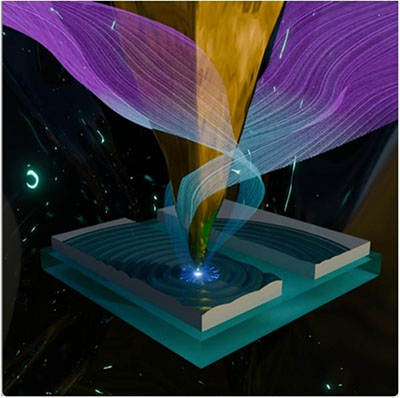 |
| Artistic illustration of exotic light waves known as Dirac plasmon polaritons traveling across nanoscale antennas in a topological insulator, guided and probed at terahertz frequencies. (Image: Leonardo Viti et al.) |
| Using advanced near-field microscopy, they directly observed these waves in action. The results showed that fine-tuning the geometry of the nanostructures could boost the wavevector of DPPs by up to 20% and extend their travel distance by more than 50%. |
| The discovery addresses one of the main hurdles in harnessing DPPs—their rapid signal loss at terahertz frequencies. With this new method, scientists are closer to building practical THz devices such as detectors, modulators, and compact waveguides. |
| The team sees the advance as a step toward reconfigurable optical circuits with applications in quantum technologies, high-speed computing, and energy-efficient photovoltaics. |
| Source: Changchun Institute of Optics, Fine Mechanics And Physics (Note: Content may be edited for style and length) |