| Sep 19, 2025 |
New ceramic fiber boosts nanogenerators for self-powered grid sensorsResearchers design branch-heterostructure ceramic fibers that triple nanogenerator output and enable accurate self-powered power grid monitoring.(Nanowerk News) A team at Henan University has created a new piezoelectric ceramic fiber that could lead to powerful self-powered sensing systems for critical infrastructure such as power grids. |
| The researchers synthesized the fiber through chemical methods and coaxial electrospinning, growing silver nanoparticles on BCZT ceramic fibers to form a branch-like heterostructure. This structure serves as an advanced piezoelectric filler for building high-performance flexible composites-based piezoelectric nanogenerator (PENGs). |
| Professor Haowei Lu, a materials scientist at Henan University’s School of Physics and Electronics, explained that the branch heterostructure improves performance in two key ways. First, it enhances the effective polarization field through a capacitive effect, increasing polarization efficiency. Second, when the PENG is compressed, numerous Schottky barriers form at the interface between silver and nano-BCZT particles, which strengthens directional charge transport. The combined effect greatly boosts electrical output. |
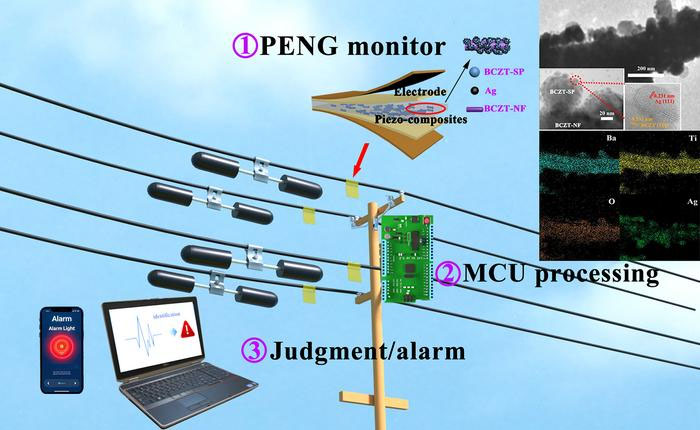 |
| The high-performance flexible PENG is designed based on branch-heterostructure fiber fillers. By combining signal processing circuit design and machine learning algorithms, a power grid transmission line status monitoring system is constructed. This offers a new solution for improving the efficiency of power grid maintenance. (Image: Reprinted from DOI:10.26599/JAC.2025.9221171, CC BY) |
| Tests confirmed the impact. A PENG containing 20 weight percent of the branch-heterostructure ceramic fiber doped into PVDF showed strong dielectric properties (ε ≈ 24, tanθ ≈ 0.08 at 100 Hz) and piezoelectric response (d33 ≈ 55 pC/N). Under 30 newtons of mechanical pressure, it produced outputs of 96.4 volts and 15.52 microamperes—about 3.2 and 6.5 times higher than PENGs without the special fiber design. |
| “This excellent electrical output performance is crucial for efficient integration with energy management circuits and signal recognition systems in sensing applications,” said Lu. |
| To showcase its potential, the team built a sensing system for monitoring vibrations in power grid transmission lines. By combining the high-output PENG with signal processing circuits, wireless communication, and machine learning technologies, the system could distinguish three operating states of anti-vibration devices—normal, abnormal, and failure—with up to 96 percent accuracy. This demonstrates how the technology could help ensure safe and stable power grid operation. |
| Even so, Lu noted that more research is needed before practical deployment. Key challenges include further improving PENG output, optimizing integration with circuit systems, achieving fully self-powered operation, and refining assessments of complex power line conditions. |
| The study was published in the Journal of Advanced Ceramics ("Performance enhancement of nanogenerator achieved in branch-heterostructure piezoelectric ceramic fiber towards electrical transmission power line monitoring"). |
| Source: Tsinghua University Press (Note: Content may be edited for style and length) |