| Sep 23, 2025 |
New method improves surface plasmon resonance studies of key drug target proteinsResearchers created a stable way to analyze membrane proteins with SPR, solving a major technical barrier and improving accuracy in drug target research.(Nanowerk News) A new technique is making it easier to study some of the body’s most important proteins, those embedded in cell membranes. These proteins help regulate everything from how cells communicate to how substances move in and out of them. They also represent nearly 60 percent of drug targets. But studying their interactions with other molecules has remained a major challenge, especially using a method known as surface plasmon resonance, or SPR. |
| SPR allows scientists to observe molecular interactions in real time without labeling the molecules. It is widely used for tracking how proteins bind to drugs or other partners. But with membrane proteins, the method often struggles. These proteins are difficult to keep stable once removed from their natural environment. That makes it hard to immobilize them on SPR sensor chips without damaging their structure or disrupting their activity. |
| To solve this problem, researchers created a new way to anchor membrane proteins while preserving their function. They combined two technologies. One uses nanodiscs formed with a membrane scaffold protein, or MSP. The other uses a binding system called SpyCatcher and SpyTag, which locks proteins together with high precision. |
| The findings have been published in Analytical Chemistry ("A Robust Immobilization Method for Membrane Protein SPR Assays Using SpyCatcher–SpyTag"). |
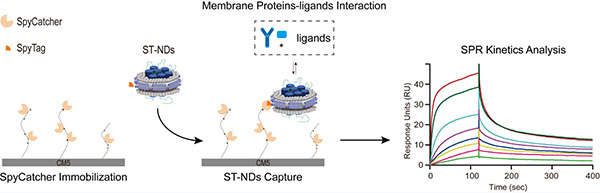 |
| Schematic of the SpyCatcher-SpyTag-mediated covalent immobilization strategy for membrane protein SPR analysis. (Image: WU Bo) |
| The process begins by fusing SpyTag to the scaffold protein, which helps form lipid nanodiscs that act as a synthetic membrane. These discs contain the target membrane protein. Once prepared, the discs are captured by SpyCatcher proteins that have already been attached to the SPR chip using standard techniques. This creates a stable setup that mimics the natural membrane environment. |
| The team tested the method by analyzing three types of interactions. One involved a protein and a lipid. Another studied a transmembrane protein with an antibody. The third measured a transmembrane protein with a small molecule. Each test produced consistent, high-quality data that allowed precise measurement of how strongly and how quickly the molecules interacted. |
| “This method enables robust and stable immobilization of membrane proteins within a near-native lipid environment,” the researchers wrote. |
| By removing one of the biggest technical barriers in SPR analysis of membrane proteins, this method could help improve both drug development and basic research into how these proteins work. |
| Source: Hefei Institutes of Physical Science (Note: Content may be edited for style and length) |