| Sep 30, 2025 |
Copper cobalt nanocomposite offers clean energy storage water and hydrogen
A copper cobalt nanocomposite on nitrogen-doped carbon enables energy storage, water purification and hydrogen fuel, offering a cheap sustainable alternative to noble metals.
(Nanowerk News) Meeting the world’s surging energy needs without worsening pollution remains one of the biggest challenges of our time. Many current solutions rely on noble metals like platinum and palladium, which are costly, scarce, and toxic—making them impractical for widespread use.
|
|
Now, researchers say they have created a low-cost alternative with wide-ranging potential. In a new study (Advanced Composites and Hybrid Materials, "Hierarchical CuCo-Oxide/N-Doped Graphene-CNTs 3D Composite Material for High-performance Energy Storage and Environmental Sustainability"), a team reports developing a copper–cobalt oxide composite anchored on nitrogen-doped graphene and carbon nanotubes. Produced with a straightforward synthesis method, the material shows impressive results in energy storage, water purification, and clean fuel production.
|
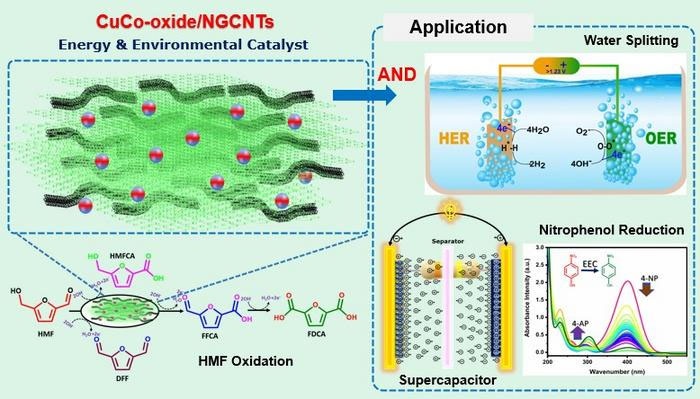 |
| CuCo-oxide/N-GCNT offers a unique hierarchical structure, resulting in exceptional performance and durability across multiple applications. (Image: Ick Soo Kim, Institute for Fiber Engineering and Science, Shinshu University)
|
|
“Our motivation stems from the urgent need to develop sustainable, efficient, and environmentally benign materials that address the intertwined challenges of energy scarcity, environmental pollution, and reliance on fossil resources,” explains Prof. Ick Soo Kim, who led the research.
|
|
The composite’s strength lies in its unique three-dimensional structure, which combines bimetallic oxides with nitrogen-doped carbon nanostructures. This design allows electrons to move efficiently and creates numerous active catalytic sites. The result is a material that performs strongly across multiple critical applications.
|
|
For energy storage, the composite shows promise in supercapacitors used in renewable power systems and electric vehicles. It maintains 88 percent of its capacity even after 10,000 charge–discharge cycles. In environmental remediation, it can transform toxic industrial pollutants such as 4-nitrophenol into valuable compounds in minutes, offering a practical route for water purification. It also enables nearly complete conversion of biomass-derived chemicals into precursors for sustainable plastics, underscoring its versatility.
|
|
Perhaps most strikingly, the material works as a powerful catalyst for water splitting, the process of producing hydrogen fuel. It demonstrates strong activity for both oxygen and hydrogen evolution reactions, with low energy requirements and stability across 40 hours of continuous testing. “By providing a cost-effective, non-toxic, and durable catalyst for water splitting, CuCo-oxide/NGCNT advances green hydrogen production technologies, which are key to decarbonizing energy systems,” says Prof. Kim.
|
|
Because it is inexpensive, non-toxic, and easy to produce, this composite could accelerate the adoption of renewable energy and cleaner industrial practices. “Supported by green chemistry principles and a commitment to sustainable development, this work paves the way for multifunctional materials that integrate energy storage with environmental sustainability, aligning with global goals for clean water, affordable energy, and responsible industry,” Prof. Kim concludes.
|