| Oct 09, 2025 |
Watching bandgaps in motion - attosecond interferometry of solidsThe bandgap defines how insulators absorb light and conduct electricity. XUV high-harmonic interferometry now lets researchers track its femtosecond dynamics.(Nanowerk News) The bandgap, i.e. the energy gap between the highest lying valence and the lowest lying conduction band, is a defining property of insulating solids, governing how they absorb light and conduct electricity. |
| Tracking how a bandgap changes under strong laser excitation has been a long-standing challenge, since the underlying processes unfold on femtosecond timescales and are difficult to track directly, especially for wide-bandgap dielectrics. |
 |
| Schematic of extreme-ultraviolet high-harmonic interferometry of solids. Two phase-locked near-infrared pulses generate high-order harmonics in a solid sample. Interference of the emitted XUV fields encodes transient changes in the electronic bandgap, revealing how strong-field excitation modifies the material’s electronic structure on femtosecond timescales. (Image: MBI) |
| In a collaboration between the Max-Born-Insitute, ARCNL Amsterdam, and Aarhus University, researchers have now shown that extreme ultraviolet (XUV) high-harmonic interferometry can provide direct access to such dynamics (Optica, "Extreme ultraviolet high-harmonic interferometry of excitation-induced bandgap dynamics in solids"). |
| Using pairs of phase-locked near-infrared laser pulses (see figure below for experimental setup), the team measured interference fringes and their intensity-dependent shift in the generated high-order harmonics from silica glass (SiO2) and magnesium oxide (MgO). |
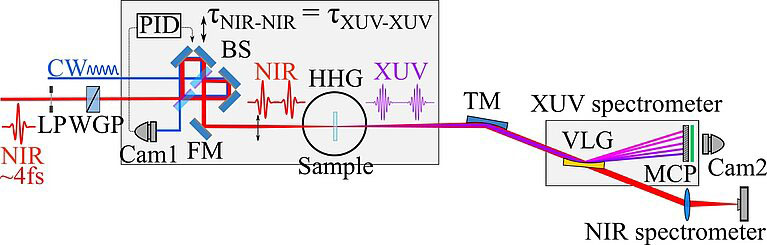 |
| Experimental setup for generating phase-locked NIR and XUV pulse pairs using a common-path interferometer. (Image: MBI) |
| The experiments were supported by analytical modeling and semiconductor Bloch-equation simulations, confirming that the observed phase variations are consistent with excitation-induced modifications of the electronic structure. |
| The work establishes interferometric HHG as a broadly applicable, all-optical probe of band-structure dynamics in solids. Beyond fundamental insight, this approach opens pathways toward ultrafast semiconductor metrology and future petahertz electro-optic technologies. |
| Source: Max-Born-Insitute (Note: Content may be edited for style and length) |