| Oct 13, 2025 |
Perovskite quantum dots edge closer to real-world energy and tech uses
Perovskite quantum dots combine near-perfect light efficiency with broad potential in solar cells and LEDs, as new methods finally improve their stability.
(Nanowerk News) Perovskite quantum dots, or PQDs, are reshaping how scientists think about solar cells, LEDs, and other light-based technologies. These nanocrystals, only a few billionths of a meter wide, can convert light into energy with almost perfect efficiency. Their unique ability to tune color and absorb light makes them promising for use in solar panels, display screens, sensors, and even memory devices.
|
|
But despite their promise, PQDs face a major obstacle: they break down easily. Light exposure, humidity, and oxygen can trigger structural damage and rapid performance loss, keeping them from moving beyond the lab.
|
|
A new review published in Carbon Energy ("Perovskite Quantum Dots: Fabrication, Degradation, and Enhanced Performance Across Solar Cells, Optoelectronics, and Quantum Technologies") examines both the progress and the remaining hurdles in PQD research.
|
|
The authors outline how these materials are synthesized and how scientists are tackling their biggest weakness—instability. The paper traces how techniques such as hot-injection and ligand-assisted reprecipitation allow researchers to fine-tune PQDs across the visible spectrum, creating near-perfect photoluminescence. Yet the same surfaces that make them efficient also make them fragile.
|
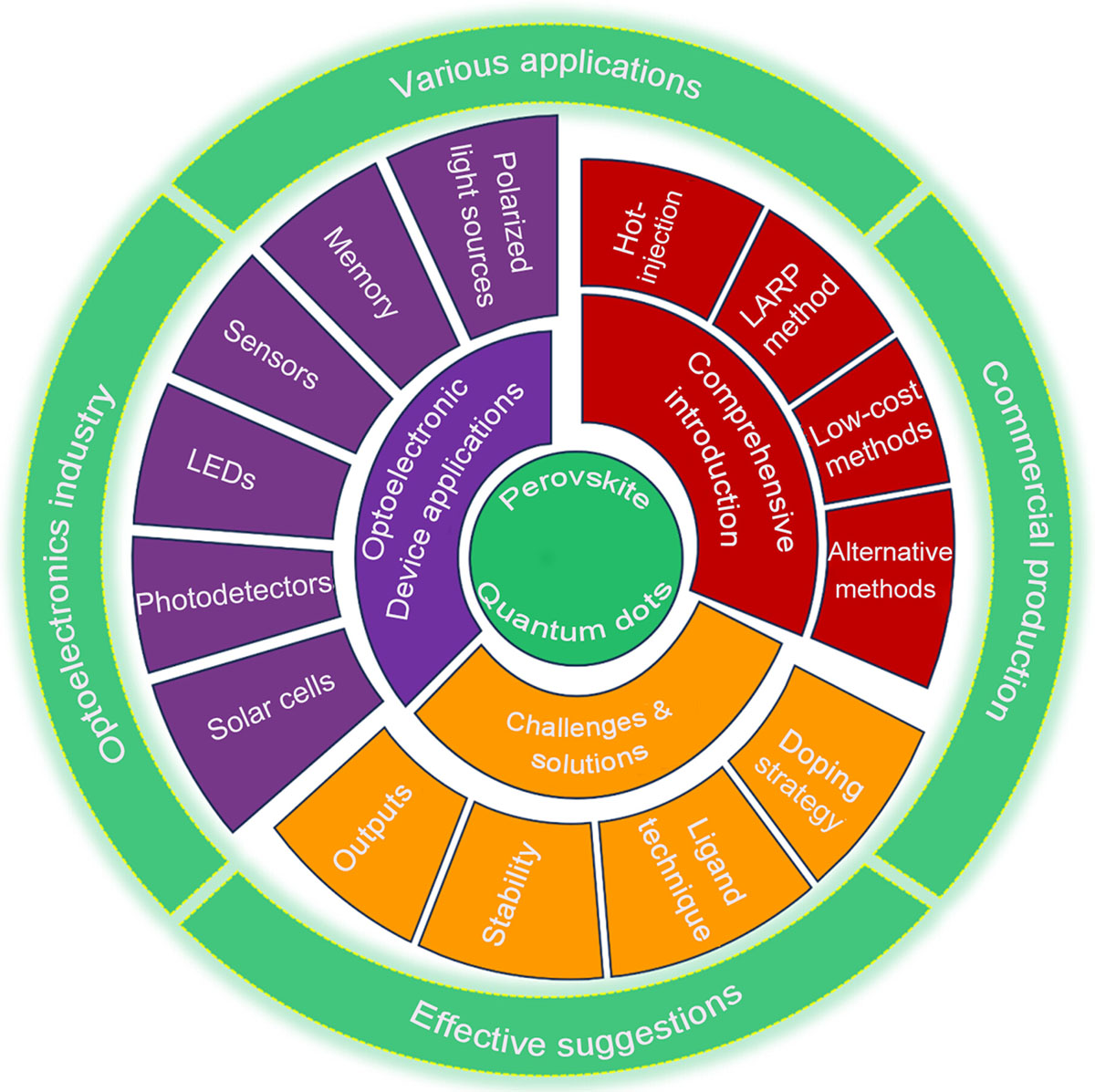 |
| Graphical abstract representing the review article of perovskite quantum dots: opportunities, challenges, and applications in next-generation device technology. (click on image to enlarge)
|
|
Photodegradation distorts the crystal lattice and creates defects, while water exposure can cause the structure to collapse. To fight this, researchers are using several strategies. Modifying the ligands that surround the crystals helps improve charge transport and resistance to light damage. Doping the PQDs with elements such as sodium, rubidium, or copper increases their thermal and air stability. Encasing them in protective layers of polymers, oxides, or metal-organic frameworks provides an additional barrier against moisture and oxygen.
|
|
These combined efforts have pushed solar cell efficiencies past 17% and expanded PQD use in bright LEDs, sensitive photodetectors, and quantum communication devices. The review emphasizes that improving surface chemistry and protective coatings is essential for making PQDs reliable enough for commercial products.
|
|
“Perovskite quantum dots offer an unprecedented combination of tunability, efficiency, and versatility,” said Najaf Rubab, corresponding author of the study. “But their instability has been a roadblock to practical deployment. Our review shows that with advances in surface chemistry, doping, and encapsulation, these challenges can be systematically addressed. PQDs are no longer just laboratory curiosities—they are poised to become building blocks for solar energy, advanced lighting, memory technologies, and quantum communication if stability hurdles can be overcome.”
|
|
The potential of PQDs reaches far beyond research labs. In renewable energy, they could make solar modules cheaper and more efficient. In consumer electronics, they promise brighter displays and energy-saving lighting. Their switching properties could lead to faster data storage, while their optical precision opens new frontiers in secure quantum communication. With ongoing innovation in fabrication and protection, PQDs are edging closer to real-world use in technologies that power, illuminate, and connect the modern world.
|