| Oct 23, 2025 |
Modeling atomistic biomolecular dynamics from HS-AFM imaging
An integrative modeling workflow to understand with atomistic precision biomolecular dynamics from high-speed atomic force microscopy experiments.
(Nanowerk News) High-speed atomic force microscopy (HS-AFM) is the only experimental technique to directly watch proteins in dynamic action. However, as a surface scanning technique with limited spatial resolution, HS-AFM will inevitably provide insufficient information for detailed atomistic understanding of biomolecular function.
|
|
Despite previous efforts in computational modeling attempting to overcome such limitations, successful applications to retrieve atomistic-level information from measurements are yet practically absent.
|
|
A research team led by Holger Flechsig (WPI-NanoLSI, Kanazawa University) and Florence Tama (WPI-ITbM, Graduate School of Science at Nagoya University, and R-CCS) now presents a computational framework and its software implementation allowing to infer 3D atomistic models of dynamic protein conformations from AFM topography imaging (ACS Nano, "Flexible Fitting to Infer Atomistic-Precision Models of Large-Amplitude Conformational Dynamics in Biomolecules from High-Speed Atomic Force Microscopy Imaging").
|
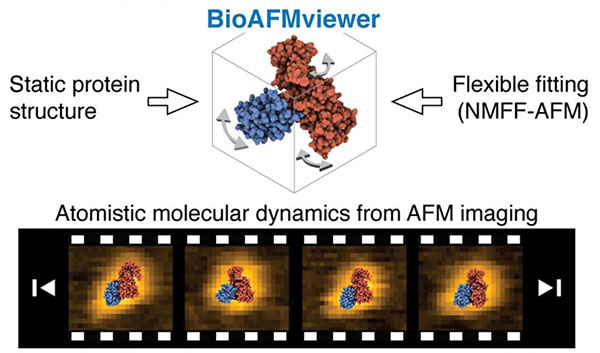 |
| Schematic of BioAFMviewer flexible fitting to infer atomistic biomolecular dynamics from HS-AFM imaging data. (Image: Reprinted from DOI:10.1021/acsnano.5c10073, CC BY)
|
|
The scientists use a new computationally efficient flexible fitting method developed by Tama’s group, which models conformational dynamics of known static protein structure to identify atomistic models that best fit experimental AFM images.
|
|
In their work, they first implement this method into the well-established BioAFMviewer software platform maintained by Flechsig’s group to provide a direct workflow for applications to measured AFM imaging data.
|
|
The presented analysis of HS-AFM data for different proteins obtained by experimental collaborators evidence that flexible fitting can infer atomistic models including large-amplitude motions to significantly improve understanding of functional conformational dynamics from resolution-limited measurements.
|
|
Computational efficiency of flexible fitting within the BioAFMviewer even allows applications to large protein assemblies, as the authors show for the example of a 4 megadalton actin filament consisting of about 280,000 atoms.
|
|
A remarkable achievement is the demonstration of an atomistic molecular movie of protein dynamics, involving functional conformational transitions, reconstructed from HS-AFM topographic movie data.
|
|
The unique software implementation of computationally efficient flexible fitting, integrating available structural data and molecular modeling with experiments, opens the opportunity for a broad range of applications to fully exploit the explanatory power of HS-AFM by large-scale analysis of single molecule imaging data toward better understanding biological processes at the nanoscale.
|
|
This work is a collaborative effort of scientists from two WPI centers in Japan, the Nano Life Science Institute (WPI-NanoLSI) at Kanazawa University, and the Institute of Transformative Bio-Molecules (WPI-ITbM) at Nagoya University. Combining the expertise of protein dynamics modeling and computational science with Nanometrology experiments, leading contributions which further advance the interdisciplinary field of nanoscale biology are achieved.
|