| Nov 05, 2025 |
New QR LED design sets record efficiency for brighter vivid displaysResearchers set a new efficiency record for red QR LEDs and improve performance across colors, paving the way for brighter and more colorful screens.(Nanowerk News) A research team at the Hong Kong University of Science and Technology has raised the bar for quantum rod light emitting diodes. The group reports a record efficiency for red QR LEDs, a breakthrough that could lead to richer colors and brighter screens in phones and TVs (Advanced Materials, "Inverted Device Engineering for Efficient and Bright Quantum Rod LEDs"). |
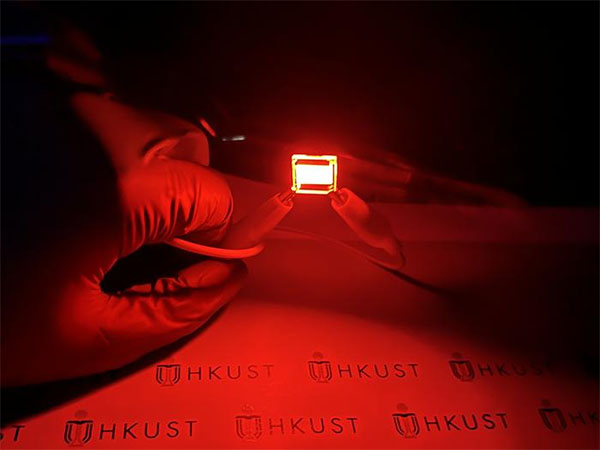 |
| A sample of the red QR-LED with record-high efficiency developed by the research team. (Image:HKUST) |
| Conventional LEDs have powered electronics for decades, but new quantum materials are changing the game. Quantum dot LEDs (QLEDS) already offer brighter and more vivid colors than most current displays. Still, they hit a limit when it comes to how much light escapes from the device. That bottleneck holds back further gains in efficiency. |
| Quantum rods offer a potential workaround. These tiny rod shaped particles can be tuned to emit light in a specific direction, improving how much light actually leaves the device. Yet QR LEDs come with two big issues: they lose a lot of the light they generate and their thin films are full of defects that create wasteful leakage currents. |
| Prof. Abhishek K. Srivastava and his team tackled both problems. They improved how the rods are made, pushing their light conversion efficiency to 92 percent for both red and green versions. They also made the particles more uniform, which is critical for steady performance. |
| The team then looked at a problem previous studies had ignored. Irregular films allow electrical current to leak through tiny gaps, hurting performance. To understand and fix this, the researchers built a circuit model that showed how these leaks disrupt the device. With this insight, they redesigned the device structure to balance electrical charges and cut down on leakage. |
| The results speak for themselves. The red QR LEDs reached a peak external quantum efficiency of 31 percent and a brightness of 110000 candelas per square meter, both record figures. The same strategy applied to green quantum rods delivered a 20.2 percent efficiency and a brightness of 250000 candelas per square meter. The success across different colors shows the approach can be widely used. |
| “Previous QD LED research primarily focused on optimizing quantum dot structures for high efficiency, but this approach does not apply to elongated shaped quantum rods, such as QR LED,” Prof. Srivastava said. “By utilizing equivalent circuit models and quantum rod micromorphology, we revealed that QR LED have widespread pinholes due to their shape, which leads to critical leakage currents an issue not encountered in tightly packed QD LED. By modifying the device structure, we addressed the quality issues in emissive layer and verified fundamental advantages of quantum rod over quantum dots. This work is set to guide research on similar anisotropic nanocrystal and advance their commercial applications.” |
| Source: Hong Kong University of Science and Technology (Note: Content may be edited for style and length) |