| Nov 10, 2025 |
New coating boosts silver nanowire performance for flexible electronics
Researchers created a simple coating method that doubles silver nanowire conductivity, paving the way for durable flexible and transparent devices.
(Nanowerk News) Researchers at UNIST have discovered a straightforward way to boost the performance of silver nanowires, a key material in flexible and transparent electronics. By swapping out the usual insulating coating for a more conductive one, the team achieved stronger electrical conductivity, better transparency, and greater durability—an advance that could accelerate the development of foldable and rollable devices.
|
|
The study (Angewandte Chemie International Edition, "Improving the Conductivity and Stability of Silver Nanowires Through Spontaneous Ligand Exchange for Joule Heating"), led by Professor Tae-Hyuk Kwon of UNIST’s Department of Chemistry, involved collaboration with Dr. Ji Hoon Seo at the Korea Electric Power Research Institute (KEPRI), Professor EunAe Cho of KAIST, and Professor Sang-Won Park of Suwon University. The team created a simple, solution-based spin-coating process that replaces polyvinylpyrrolidone (PVP)—the conventional insulating layer around silver nanowires (AgNWs)—with a more effective alternative.
|
|
Silver nanowires are ultra-thin metal filaments that conduct electricity while letting light pass through, making them ideal for transparent electrodes. However, during production, the PVP coating helps form the nanowires but also acts as an unwanted barrier, blocking electrical flow and increasing resistance.
|
|
To overcome this problem, the researchers immersed AgNWs in an ethylene glycol (EG) solution and spun them at high speed. This simple treatment stripped away the PVP and formed a new conductive layer that improves electrical connections, protects against moisture, and enhances transparency.
|
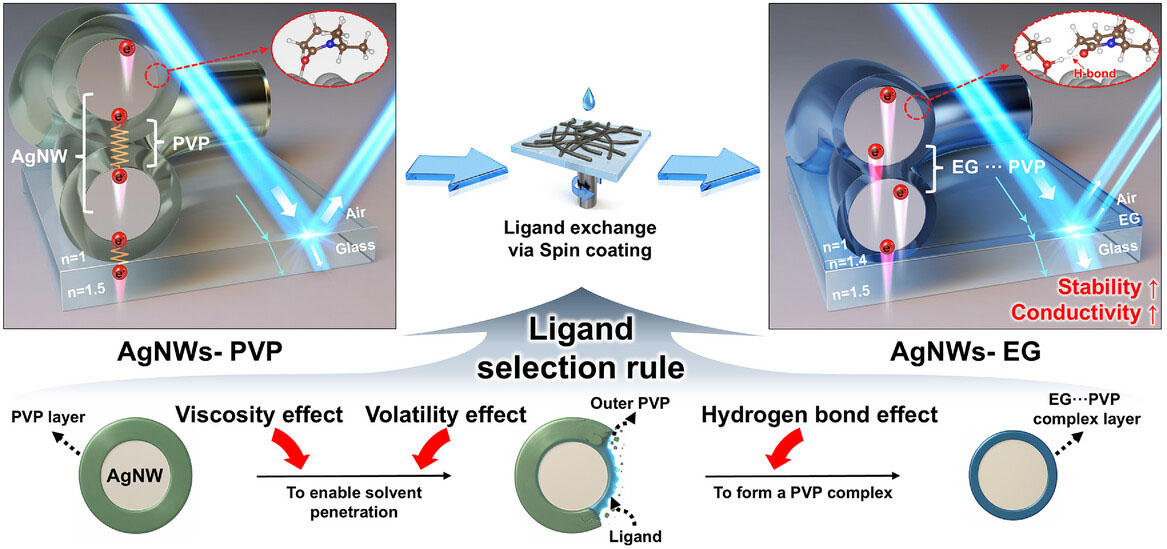 |
| Schematic illustration of the fabrication process for ligand-exchanged silver nanowires (AgNWs) electrode via spin-coating, along with the corresponding ligand selection rule. (Image: Reproduced with permission from Wiley-VCH Verlag) (click on image to enlarge)
|
|
“We considered various physicochemical properties such as viscosity, volatility, and hydrogen-bonding ability of potential replacement ligands,” said Professor Kwon. “This comprehensive approach allowed us to develop an effective ligand exchange technique.”
|
|
The results were striking. The new method reduced electrical resistance by 43 percent, nearly doubling conductivity. The electrodes maintained their performance under heat and humidity—85°C and 85 percent humidity—and even showed a slight increase in light transmittance, making them brighter and clearer.
|
|
Using the improved electrodes, the team built transparent heaters that heated up more efficiently than conventional models. The new heaters reached 140–145°C in just six minutes, compared to 102°C with traditional coatings, delivering over 35 percent higher heating performance.
|
|
Dr. Seo from KEPRI explained, “While traditional power cables use insulation to ensure stability, the insulating PVP coating on AgNWs created resistance issues. Our new ligand exchange method offers a simple and scalable fix without complex processing or high temperatures.”
|
|
According to the team, this technique could open the door to a new generation of flexible displays, wearable sensors, electronic paper, and transparent heaters.
|