| Nov 17, 2025 |
Nanocatalyst powers clean hydrogen while turning urea waste into useful energyA new hybrid nanocatalyst produces efficient hydrogen and uses urea waste to cut energy demand, combining clean fuel generation with wastewater pollutant removal.(Nanowerk News) A research team at National Taiwan University has developed a catalyst that tackles two problems at once. It produces clean hydrogen with striking efficiency and breaks down urea waste in the process. The result is a system that cuts the energy cost of hydrogen production while helping remove a pollutant found in agricultural and industrial wastewater. |
| The group, led by Prof. Pi-Tai Chou in the Department of Chemistry, built the catalyst by pairing V₄C₃Tₓ MXene with tiny Cs₂PtCl₆ perovskite nanoparticles. Instead of using conventional synthesis methods, the researchers placed the two components at the boundary of two liquids and allowed the nanoparticles to form right at that interface. |
| The reaction ran quickly at room temperature and spread the perovskite particles evenly across the MXene surface, creating a tightly linked hybrid material. |
| The study appears in Angewandte Chemie International Edition ("Interfacial Synthesis of Cs₂PtCl₆ Perovskite for Strong Coupling with V₄C₃Tₓ MXene Toward Efficient Hydrogen Evolution and Urea Oxidation"). |
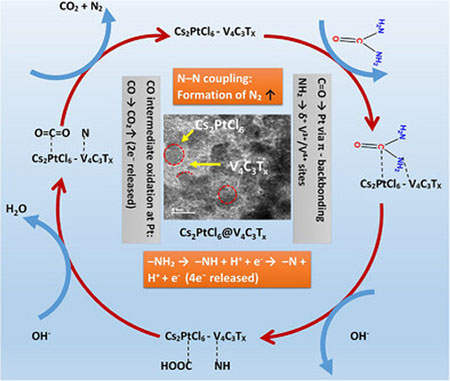 |
| Graphical abstract of the work. (Image: Reproduced from DOI:10.1002/anie.202516929, CC BY) |
| This strong, uniform attachment drives the catalyst’s performance. The Cs₂PtCl₆@V₄C₃Tₓ material needs very little energy to start producing hydrogen and delivers rapid output even at small voltages. It also outperforms many well-known catalysts, including several made with noble metals. The MXene layers move electrons with high efficiency, while the perovskite nanoparticles provide abundant reaction sites. |
| At the same time, the catalyst breaks down urea with unusual ease. Instead of acting as an obstacle, urea supplies beneficial reaction energy during oxidation, reducing the overall power needed to generate hydrogen. In effect, the system turns waste into an advantage, producing clean fuel while helping remove contaminants in a single operation. |
| “This work shows how smart material design can turn a simple interface into a powerful engine for both clean energy and environmental repair. By coupling hydrogen generation with urea removal, we reveal a strategy that produces value from waste and pushes sustainable technology forward,” says Prof. Pi-Tai Chou. |
| Source: National Taiwan University (Note: Content may be edited for style and length) |