| Nov 25, 2025 |
Nanoscale catalyst converts nitrate pollution into clean ammonia
An atomically ordered RuGa catalyst on carbon black converts nitrate into ammonia at low voltage, achieving high efficiency while suppressing hydrogen formation.
(Nanowerk News) Ammonia fuels agriculture, supports industry, and is increasingly viewed as a key player in future clean energy systems. But the way it is made is punishing, relying on high heat, high pressure, and enormous energy demand. A research team has taken a different route by designing an electrocatalyst that works on nitrate, a widespread pollutant in groundwater and agricultural runoff, turning it into ammonia under far milder conditions.
|
|
Details of their findings were published in Advanced Functional Materials ("Atomically Ordered RuGa Intermetallic Electrocatalyst Enables High‐Efficiency Nitrate‐to‐Ammonia Conversion").
|
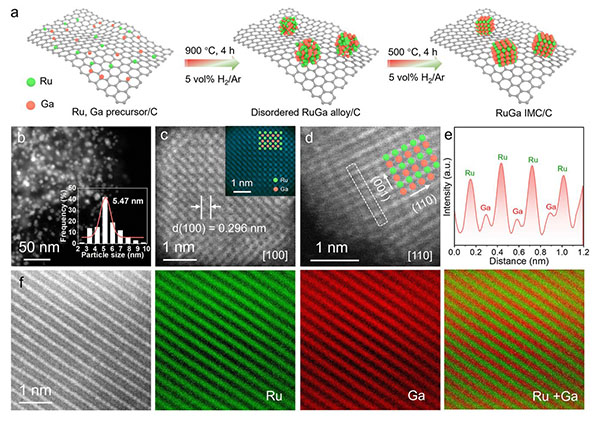 |
| Synthesis procedure and microstructural characterizations of carbon-supported atomically ordered ruthenium-gallium intermetallic compound (RuGa IMC/C). (Image: Tohoku University)
|
|
“Our new catalyst has two main benefits: first, it reduces the emissions linked to fertilizer and chemical manufacturing, and second, it enables us to essentially recycle nitrate, which would otherwise pollute our water,” points out Hao Li, Distinguished Professor at Tohoku University’s Advanced Institute for Materials Research.
|
|
The core of the innovation lies at the nanoscale. The team uses high surface area carbon black as a support material, providing a platform for uniformly anchored metal particles. On that scaffold sit ruthenium gallium nanoparticles arranged not randomly but as an atomically ordered intermetallic compound. Each RuGa IMC nanoparticle is only about 5.47 nanometers across on average, with ruthenium and gallium atoms alternating in neat lattice rows. This structure isolates ruthenium sites, where the chemistry happens, while the surrounding gallium remains catalytically inert and shapes the local electronic environment that guides nitrate toward the reaction steps that produce ammonia.
|
|
That precise arrangement proves powerful. Even at low nitrate concentrations, the catalyst converts nitrate efficiently at an ultralow potential of minus 0.05 volts. It reaches a Faradaic efficiency of 97.03 percent and an ammonia yield rate of 31.73 milligrams per hour per milligram of ruthenium. It maintains high selectivity across concentrations ranging from 0.01 to 0.1 molar and continues operating with steady performance, showing how careful atomic design and nanoscale architecture can support nitrate conversion under realistic environmental conditions.
|
|
Computer simulations helped explain why. Incorporating gallium shifts the electronic structure of ruthenium, affecting how nitrogen containing intermediates attach and transform on the surface. This adjustment also slows down hydrogen formation, a competing reaction that often limits ammonia yields.
|
|
The catalyst was also evaluated in a zinc nitrate battery. The system generated a maximum power density of 52.74 milliwatts per square centimeter and ran for more than 300 hours, demonstrating that the material can support both chemical production and energy related applications.
|
|
“We hope to convert a widespread pollutant into a valuable product and offer guidance for designing future catalysts that take advantage of controlled atomic ordering,” adds Li.
|
|
Looking ahead, the researchers plan to expand their theoretical modeling, integrating machine learning tools to more effectively map reaction pathways. This work aims to accelerate the design of next generation electrocatalysts for sustainable chemical production.
|