| Posted: Nov 04, 2009 | |
What happens to those nanotechnology socks during washing? |
|
| (Nanowerk Spotlight) Nanotechnology has brought a new area of finishing applications - nanofinishing - to the textile industry. Coating the surface of textiles and clothing with nanoparticles has become a common approach for the production of highly active surfaces to have UV blocking, antimicrobial, flame retardant, water repellant or self-cleaning properties. While antimicrobial properties are exerted by nanosilver, UV blocking, self-cleaning and flame-retardant properties are imparted by coatings containing zinc oxide or titanium oxide nanoparticles. | |
| For centuries, silver has been used to prevent and treat a variety of diseases. Silver is known as one of the oldest antimicrobial agents and it has been used effectively against different bacteria, fungi and viruses. Silver's antibacterial effect may be due to blockage of the respiratory enzyme pathways and alteration of microbial DNA and the cell wall. | |
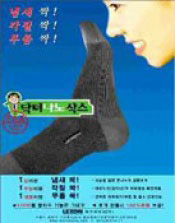
| The potential use of antimicrobial surface coatings ranges from medicine, where medical device infection is associated with significant healthcare costs, to the construction industry and the food packaging industry. Thin films which contain silver have been seen as promising candidate coatings. There now are even anti-odor, anti-bacterial socks that are treated with silver nanoparticles (the following advertising from a Korean manufacturer has got to be one of our favorites). | |
 |
|
| Researchers in Switzerland have now examined what happens to these silver nanoparticle-treated textiles during washing. The scientists studied release of nanoparticles in laundry water from nine different textiles, including different brands of commercially available anti-odor socks. Studies like these will help address the question what the chances are of nanoparticles from nanofinished textiles being released into the environment. | |
| "We found that the total released varied considerably from less than 1 to 45 percent of the total nanosilver in the fabric and that most came out during the first wash," Bernd Nowack, head of the Environmental Risk Assessment and Management Group at the Empa-Swiss Federal Laboratories for Materials Testing and Research, tells Nanowerk. "These results have important implications for the risk assessment of silver textiles and also for environmental fate studies of nanosilver, because they show that under certain conditions relevant to washing, primarily coarse silver-containing particles are released." | |
| Reporting their findings in the September 24, 2009 online edition of Environmental Science & Technology ("The Behavior of Silver Nanotextiles during Washing"), Nowack and his team show that it is the larger silver particles of greater than 450 nm that are most likely the predominant form of silver released into the washing water and subsequently to wastewater. | |
| "An important result of our work is that it shows that it is possible to engineer nanosilver textiles so that only little silver is released during washing" says Nowack. "There are ways that manufacturers and consumers can minimize the release of these particles to the environment, where they potentially could harm fish and other wildlife." | |
| The study shows that the release of the nanoparticles depends on the way the silver is incorporated into the textile fiber. Nowack explains that his team's results demonstrate that little dissolution of silver nanoparticles occurs under conditions relevant to washing (pH 10) with dissolved concentrations 10 times lower than at pH 7. However, bleaching agents such as hydrogen peroxide or peracetic acid can greatly accelerate the dissolution of silver. However, the amount and form of silver released from the fabrics as ionic and particulate silver to a large degree depends on how the silver particles are incorporated into the textile. | |
| Nowack points out that there are ways to apply only small amounts of silver that show hardly any release. "The trick for manufacturers is to use a nanofinishing process that binds silver to the fiber so that some release of dissolved silver occurs – for the antimicrobial effect – but that the nanoparticles are efficiently immobilized and don't get released during washing." | |
| This means that textile companies have options to optimize the use and release of silver nanoparticles, i.e. it is possible to have a nanosilver-treated textile that releases only small amounts of nanoparticles. | |
| "Companies should not only look at the efficacy of their textiles against microbes after extended washing, but also at the amount of released nanosilver," says Nowack. | |
 By
Michael
Berger
– Michael is author of three books by the Royal Society of Chemistry:
Nano-Society: Pushing the Boundaries of Technology,
Nanotechnology: The Future is Tiny, and
Nanoengineering: The Skills and Tools Making Technology Invisible
Copyright ©
Nanowerk LLC
By
Michael
Berger
– Michael is author of three books by the Royal Society of Chemistry:
Nano-Society: Pushing the Boundaries of Technology,
Nanotechnology: The Future is Tiny, and
Nanoengineering: The Skills and Tools Making Technology Invisible
Copyright ©
Nanowerk LLC
|
|
|
Become a Spotlight guest author! Join our large and growing group of guest contributors. Have you just published a scientific paper or have other exciting developments to share with the nanotechnology community? Here is how to publish on nanowerk.com. |
|
