
| Posted: Feb 14, 2007 | |
Telescoping nanotubes promise ultrafast computer memory |
|
| (Nanowerk Spotlight) Non-volatile random access memory (NVRAM) is the general name used to describe any type of random access memory which does not lose its information when power is turned off. This is in contrast to the most common forms of random access memory today, DRAM and SRAM, which both require continual power in order to maintain their data. NVRAM is a subgroup of the more general class of non-volatile memory types, the difference being that NVRAM devices offer random access, as opposed to sequential access like hard disks. The best-known form of NVRAM memory today is flash memory, which is found in a wide variety of consumer electronics, including memory cards, digital music players, digital cameras and cell phones. One problem with flash memory is its relatively low speed. Also, as chip designers and engineers reach size barriers in downscaling the size of such chips, the research focus shifts towards new types of nanomemory. Molecular-scale memory promises to be low-power and high frequency: imagine a computer that boots up immediately on powering up and that writes data directly onto its hard drive making saving a thing of the past. Researchers are designing the building blocks for this type of memory device using telescoping carbon nanotubes as high-speed, low power microswitches. The design would allow the use of these binary or three-stage switches to become part of molecular-scale computers. | |
| The advantages that nanostructures such as quantum dots, carbon nanotubes (CNTs) and nanowires offer over their silicon-based predecessors include their tiny size, speed and their density. Several concepts of molecular-scale memory devices have been developed recently. Objectives for next-generation memory are that it should be nonvolatile and low power, as well as ensuring high-frequency operation and high resistance to environmental forces. | |
| Researchers have worked with CNTs to create nanoscale oscillators of frequencies in the gigahertz range. Quite recently, inner CNTs of a multiwalled CNT (MWCNT) could be extracted by the electrostatic forces and nanotube linear servomotors were realized using the interlayer motion of telescoping MWCNTs. Taking this one step further, researchers now have developed a conceptual design for a macroscopically addressable data storage device based on CNTs, which can be utilized both as nonvolatile random access memory and terabit solid-state storage. | |
| "Our approach is deceptively simple; the design involves inserting one hollow nanotube, closed at both ends, into a slightly larger one, open at both ends, creating a telescoping motion using an electrostatic charge" Dr. Qing Jiang explains to Nanowerk. "That contact between the nanotube and the electrodes creates a conduction pathway with three possible positions." | |
| Jiang is professor of Mechanical & Electrical Engineering at the University of California, Riverside, where part of his research focuses on the mechanical properties of carbon nanotubes and CNT-based devices. | |
 |
|
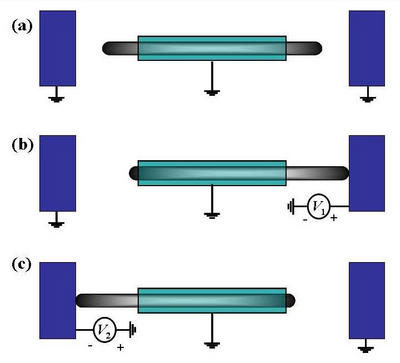
| A general design of MWCNT-based nonvolatile memory. (a) The initial equilibrium position, (b) the core CNT contacts with the right electrode with V1 and (c) the core CNT contacts with the right electrode with V2.(Graphic: Dr. Jiang/UC Riverside) | |
| "We have demonstrated that the two telescoped positions of the double-walled carbon nanotube, (b) and (c) in above figure, are both stable, and the switching time from one position to the other is as short as 0.01 nano-seconds" Jiang says. "This finding leads to a promising potential to build ultrafast high-density nonvolatile memory, up to 100 gigahertz or into the terahertz range. Realization of ultrafast high-density nonvolatile memory units will bring a broad range of applications in electronics." | |
| The main structural element of this nano-memory is composed of a MWCNT deposited on a metallic electrode. For the MWCNT embedded in a metal electrode, both the metal electrode and CNT are refined to have clean edges of a few nanometers by etching processes. The proposed nano-memory device is based on the MWCNT's telescoping motion relative to each other. The movable core nanotube can slide inside a stationary nanotube by varying the electrostatic forces. This 'telescope' lies between two electrodes, which are neutral when at rest. But by negatively charging one of the electrodes and positively charging the core nanotube, the nanotube can overcome the van der Waals force keeping the inner and outer nanotubes together, and move toward the oppositely charged electrode. Alternatively, by positively charging the other electrode and negatively charging the core nanotube, the nanotube would slide the other way. High damping would send the core nanotube back in the center. | |
| The potential of such molecular-scale processors have attracted the attention of major corporations such as Hewlett-Packard, IBM, Lucent, Motorola, Siemens and Hitachi to name a few. Jiang predicted a likely functioning prototype of a molecular processor could be demonstrated in the next two to three years. | |
| These findings have been reported in the January 24, 2007 online issue of Nanotechnology (Electrostatically telescoping nanotube nonvolatile memory device). | |
 By
Michael
Berger
– Michael is author of three books by the Royal Society of Chemistry:
Nano-Society: Pushing the Boundaries of Technology,
Nanotechnology: The Future is Tiny, and
Nanoengineering: The Skills and Tools Making Technology Invisible
Copyright ©
Nanowerk LLC
By
Michael
Berger
– Michael is author of three books by the Royal Society of Chemistry:
Nano-Society: Pushing the Boundaries of Technology,
Nanotechnology: The Future is Tiny, and
Nanoengineering: The Skills and Tools Making Technology Invisible
Copyright ©
Nanowerk LLC
|
Become a Spotlight guest author! Join our large and growing group of guest contributors. Have you just published a scientific paper or have other exciting developments to share with the nanotechnology community? Here is how to publish on nanowerk.com.